


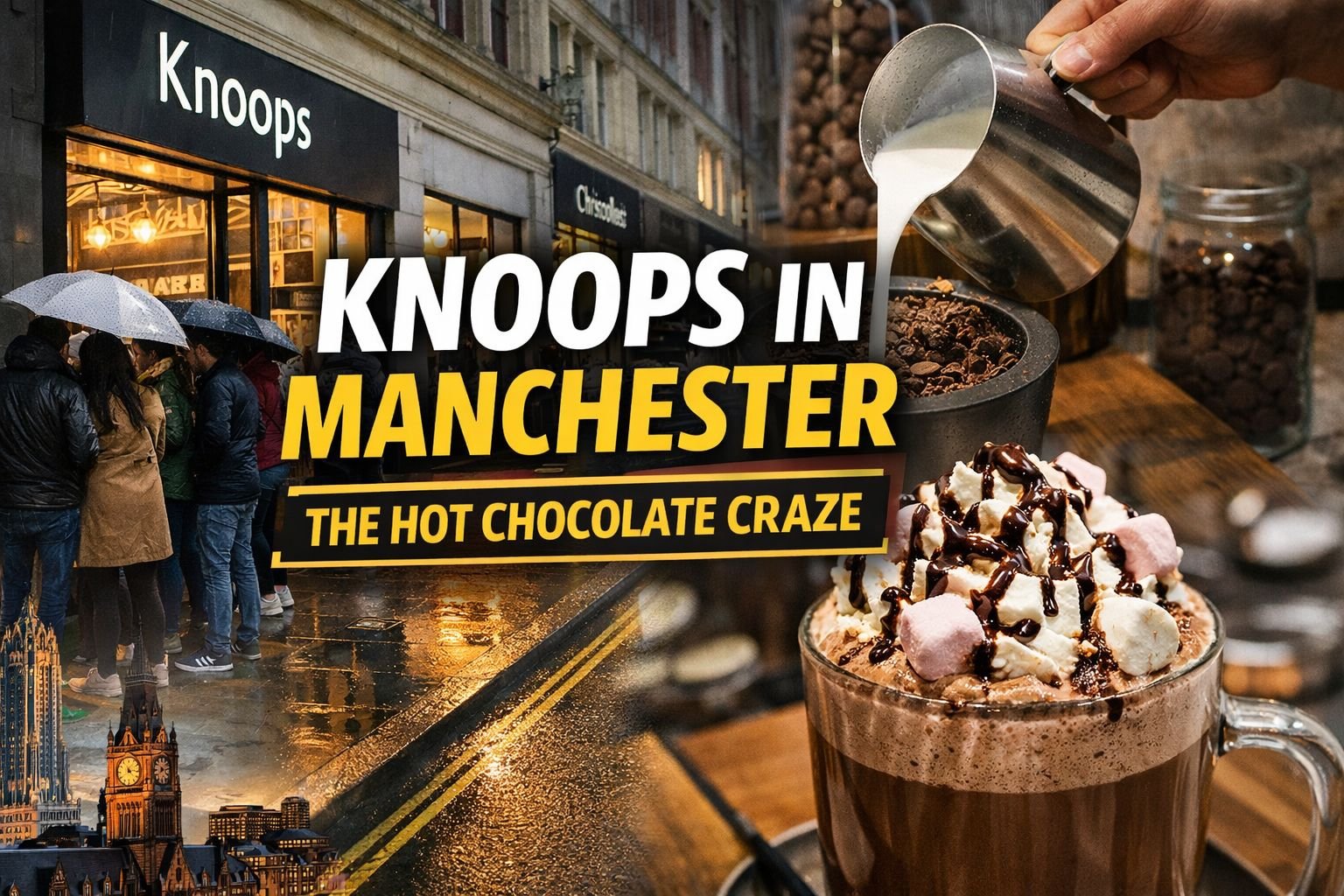
On a wet Tuesday morning in April 2023, a queue appeared outside a narrow unit on Cross Street that had stood empty for almost two years. The former Chop’d salad bar one of many casualties of remote working and shrinking lunch breaks had quietly reopened as something Manchester hadn’t quite seen before a café selling only hot chocolate.
There were no pastries stacked behind glass, no espresso machines hissing for attention. Instead, customers waited patiently to order drinks made from real chocolate flakes, chosen by cocoa percentage and melted to order. Prices started at £5 and rose above £6. For a city navigating a cost-of-living squeeze, it looked like an unlikely success.
Eighteen months on, the Manchester outpost of knoops is still drawing steady footfall. Not because the city was crying out for expensive hot chocolate, but because it revealed something more telling about how premium food retail can still work on the high street when it is done with focus, discipline, and a degree of obsession.
Why Cross Street Made Sense
Jens Knoop did not stumble into Manchester. The former IT manager from rural Germany had been refining his concept for a decade after opening his first shop in Rye in 2013. By the time knoops expanded beyond the South, the strategy was deliberate: small sites, limited seating, high margins, and relentless attention to a single product.
Cross Street offered a rare overlap of demographics. It links Market Street’s retail footfall with King Street’s luxury corridor. Office workers cut through it daily. Students drift past between lectures and part-time jobs. Shoppers move between the Arndale and Spinningfields without quite realising how much time they spend there.
The presence of Hotel Chocolat nearby was not a deterrent. If anything, it validated the market. Manchester consumers were already willing to pay premium prices for chocolate; the question was whether they would do so in drinkable form.
The unit itself just over 800 square feet with 14 seats suited the model. It is not designed for lingering. Orders are placed, drinks prepared in full view, and customers either leave or perch briefly at the window bar. High turnover keeps the economics workable in a city where rents still reflect more optimistic pre-pandemic expectations.
What Knoops Is Actually Selling
Strip away the branding and knoops is selling customisation. Not syrups or flavours, but cocoa strength. The menu lists percentages rather than names: white, milk, dark, extra dark. Customers choose their chocolate, their milk (dairy or plant-based at no extra cost), and optional additions such as sea salt, orange zest, or chilli.
For first-time visitors, the experience can feel unfamiliar. There is no standard order to fall back on. Staff guide rather than upsell, asking questions that sound closer to wine tasting than café service. It can feel indulgent, occasionally theatrical, but it is carefully calibrated.
The chocolate itself is single-origin and bean-to-bar, sourced from producers in places such as Peru, Venezuela, Ghana, and the Philippines. Much of the range is vegan-friendly. Marshmallows are handmade. Pastries, when available, come from respected local bakeries. Most customers may not articulate these details, but they register them.
That perception of care creates permission to charge premium prices.
Why the Model Works Up to a Point
Timing has played a role. Chocolate has become one of Britain’s most resilient indulgences, increasingly framed as an “affordable luxury” rather than a guilty pleasure. Younger consumers, in particular, have shifted café habits since the pandemic, favouring customisation and experience over speed.
Manchester’s student population helps. With tens of thousands of young adults moving through the city centre each day, there is a steady audience for whom a £6 drink is an occasional treat rather than a daily habit. Knoops is not trying to replace the morning coffee run. It is positioning itself as a reward after shopping, after lectures, after work.
The format also fits the realities of city-centre retail. A small footprint limits overheads. A takeaway-led service avoids the need for long dwell times. In an environment where full-service cafés struggle to justify their rents, that efficiency matters.
Where the Cracks Appear
Premium pricing inevitably invites scrutiny. Customer reviews often return to the same complaint: value. Even satisfied visitors question whether they can justify the cost regularly. For a concept built on indulgence, repeat custom is harder to secure than initial curiosity.
Consistency is another pressure point. When expectations are high, small slips feel magnified. A drink that lacks richness or a rushed interaction can quickly turn indulgence into irritation. In a business charging double the price of mainstream chains, there is little margin for error.
The space itself imposes limits. Fourteen seats cap capacity. The lack of customer Wi-Fi reinforces the takeaway focus but excludes those looking to linger. During peak hours, operational efficiency can clash with the carefully cultivated sense of ritual.
Rising cocoa prices and energy costs add further strain. Maintaining margins without passing on every increase will test knoops as it continues to expand.
What This Says About Manchester’s High Street
The quiet success of knoops on Cross Street reflects a broader shift rather than an anomaly. Manchester’s high street is not dying; it is fragmenting. Value-driven chains continue to thrive at one end. At the other, premium experiences survive by offering something supermarkets and delivery apps cannot replicate.
This concept sits firmly in the latter category. It sells ritual as much as product the act of choosing percentages, watching chocolate melt, feeling momentarily knowledgeable about cocoa. You can recreate it at home, but that misses the point.
The same logic underpins much of Manchester’s independent café scene, where provenance, craft, and narrative now matter as much as convenience. It is not about replacing mass-market brands, but about occupying a different moment in the day.
A Measured Outlook
This is not a guaranteed blueprint for every town. What works on Cross Street may falter elsewhere. Scale brings risk, and ritual is harder to maintain as operations grow.
For now, though, the Manchester location stands as evidence that even in a cautious spending climate, people will still pay more selectively when the offer feels precise, considered, and genuinely different. On a street that has seen plenty of cafés come and go, that quiet discipline may be its greatest strength.
Read More: Cafe Continental Stalybridge Is Drawing Diners Back to Melbourne Street
Frequently Asked Questions
What is Knoops?
Knoops is a premium hot chocolate café specialising in made-to-order drinks created from real chocolate flakes, with customers choosing by cocoa percentage rather than flavour syrups.
Why did Knoops choose Manchester?
Manchester offers strong city-centre footfall, a large student population, and consumers who are receptive to premium food experiences when the value feels justified. Cross Street provides access to both shoppers and office workers.
Is Knoops expensive compared with other cafés?
Prices are higher than most high-street cafés. Many customers treat a visit to Knoops as an occasional indulgence rather than a daily habit.
Does Knoops offer vegan options?
Yes. Knoops offers multiple plant-based milk options at no additional cost, and much of its chocolate range is suitable for vegan or dairy-free diets.
How does Knoops compare to other chocolate retailers?
Unlike traditional chocolate shops focused on boxed products, Knoops centres its offering on the in-store drink experience and customisation.
Can premium cafés survive the cost-of-living crisis?
Survival depends on consistency, location, and clear positioning. While consumers are spending more cautiously, they continue to pay selectively for experiences that feel distinctive and well executed.
Read More: Peter Street Kitchen: A Stunning Japanese-Mexican Experience
