

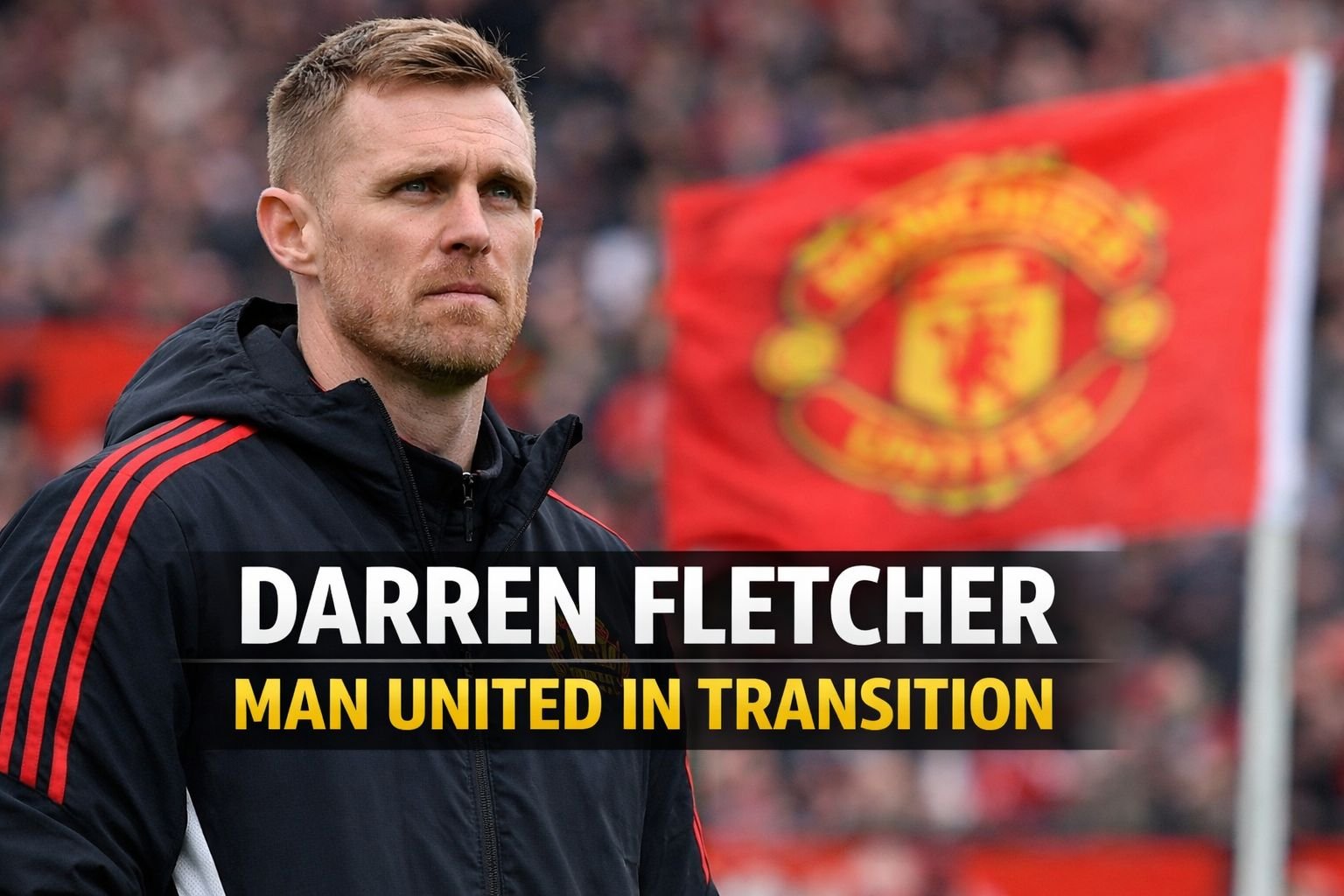
Darren Fletcher has once again found himself at the centre of events at Manchester United, stepping into a senior on field role during another period of uncertainty at Old Trafford.
The former midfielder, who has held several positions across the club’s football structure in recent years, has been asked to support the first team setup following the club’s decision to part company with Ruben Amorim. While the arrangement is understood to be temporary, Fletcher’s reappearance on the touchline has reignited familiar questions about Manchester United’s direction and why his name so often emerges when the club faces upheaval.
Fletcher’s Evolving Role at Old Trafford
Since returning to Manchester United in 2020, Darren Fletcher’s responsibilities have shifted repeatedly. He initially worked within the academy system before moving into a first-team coaching role, and later taking on broader oversight responsibilities focused on player development and alignment between youth and senior levels.
That hybrid role was not always clearly defined publicly, and at times even within the club there was acknowledgement that the scope of his duties could appear blurred. Fletcher has since spoken about his focus on maintaining continuity across age groups, supporting coaching staff, and ensuring young players are prepared for the demands of first-team football.
In the summer of 2025, Darren Fletcher transitioned into the role of under 18s head coach. The move was viewed internally as a return to hands-on coaching, allowing him to work closely with the club’s next generation while remaining connected to senior football operations.
Success at Youth Level
Fletcher’s time with the under-18s has been widely viewed as positive. The team made a strong start to the campaign, combining defensive solidity with a clear tactical identity, and progressed comfortably in domestic youth competitions.
That work has reinforced the perception of Fletcher as a coach capable of organising teams and communicating expectations clearly attributes that have increased his visibility whenever Manchester United require short-term stability.
The Context of Amorim’s Departure
Manchester United’s decision to end Ruben Amorim’s tenure followed a challenging spell marked by inconsistent performances and growing pressure. While there were signs of improvement this season, results and displays failed to convince that the project was developing quickly enough.
Amorim’s public comments in recent months, particularly those reflecting frustration with results and broader club issues, drew attention at a time when United’s leadership were attempting to project unity and long-term planning. The club ultimately concluded that a change was required, bringing his time in charge to an end after just over a year.
Why Fletcher Is Turned to Again
Fletcher’s recurring presence during transitional moments is not accidental. It reflects three key factors: familiarity, credibility, and practicality.
As a player, he made more than 300 appearances for Manchester United during one of the most successful periods in the club’s history, winning multiple league titles and the Champions League. That background commands immediate respect within the dressing room.
His personal journey including his well-documented battle with serious illness during his playing career has further shaped his reputation as a resilient and grounded figure. Those experiences resonate within a squad operating under intense scrutiny.
From an organisational standpoint, Fletcher offers continuity. Manchester United have experienced repeated managerial turnover since Sir Alex Ferguson’s retirement, and his presence provides a link between successive regimes without representing a dramatic change of direction.
A Holding Role, Not a Long-Term Appointment
It is important to stress that Darren Fletcher involvement is not viewed internally as a long-term managerial solution. His remit is focused on supporting the squad, maintaining standards, and helping the club navigate a short period of transition while longer-term plans are considered.
That distinction matters. Manchester United’s leadership has made clear that decisions around permanent appointments will be taken with a broader strategic view, rather than in reaction to short-term results.
The Manchester Perspective
Among supporters in Manchester, Darren Fletcher return to prominence has been met with a mixture of realism and cautious reassurance. There is recognition that familiar faces alone cannot solve deep-rooted issues, but also an acceptance that turning to someone who understands the club carries value during uncertain moments.
Recent home performances and results had intensified frustration in the stands, underlining a wider sense that problems extend beyond the dugout. For some supporters, Fletcher’s presence represents steadiness rather than change a pause rather than a reset.
Strengths and Limitations
Fletcher’s strengths are clear: communication, authority rooted in experience, and an ability to operate calmly within the club’s existing structure. His limitations are equally obvious. He has not managed at senior first-team level on a permanent basis, and the demands of the role at Manchester United remain unlike those anywhere else.
The club is conscious of that balance, and there is no indication that Fletcher’s temporary role will evolve beyond its current scope.
A Reflection of Wider Issues
Ultimately, Darren Fletcher repeated emergence during periods of instability highlights broader structural questions at Manchester United. Recent changes within football operations are designed to create a clearer hierarchy and reduce reliance on individual personalities.
The challenge now is ensuring that framework holds under pressure.
As Manchester United prepare for their upcoming fixtures, Darren Fletcher finds himself once again playing a quiet but significant role. Whether his involvement lasts days or weeks, it reflects a club attempting to steady itself and leaning, once more, on one of its own to do so.
Read More: West Ham’s £25m Taty Castellanos Bet as Relegation Pressure Mounts
