

Manchester has never been short of big ideas housed inside old buildings. What separates the ones that last from those that quietly fade is not ambition, but timing. That is the context in which Ducie Street Warehouse now finds itself, on the brink of yet another reinvention and perhaps its most convincing one yet.
For years, ducie street warehouse has hovered somewhere between destination and convenience. Known, used, but rarely loved. With its ground floor closing at the end of 2025 and a major food hall relaunch planned for 2026, the question is no longer what is it, but why might it finally matter.
What Is Ducie Street Warehouse?
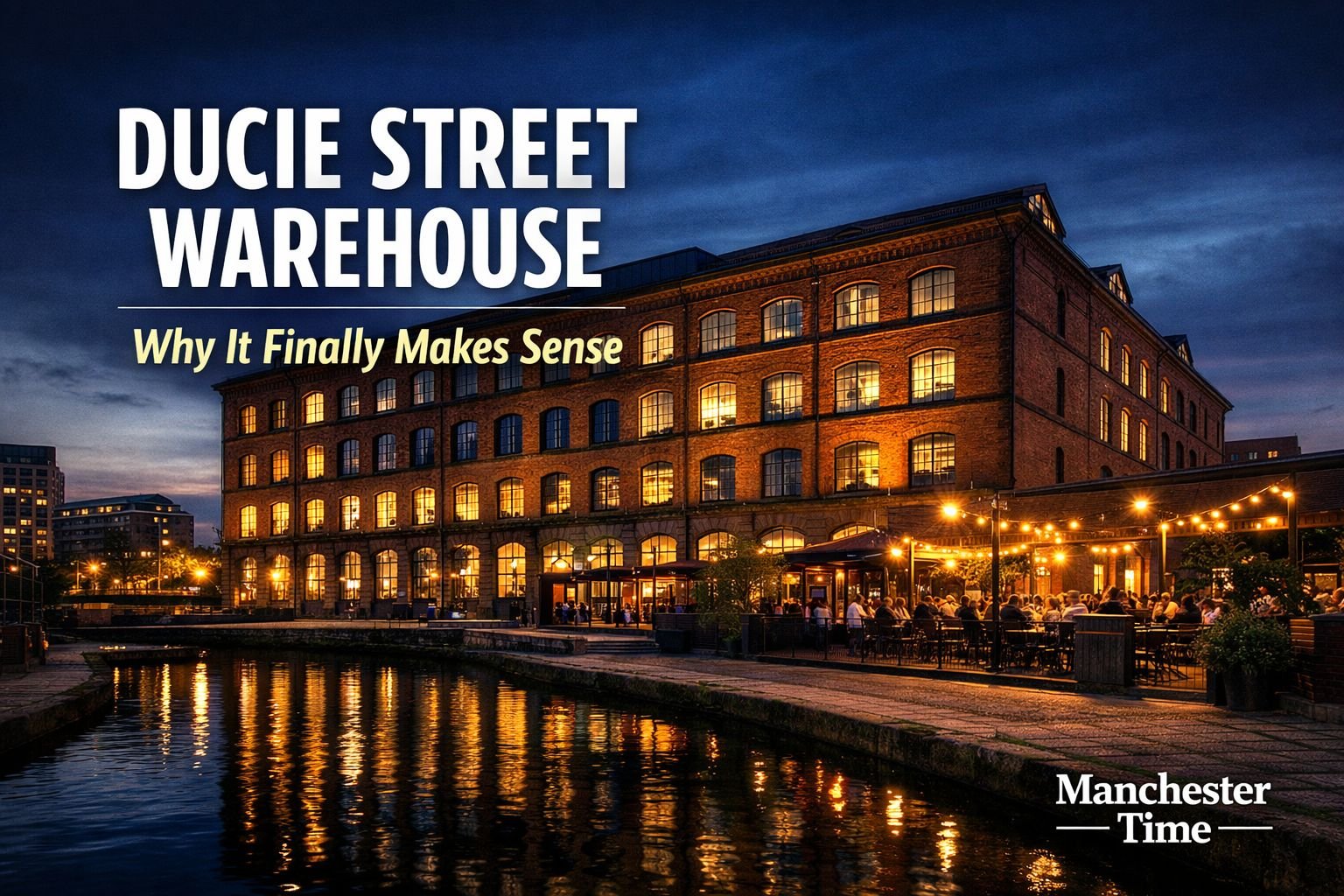
Ducie street warehouse occupies 180,000 square feet of a Grade II-listed Victorian cotton warehouse beside the Rochdale Canal basin, a five-minute walk from Piccadilly Station. Designed in 1867 by Edward Walters, one of the architects who shaped industrial Manchester, the building once stored raw cotton arriving by rail and canal before distribution to mills across the region.
The warehouse survived the collapse of the cotton industry, later becoming student accommodation, then an aparthotel, and finally a hybrid ground-floor venue combining bar, restaurant, co-working space and cinema. Each iteration made sense in isolation. None quite aligned with how the surrounding city centre was evolving.
That misalignment may finally be ending.
Why Ducie Street Warehouse Has Always Been About Context
Manchester’s city centre works in micro-neighbourhoods. What thrives in Ancoats does not automatically translate to Spinningfields, and Piccadilly has long lagged behind both. Ducie street warehouse sits precisely at that fault line, close enough to the Northern Quarter to borrow footfall, yet far enough east to feel disconnected once the evening sets in.
For years, that geography limited the venue’s potential. But geography does not stand still.
Piccadilly is now the fastest-changing part of the city centre. Major regeneration schemes at Piccadilly Basin and Mayfield are adding thousands of homes and tens of thousands of jobs within walking distance. Commuter footfall through Piccadilly Station, already among the busiest outside London, continues to grow. Ducie street warehouse is no longer peripheral. It is becoming central by default.
Food, Drink and the Limits of Previous Versions
The early incarnations of ducie street warehouse struggled not because of poor execution, but because they asked too much of the space. Table-service dining sat uneasily inside a vast atrium designed for industrial scale. Co-working thrived during the day but evaporated after dark. The bar worked best when it felt informal, yet was often framed as a destination venue.
A food hall model resolves those tensions.
Multiple kitchens remove the pressure on any single operator. Casual seating suits the scale of the building. Short visits become viable. Long visits feel unforced. The space finally works with the architecture rather than against it.
If the new operators deliver genuinely independent traders, not soft-branded chains, ducie street warehouse gains something previous versions lacked: repeat relevance.
Why Timing Favors Ducie Street Warehouse in 2026
Food halls are no longer novel in Manchester, but saturation arguments ignore one key factor: population density. City centre living has accelerated sharply over the past decade, and Piccadilly is where much of the next wave will land.
Ducie street warehouse benefits from three converging trends:
- Commuter proximity: five minutes from Piccadilly Station places it directly on the path of daily movement, not discretionary travel.
- Residential growth: nearby developments are creating a neighbourhood that needs casual, walkable amenities rather than destination dining.
- Work pattern shifts: hybrid working has blurred the lines between lunch spots, meeting spaces and after work venues.
This is not a bet on hype. It is a bet on usage.
The Building as an Asset, Not a Backdrop
Manchester’s Victorian warehouses succeed when their scale is treated as an advantage, not a problem. Ducie street warehouse has one of the city centre’s most imposing interiors: cast-iron columns, brick vaults and a central atrium that immediately signals permanence.
Grade II listing limits structural changes, but it also guarantees character. In a city increasingly filled with glass-fronted developments, that matters. The building provides instant gravitas to whatever operates inside it, provided the offer does not feel temporary.
A well run food hall fits that requirement. It is flexible, resilient and adaptable without erasing history.
Co-Working, Cinema and the Case for Mixed Use
One reason ducie street warehouse has endured multiple reinventions is its refusal to become single-purpose. The retained cinema, small but distinctive, reinforces that identity. So does the continued presence of the aparthotel above.
That vertical mix is underappreciated. Guests staying on-site generate consistent, predictable footfall. Daytime laptop users soften the peaks and troughs that kill many hospitality venues. Evening drinkers extend dwell time. Few Manchester venues benefit from all three simultaneously.
If managed intelligently, ducie street warehouse becomes less of a venue and more of a piece of social infrastructure.
Who Ducie Street Warehouse Is Actually For
This is not a Northern Quarter clone, nor does it need to be. Ducie street warehouse works best for people who value convenience, flexibility and atmosphere over scene-chasing.
- Commuters passing through Piccadilly
- City centre residents east of the core nightlife zones
- Freelancers and hybrid workers
- Aparthotel guests seeking low-effort evenings
- Groups who want variety without committing to a single restaurant
It will never replace Manchester’s specialist dining spots. It does not need to. Its role is different.
Is Ducie Street Warehouse Worth Visiting in 2026?
The honest answer depends on execution, but the fundamentals are finally aligned.
Previous versions asked the space to be something it wasn’t. The next version accepts what it is: large, central, flexible and historically significant. If the food quality matches the ambition and pricing remains grounded, ducie street warehouse could become Piccadilly’s default meeting point rather than a curiosity people forget exists.
Not the loudest venue. Not the trendiest. But one people actually use.
A Venue Catching Up With Its Own Location
Ducie street warehouse has always been ahead of its surroundings. Now, the surroundings are catching up. As Piccadilly evolves into a true residential and employment hub, the warehouse finally makes sense in context.
Manchester’s best venues are rarely perfect. They are useful, adaptable and embedded in daily life. If this next chapter succeeds, ducie street warehouse will not feel new. It will feel inevitable, which in this city is usually the strongest sign something is going to last.
Read More: What Interior DesignMode24 Reveals About How Manchester Homes Really Live Now