

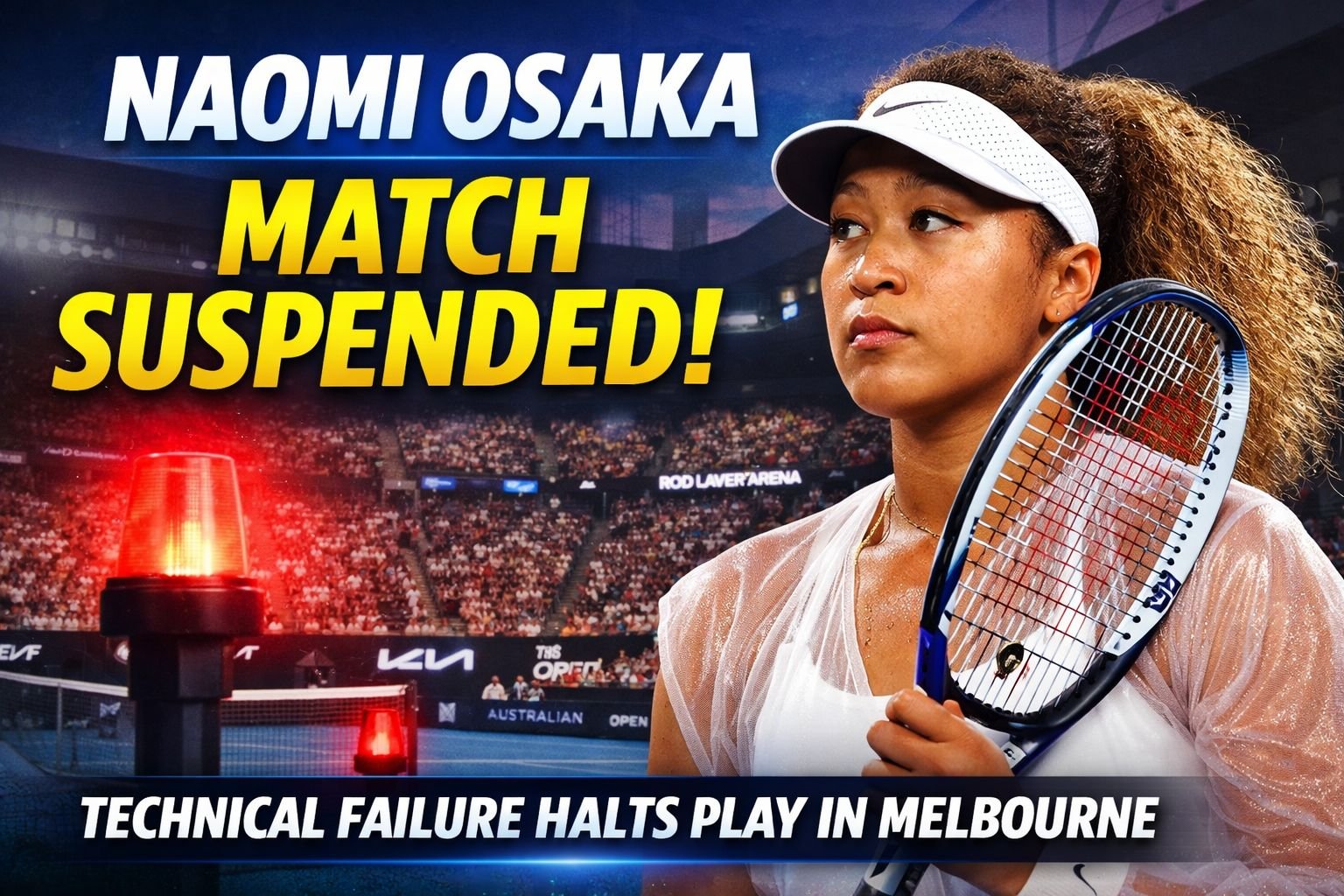
Four time Grand Slam champion and former world No.1 Naomi Osaka was at the centre of early Australian Open drama on Tuesday evening after her first-round match was temporarily halted due to a technical malfunction on Rod Laver Arena.
The 16th seed was facing Croatian world No.65 Antonia Ruzic when play was suspended at a critical moment, with the second set finely poised and momentum hanging in the balance. For UK viewers tuning in from Manchester and beyond, the interruption raised immediate questions about player welfare, technology, and tournament readiness.
What Happened in Melbourne
Osaka had taken control of the opening set, breaking early and closing it out 6-3 with authority. The match shifted in the second set, however, as Ruzic surged into a 5-3 lead and stepped up to serve for the set.
At deuce during that game, the newly installed red warning lights positioned on either side of the net suddenly illuminated and crucially, failed to switch off. Designed to support the tournament’s automated line calling system, the lights became a persistent distraction, leaving both players uncertain whether play could continue under fair conditions.
When asked by the umpire if she was willing to proceed with the lights still active, Osaka declined. Tournament officials then suspended play for approximately eight minutes while technicians worked to resolve the issue.
A Rare Technology Failure on a Major Stage
The delay marked the first major on court failure of the Australian Open’s new warning-light system, introduced to improve clarity around line calls. While the technology is intended to enhance accuracy, its malfunction at such a pivotal stage of the match exposed the risks of rolling out new systems under Grand Slam pressure.
Once the issue was resolved, play resumed quickly. Ruzic held serve to take the second set 6-3, pushing the contest into a deciding third set and shifting the atmosphere inside Rod Laver Arena.
Why Naomi Osaka Response Matters
Osaka’s refusal to continue until conditions were corrected was widely viewed as a statement of professional standards rather than gamesmanship. At the elite level, even minor visual distractions can affect reaction time and shot selection, particularly in high-stakes moments.
For UK tennis fans accustomed to Wimbledon’s strict operational controls, the incident highlighted how technological innovation can sometimes clash with competitive understanding. Osaka’s stance reinforced a principle long supported by players’ councils: fairness must outweigh convenience.
Osaka’s Comeback Narrative Adds Extra Weight
This year’s Australian Open represents another important step in Osaka’s post-maternity return to the sport. A two-time champion in Melbourne (2019 and 2021), she arrived as the 16th seed with renewed confidence following a steady climb back up the rankings.
Her record at the tournament remains among the strongest in the women’s game, and Rod Laver Arena holds particular significance as the venue where she claimed her first major titles. For British audiences who followed her rise closely, the suspension served as a reminder that her presence still commands attention — both for her tennis and her principles.
UK Viewing Context and British Interest
Australian Open coverage in the UK is being led by TNT Sports and Discovery+, with highlights available on Quest. With Melbourne operating 11 hours ahead of GMT, night sessions begin around 8am UK time a commitment many Manchester fans have embraced during the opening rounds.
British interest remains strong elsewhere in the draw. Emma Raducanu made a confident start to her campaign, while Katie Boulter exited in the first round, underlining the tournament’s competitive depth. Against that backdrop, Osaka’s interrupted match added another layer of intrigue for UK viewers following events overnight.
Expert Reaction and Manchester Insight
Tennis analysts were largely supportive of Osaka’s decision, noting that player consent is vital when conditions deviate from the norm. Within Manchester’s tennis community, early-morning viewing groups reacted with frustration at the delay but approval of Osaka’s insistence on fair play.
Local clubs and fans took to social media during the stoppage, reflecting the broader British sentiment that Grand Slam matches should not proceed under compromised conditions — regardless of scheduling pressures.
What Happens Next
Osaka now faces the challenge of resetting mentally for a deciding set understanding that momentum has shifted. Ruzic, ranked outside the world’s top 60, is chasing the biggest win of her career, while Osaka is seeking to reassert her authority early in the tournament.
Should the former champion advance, a second-round meeting with Romania’s Sorana Cirstea awaits a matchup that would test Osaka’s resilience further.
For Manchester and UK tennis fans, the episode served as a reminder that even at the sport’s most prestigious events, unpredictability remains part of the spectacle. The Australian Open’s opening week has already delivered drama, and Osaka’s interrupted night on Rod Laver Arena may yet prove a defining moment in her 2026 campaign.