

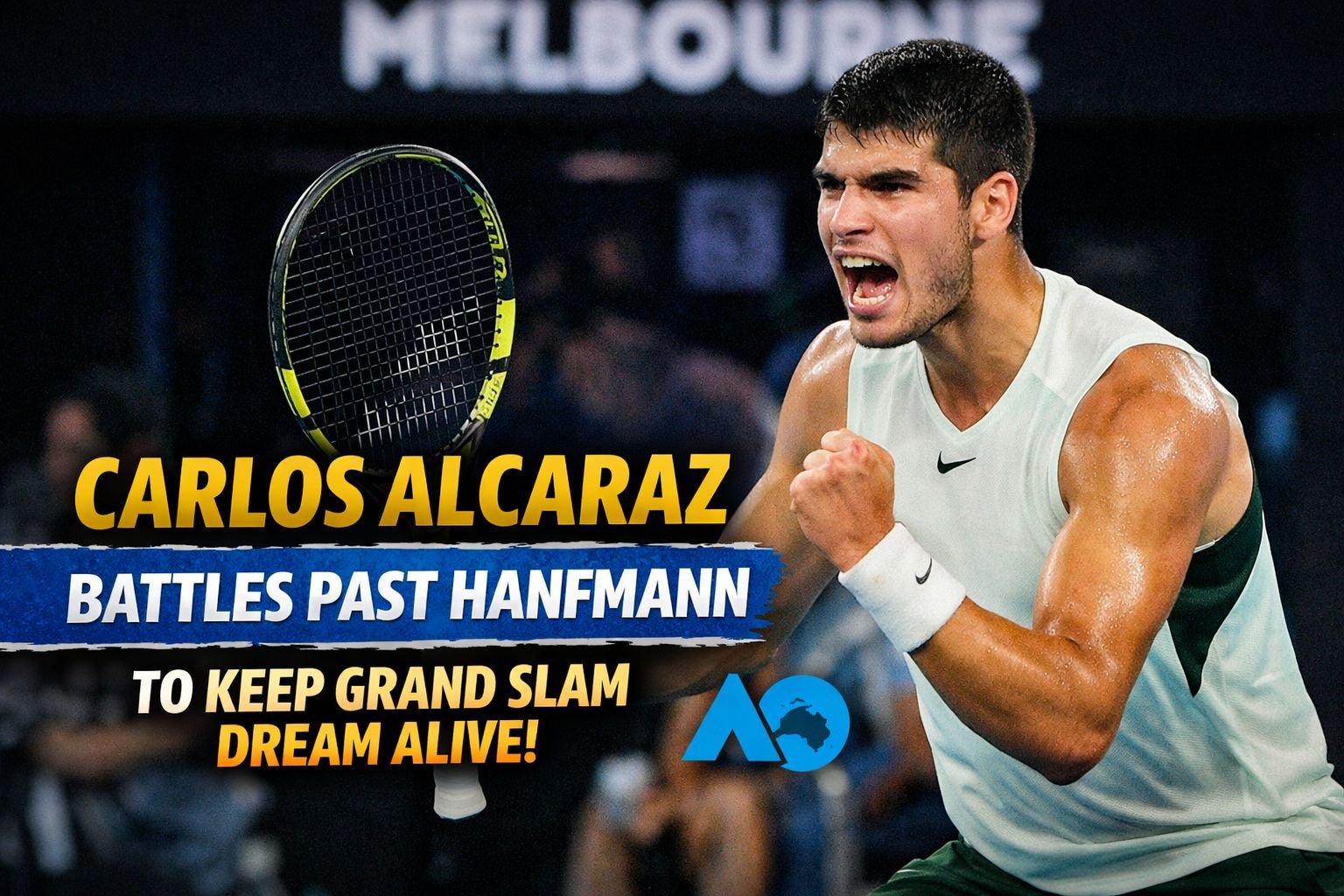
Carlos Alcaraz took another decisive step towards history in Melbourne with a hard-fought 7-6(4), 6-3, 6-2 victory over Germany’s Yannick Hanfmann, surviving a punishing 78-minute opening set to reach the third round of the Australian Open.
The world number one’s latest win keeps his bid for a career Grand Slam firmly alive and ensures UK and Manchester tennis fans will once again be setting alarms as his Australian Open campaign gathers real momentum.
This edition of the Australian Open carries added weight for Alcaraz. Melbourne remains the missing piece in his Grand Slam collection, and after back-to-back quarter-final exits in 2024 and 2025, the 22-year-old Spaniard has arrived this year with both the ranking and the composure of a player ready to complete the set. His second straight-sets win of the fortnight was anything but routine, yet the manner in which he wrestled control of a dangerous match under the Rod Laver Arena lights reflected a champion increasingly comfortable with tennis history pressing in.
What Happened in Alcaraz v Hanfmann
The scoreline suggests a straightforward passage; the opening set told a very different story. Hanfmann, ranked 102 in the world, came out swinging and broke early to lead 3-1, pinning Alcaraz deep behind the baseline with flat, penetrating groundstrokes. For long spells, it was the German dictating exchanges, forcing Alcaraz into uncomfortable court positions and drawing uncharacteristic errors through sheer weight of shot.
At 5-5, Hanfmann saved two break points to keep the set on serve, and in the tie-break he even edged ahead at 4-3, threatening to land the first real blow of Alcaraz’s tournament. That was the moment the top seed’s big-match temperament surfaced. From 3-4 down, Alcaraz reeled off four consecutive points with fearless first strikes, snatching a gruelling 78-minute set that instantly shifted the tone of the night.
Once the opener was secured, the dynamic changed decisively. Alcaraz stepped further inside the court in the second set, taking time away from Hanfmann and forcing the German into longer defensive rallies. A pair of breaks established a two-set cushion, and with Hanfmann increasingly hampered by an apparent oblique issue that required treatment between sets, the physical and tactical gap widened in the third. Alcaraz broke twice more and closed out a 6-2 finish in just over two hours.
The numbers reinforced the pattern. Alcaraz struck 11 aces, including a remarkable run of four in succession to open the final set, while balancing 38 winners against 36 unforced errors — a reflection of his attacking intent as well as early-round rust. Crucially, he weathered significant scoreboard pressure on serve early on before locking down his delivery as the match progressed.
Why This Win Matters in Melbourne
In isolation, this was a solid second-round win over an unseeded opponent. Within the wider Carlos Alcaraz Australian Open narrative, it carries greater significance. For the third year running, he has been tested early in Melbourne, yet this time he found an extra gear precisely when required, without the mid-match lapses that proved costly in previous campaigns.
Alcaraz now sits two victories away from matching his best Australian Open result — quarter-final runs in 2024 and 2025 that ended against Alexander Zverev and Novak Djokovic respectively. Go one step further this year and he will be in uncharted territory at this event. Go all the way and he would become the youngest man ever to complete a singles career Grand Slam, and the youngest in the Open era to claim seven major titles.
In a men’s field undergoing transition, that context matters. With Novak Djokovic and Rafael Nadal approaching the twilight of their careers, the Australian Open has become a defining battleground for the next generation. For the top seed, Melbourne represents opportunity as much as pressure.
Manchester and UK Perspective
From a Manchester and wider UK standpoint, there are several reasons this Carlos Alcaraz Australian Open run is resonating so strongly.
First, viewing habits. With live coverage stretching through the night and into early morning in Britain, Alcaraz has become a natural focal point for fans choosing which matches justify the loss of sleep. His blend of explosiveness, speed and aggression offers a guarantee of value — the same pull factor that made his Wimbledon final victory over Djokovic compulsory viewing.
Second, there is an emotional overlap with Britain’s own tennis story. Many in Manchester grew up watching Andy Murray shoulder similar expectations. The idea of a 22-year-old chasing a career Grand Slam so early cuts through even for casual fans, tapping into memories of following British hopes across all four majors.
Third, British audiences have long embraced overseas stars who play the game with visible effort and respect. Alcaraz’s on-court demeanour, frequent smiles under pressure and habit of acknowledging opponents’ good shots have made him one of the tour’s most widely admired figures.
Tactical and Physical Insight
Tactically, the Hanfmann match offered a useful examination of Alcaraz’s adaptability when his initial plan falters. Early on, he allowed himself to be pushed too deep. The adjustment was clear: sharper return positioning, more frequent changes of direction, and heavier forehand pressure to open up the court.
His serve, often underrated in wider discussion of his game, proved decisive. The burst of aces at the start of the third set did more than win points — it sent a message that he was fully in control. Physically, he finished stronger than he started, showing no signs of the fatigue or cramping that can surface in humid Melbourne night sessions.
What Comes Next for Alcaraz
Next in the Carlos Alcaraz Australian Open journey is a third-round meeting with French left-hander Corentin Moutet, a player renowned for variation and disruption. Where Hanfmann brought linear power, Moutet offers angles, drop shots and constant changes of rhythm.
Alcaraz has generally thrived against such opponents, but patience will be key. If he maintains discipline and controls his error count, his superior athleticism and weight of shot should assert themselves over five sets. For UK and Manchester viewers, another awkwardly timed start appears likely — but with the promise that every round deepens the sense of something significant building in Melbourne.
Calm Confidence at the Right Time
Two rounds in, the Carlos Alcaraz Australian Open story is exactly where a top seed would want it: tested but not derailed, stretched but not drained. The win over Hanfmann underlined both the dangers of early-round opponents and Alcaraz’s growing assurance under pressure.
Sterner challenges lie ahead, yet if this performance is any indication, Alcaraz has arrived in Melbourne with the resilience, tactical clarity and physical readiness required to turn his most frustrating major into the one that finally completes the set.
Read More: Australian Open Delivers Overnight Drama as Manchester Wakes to British Hope