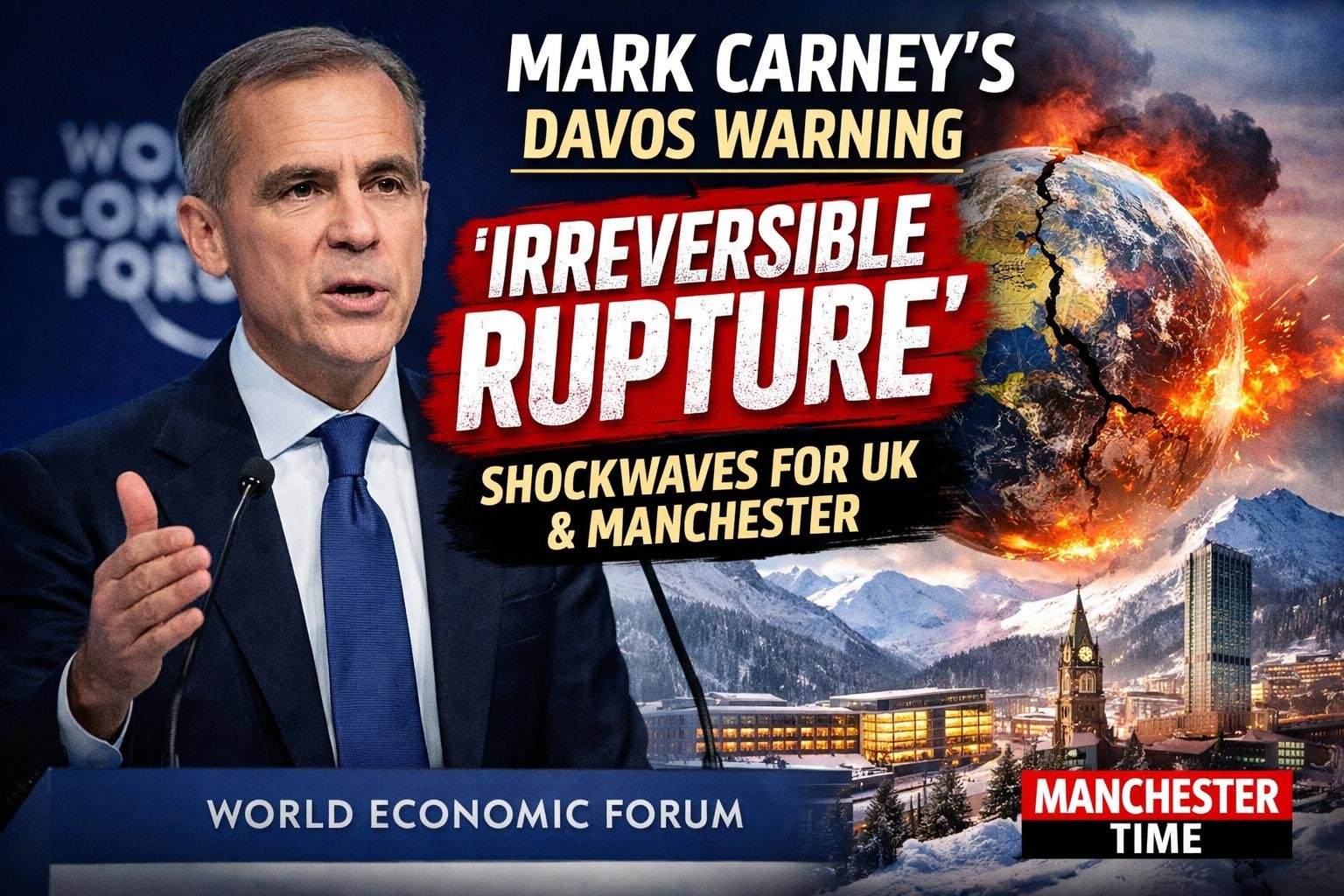
The Mark Carney speech Davos delivered at the World Economic Forum on Tuesday cut through the usual optimism of the Swiss gathering with a stark message. The international rules-based order has suffered “a rupture, not a transition”, and the consequences for the UK economy and city regions like Greater Manchester could be profound.
Speaking just a day before US President Donald Trump’s scheduled Davos appearance, Canadian Prime Minister Mark Carney described a world in which great powers increasingly weaponise trade, tariffs and supply chains. For Britain, navigating fragile post-Brexit trade relationships, the warning landed at a sensitive moment.
Why the Mark Carney Speech Landed Now
The Mark Carney speech Davos came amid one of the most volatile geopolitical backdrops in recent memory. The annual meeting of the World Economic Forum has been overshadowed by escalating transatlantic tensions following President Trump’s renewed tariff threats and demands linked to Greenland.
European leaders, including France’s Emmanuel Macron, have publicly pushed back against what they describe as economic coercion, while NATO Secretary General Mark Rutte has warned that the dispute risks destabilising the alliance itself. Against this backdrop, Carney’s address moved beyond abstract analysis to outline how middle power nations may need to adapt to survive.
Mark Carney’s Core Warning
At the heart of the Mark Carney speech Davos was a rejection of the idea that the world is simply passing through another temporary disruption.
“Let me be direct,” Carney told delegates. “We are in the midst of a rupture, not a transition.” He argued that decades of deep global integration have left nations exposed, with tariffs, financial systems and supply chains now routinely used as strategic weapons.
His most quoted line captured the urgency of the moment. “If we’re not at the table, we’re on the menu.” The message was clear. Countries like the UK and Canada must act collectively or risk negotiating alone from a position of weakness.
Europe Aligns With Carney’s Message
While Carney avoided naming the United States directly, the Mark Carney speech Davos resonated strongly across Europe. French President Macron echoed the theme in his own remarks, warning against “the law of the strongest” dominating global trade.
European Commission President Ursula von der Leyen pledged a firm response to coercive trade practices, and the European Parliament moved to suspend ratification of a US-EU trade agreement. Analysts have described the moment as the most serious test of the transatlantic relationship since the Suez Crisis.
Trade, Defence and a Strained Special Relationship
For Britain, the Mark Carney speech Davos crystallised long-standing anxieties about its geopolitical positioning. The US remains the UK’s largest single export market, with goods exports worth more than £58 billion annually, including around £10 billion in automotive exports alone.
The UK government has committed to raising defence spending to 2.5 percent of GDP by 2027, reflecting growing recognition that economic security and national security are increasingly intertwined. Yet officials privately acknowledge that Britain’s leverage outside the EU single market is limited if tariff disputes escalate.
Prime Minister Keir Starmer’s measured response, warning that tariff wars between allies benefit no one, underlines the delicate balance Britain is attempting to maintain.
What the Global Rupture Means Locally
For Greater Manchester, the implications of the Mark Carney speech Davos extend well beyond diplomatic theory. The city region’s export economy, valued at around £60 billion, depends heavily on stable access to European and North American markets.
Local businesses are still adapting to post-Brexit trade friction, and renewed US protectionism threatens to slow already fragile export growth. Analysts warn that Manchester exporters face a double exposure. Ongoing EU trade barriers combined with potential American tariffs.
Institutions such as Alliance Manchester Business School are increasingly focused on supply-chain resilience and diversification. These priorities closely mirror Carney’s call for building strength at home while reducing vulnerability to geopolitical shocks.
Manchester Airport’s connectivity has also become a strategic asset as regional leaders push to diversify trade towards faster-growing markets in Asia-Pacific and the Middle East.
Read More: Carlos Alcaraz Battles Past Hanfmann to Keep Australian Open Grand Slam Dream Alive
What Comes Next for the UK and Manchester Businesses
Carney closed his Davos address with a warning that “nostalgia is not a strategy”. The old global order, he argued, is not coming back.
For the UK, the challenge is deciding whether to embrace its role as a senior middle power working through coalitions or to continue relying on bilateral relationships that may prove increasingly unpredictable. For Manchester, the task is more practical. Diversifying export markets, strengthening local supply chains and ensuring regional voices are heard in national trade policy.
The Mark Carney speech Davos may ultimately be remembered as a watershed moment. The point at which global leaders publicly acknowledged that the post-1945 economic system has fractured beyond repair. Whether Britain and its city-regions can adapt quickly enough now becomes the defining question.
Read More: Kiefer Sutherland Arrested in Hollywood After Alleged Rideshare Incident