

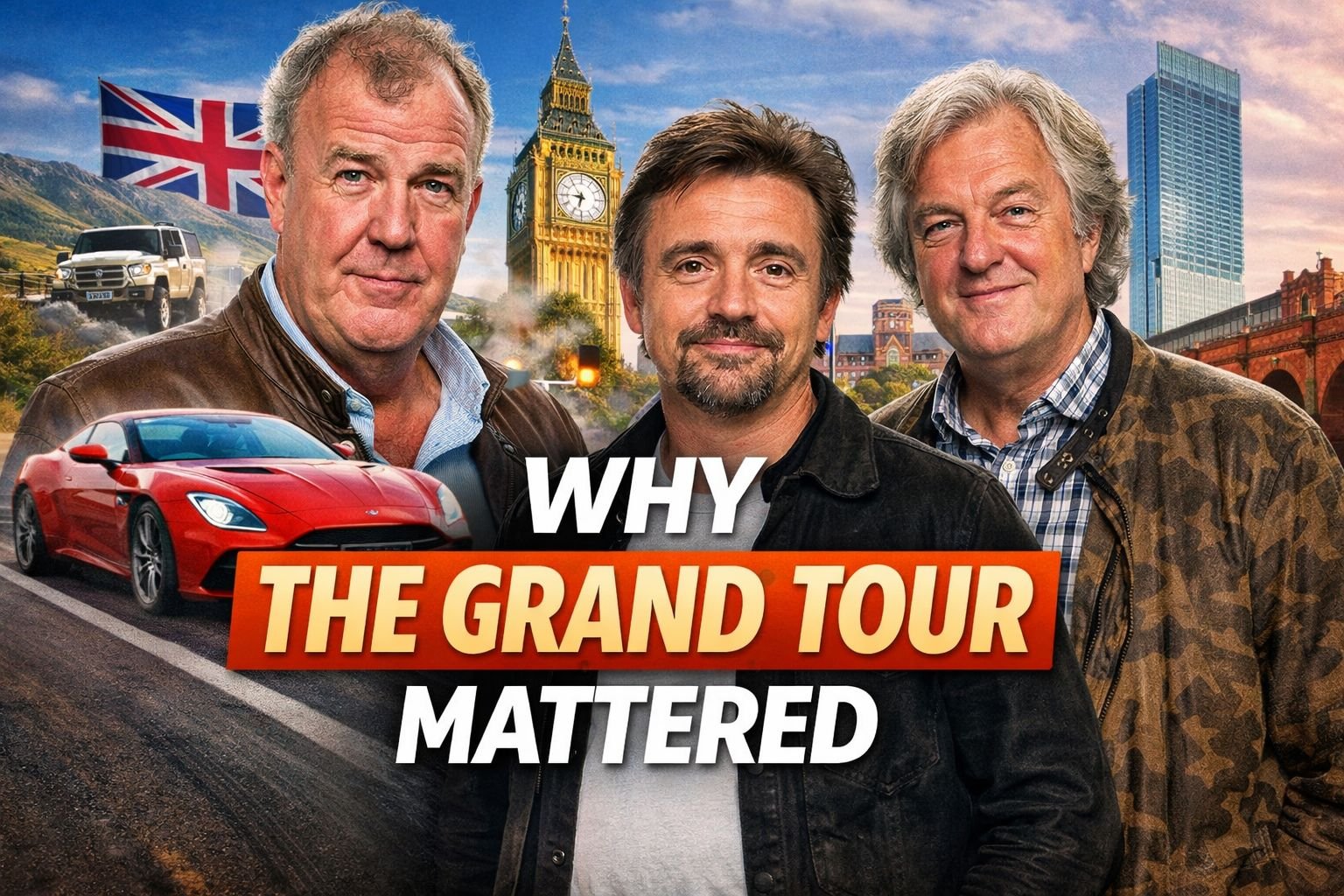
When The Grand Tour arrived on Amazon Prime Video in late 2016, it was not simply Top Gear with a bigger budget. The Grand Tour marked the first time a cornerstone of British broadcast culture defected completely to streaming. Clarkson, Hammond and May took the chemistry, the running jokes and the format DNA that had built one of the BBC’s last true weekend juggernauts and placed it behind a login screen.
For viewers who had followed the fallout from Jeremy Clarkson’s departure from Top Gear in 2015, The Grand Tour felt like a small act of cultural defiance. It was the same trio, the same laddish instincts, and none of the BBC’s institutional restraint. Northern audiences in particular, with a sharp instinct for authority losing its grip, warmed quickly to The Grand Tour as a banned BBC institution re forming under the nose of an American tech giant.
Amazon spent heavily on The Grand Tour, and the money was visible on screen. Vast locations, cinematic drone shots and production values that felt closer to blockbuster film than Sunday night television all signalled that British motoring television had shifted from scheduled viewing to global streaming asset. For a brief period, The Grand Tour appeared to have escaped terrestrial gravity altogether.
A show built on a very British joke
What made The Grand Tour work in its early years was its refusal to abandon the central gag. Three ageing men behaving like sixth formers with expensive toys remains an unmistakably British joke. It draws on petty rivalry, exaggerated competence and mock heroic narration applied to situations that are, at heart, faintly ridiculous.
Even as The Grand Tour travelled the world, the sensibility stayed resolutely provincial. Northern viewers did not need to know the price of a Lamborghini to recognise the man behind the wheel from an office car park or motorway services. The presenters remained, fundamentally, company car types from a country where most people experience motoring through monthly finance payments and traffic jams on the M62.
That grounding is why the early touring tent years of The Grand Tour still felt rooted in Britain. The audience segments, the celebrity appearances and the studio rhythm echoed Top Gear’s social script. Amazon money wrapped around a BBC era idea. The Grand Tour understood that viewers were not watching for lap times. They were watching to see three familiar personalities argue, fail and take the mick out of each other.
When The Grand Tour stopped being a weekly show
The decisive shift came when The Grand Tour abandoned the traditional series structure and became a sequence of standalone road trip films. The tent disappeared, the live audience vanished and the weekly rhythm dissolved. In its place came feature length specials that leaned closer to travel documentary than light entertainment.
From an industry perspective, the change was logical. Weekly factual television was losing traction, while streaming platforms favoured evergreen events. For the presenters, it allowed The Grand Tour to focus on what it always did best. Long journeys, ill judged vehicles and gradual narrative chaos.
The cost of that change was cultural. As The Grand Tour became an occasional event rather than a regular fixture, it drifted from its British television roots. The specials were often reflective and beautifully produced, but for viewers in Trafford Park, Wigan or Salford, The Grand Tour became something you saved for holidays rather than a programme you watched every week.
Appointment viewing faded. What had once been shared national conversation became something more private and episodic. In the streaming age that is normal. For The Grand Tour, it felt like a gentle demotion.
Audience fatigue rather than failure
By the time the final specials arrived, Clarkson, Hammond and May had been performing some version of The Grand Tour for nearly a decade and variations of the same act for close to twenty years. The production remained polished and the jokes still landed, but the audience had moved on.
Cars themselves had changed status. What once symbolised freedom and aspiration increasingly sat inside environmental debate. Younger viewers were as likely to watch a local creator filming a leased hatchback outside Stockport as they were to watch The Grand Tour coax another unreliable car across a border.
This was not failure. It was entropy. Even in the North, where car culture clings on more stubbornly through track days and industrial estate meets, The Grand Tour began to feel like a period piece. Familiar beats repeated. Mishaps felt expected rather than surprising.
British cultural impact with a northern tint
At its core, The Grand Tour extended a specific type of British television masculinity into the streaming era. The irreverent, nostalgic, machinery obsessed Top Gear archetype survived, now funded by a global platform rather than the licence fee.
In northern England, that figure is instantly recognisable. He exists in taxi ranks, on industrial estates and in pub car parks. The Grand Tour gave that character international visibility and allowed audiences to laugh with him and at him simultaneously.
The show also shifted where British television lived. Viewing moved from the scheduled living room to on demand nights in across Manchester, Leeds and beyond. The Grand Tour embedded itself less as a numbered series and more as a collection of remembered disasters. The one with the boats. The one in the snow. The one where everything went wrong.
Where The Grand Tour sits in UK television history
Seen in hindsight, The Grand Tour works best as the Amazon era continuation of the Clarkson Hammond May project rather than a standalone show. It carried the same personalities through shifting platforms, technologies and cultural norms.
It also marked the moment when British public service broadcasting stopped being the sole home of shared national entertainment. For viewers in Eccles or Oldham, the practical difference was simple. The Grand Tour now required a Prime subscription.
Unlike Top Gear’s abrupt and chaotic ending, The Grand Tour concluded with restraint. A slow run down, a final set of specials and a deliberate decision to stop before collapse. In British television terms, that is unusual.
Why nothing really replaces The Grand Tour
There will be attempts to replace it. New presenters will be younger, safer and more brand friendly. Some of those programmes will be well made. None will be The Grand Tour.
The engine was never the cars or even the format. It was the long, uneven relationship between three presenters and their audience. For northern viewers especially, that bond was built on familiarity, class and attitude rather than horsepower.
In practice, nothing replaces The Grand Tour. British car culture has fragmented across platforms and formats. What remains is a box set memory, a reminder of a time when the country could still see itself reflected through badly chosen cars and stubborn personalities.
The Grand Tour will linger as a cultural echo. Not because it was perfect, but because it captured something specific about Britain before the audience scattered and the road moved on.
Read More: Michelle Keegan Netflix: How a Stockport Star Became One of Britain’s Most Powerful Streaming Leads