

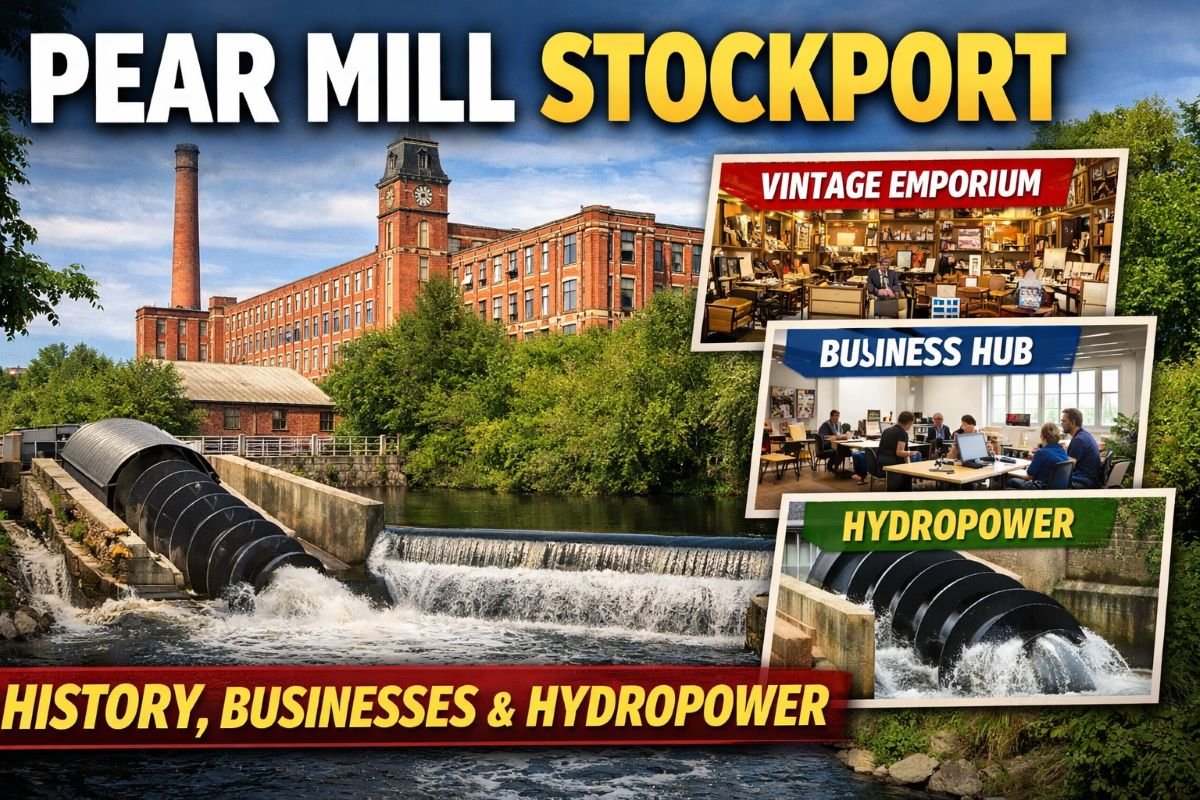
On the banks of the River Goyt in Bredbury stands one of Stockport’s most resilient industrial landmarks. Pear Mill Stockport was built at the height of the cotton boom, survived the collapse of Lancashire textiles, and today operates as a thriving business and leisure hub. Few buildings in Greater Manchester tell a story of reinvention quite like this one.
The Industrial Origins of Pear Mill Stockport
Construction of Pear Mill Stockport began in 1908 and was completed in 1913, making it one of the last cotton spinning mills ever built in England. It arrived at a difficult moment. The Lancashire cotton trade was already under pressure from overseas competition, and the industry’s decline accelerated soon after the First World War.
Architecturally, Pear Mill Stockport reflects Edwardian industrial ambition. The red-brick structure rises across multiple storeys, supported by heavy internal columns designed to carry vast spinning machinery. Its scale alone marks it out as significant.
The building now holds Grade II listed status, recognising its importance within Stockport industrial heritage. That listing protects its core character while allowing for adaptive reuse.
From Cotton Production to Commercial Reinvention
When textile manufacturing ended, many mills across the North West were demolished or abandoned. Pear Mill Stockport avoided that fate.
Instead, private investment gradually converted the site into flexible commercial space. According to local planning records, the adaptive reuse of Pear Mill Stockport is frequently cited as a practical example of heritage-led regeneration within Greater Manchester.
Today the complex houses more than sixty five businesses. Units range from office suites to light industrial workshops and storage facilities. The diversity of tenants has helped Pear Mill Stockport remain resilient through economic cycles.
Unlike city-centre developments, the site offers scale and affordability. For small enterprises and independent operators, Pear Mill Stockport provides realistic entry points into commercial premises within the borough.
The Vintage Emporium and Visitor Appeal
Pear Mill Stockport is not simply an industrial estate. It has become a visitor destination.
The Vintage Emporium occupies a substantial section of the building and has developed a reputation as one of the North West’s largest vintage retail spaces. Independent traders sell furniture, clothing, vinyl records and collectables within the mill’s original industrial shell.
Weekend footfall regularly draws visitors from across Greater Manchester and beyond. Shopping within Pear Mill Stockport carries a sense of authenticity that modern retail parks cannot replicate. Exposed brickwork, iron beams and original architectural features provide atmosphere that enhances the experience.
This retail anchor has shifted public perception. Pear Mill Stockport is now associated not just with business premises but with leisure and discovery.
Awesome Walls and Adaptive Design
Another major tenant demonstrates how industrial architecture adapts to new demands. Awesome Walls Climbing Centre occupies significant vertical space within the mill. The generous ceiling height that once accommodated spinning machinery now supports indoor climbing routes.
The success of this conversion reinforces a wider point. Pear Mill Stockport works because it embraces its structure rather than hiding it. The building’s physical characteristics continue to shape its modern uses.
Hydropower Returns to the River Goyt
Perhaps the most innovative chapter in the story of Pear Mill Stockport came in 2017, when a hydroelectric turbine was installed at the adjacent weir on the River Goyt.
The Archimedes screw turbine generates renewable electricity using the same water flow that historically powered textile production. In effect, water power returned to Pear Mill Stockport after more than a century.
Local environmental groups welcomed the project as a practical contribution to regional sustainability targets. The installation also strengthened the site’s identity as a working example of how historic buildings can align with modern environmental priorities.
Economic Contribution to Bredbury and Beyond
The impact of Pear Mill Stockport extends into the surrounding area. Bredbury benefits from steady visitor numbers generated by retail and leisure tenants. Cafes, pubs and small businesses nearby see increased trade, particularly at weekends.
Employment figures matter too. With more than sixty five separate businesses operating on site, Pear Mill Stockport supports hundreds of direct and indirect jobs. Flexible unit sizes allow startups and established firms to coexist.
Stockport Council has consistently emphasised the importance of protecting productive industrial heritage. In the context of wider town centre regeneration schemes around the railway station and historic market, Pear Mill Stockport stands as evidence that preservation and productivity are not opposing forces.
Community Memory and Identity
For many residents, Pear Mill Stockport represents continuity. Grandparents worked there. Parents remember its decline. Younger generations experience it as a retail and leisure venue.
Local residents often describe affection for the building. It remains a landmark reference point within Bredbury. Rather than becoming a derelict reminder of lost industry, Pear Mill Stockport continues to function as a living part of the community.
School groups have visited to learn about Stockport industrial heritage. In that sense, the building operates as both commercial asset and educational resource.
Why Pear Mill Stockport Still Matters
Across Greater Manchester, former mills face uncertain futures. Some have been demolished. Others stand empty. Pear Mill Stockport demonstrates a third path.
By combining heritage protection, diverse tenancy, visitor attractions and renewable energy innovation, the site has sustained relevance in a post industrial economy.
Pear Mill Stockport is not a museum piece. It is an active commercial environment shaped by its past but focused on viability. That balance is rare.
For businesses seeking Stockport business space, for visitors exploring local history, and for policymakers considering regeneration models, Pear Mill Stockport remains a working case study in adaptation done properly.
Frequently Asked Questions
Where is Pear Mill Stockport located?
Pear Mill Stockport sits on Stockport Road West in Bredbury, postcode SK6 2BP, alongside the River Goyt.
Is Pear Mill Stockport open to the public?
Parts of Pear Mill Stockport are open to visitors, including the Vintage Emporium and leisure facilities. Individual business units operate separately.
Is Pear Mill Stockport a listed building?
Yes, Pear Mill Stockport holds Grade II listed status recognising its industrial and architectural significance.
Can businesses rent space at Pear Mill Stockport?
Commercial units are available subject to lease agreements. Availability varies and enquiries are handled by site management.
Read More: Always Businesses SocialBizMagazine: Why UK Entrepreneurs Are Paying Attention