

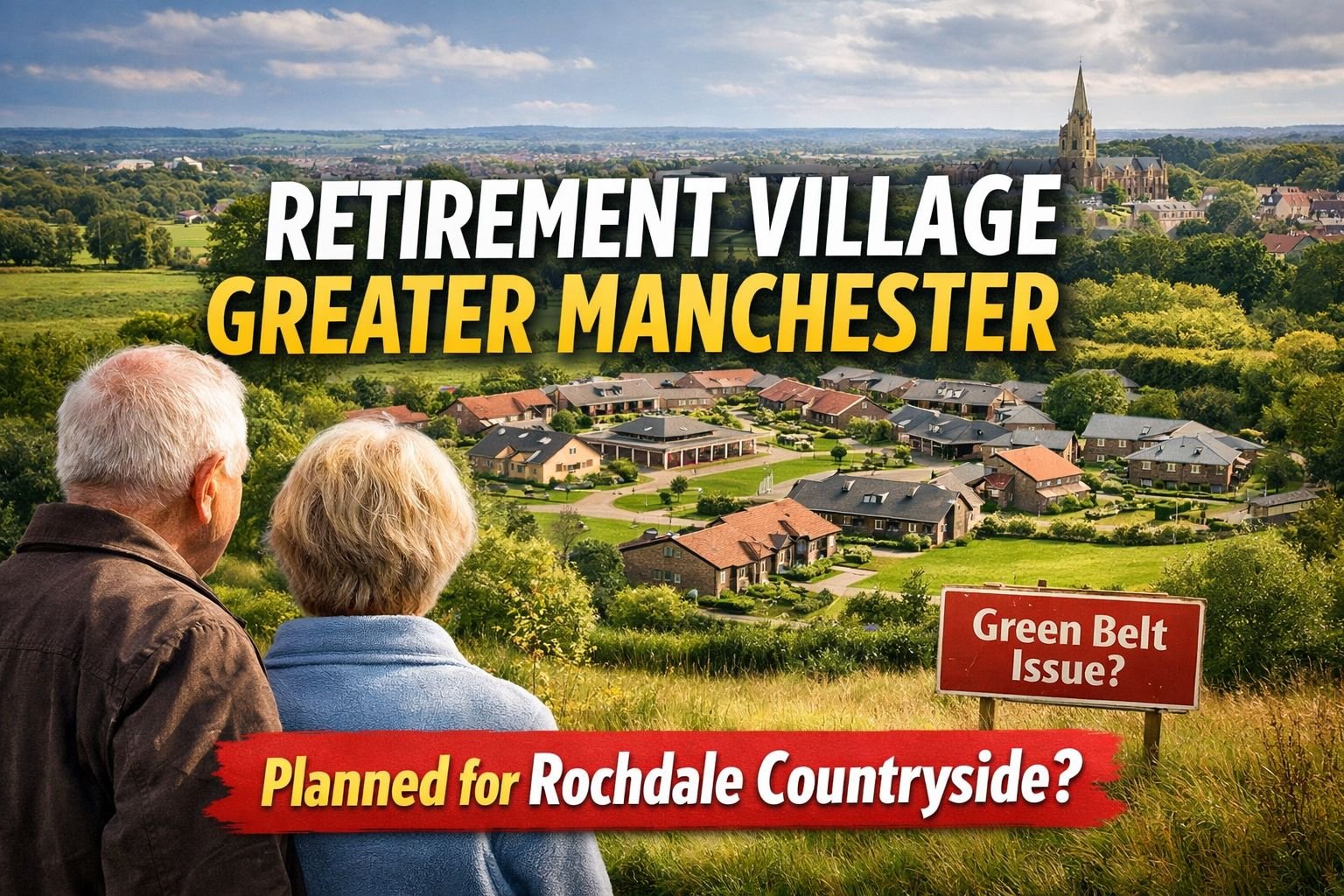
A major retirement village Greater Manchester proposal has been lodged for a countryside-edge site in Rochdale, setting up a significant planning decision for councillors in the months ahead.
The retirement village Greater Manchester scheme would bring specialist later living housing to land on the borough’s rural fringe, close to existing residential streets but bordered by open fields. Rochdale Borough Council has validated the application and opened a formal consultation period, inviting residents to comment on the retirement village Greater Manchester plans.
For Greater Manchester residents, this is not simply another housing application. The retirement village Greater Manchester development sits at the centre of two competing priorities: meeting the needs of an ageing population while protecting valued countryside landscapes that define Rochdale’s setting.
According to the Office for National Statistics, around 19 percent of Rochdale’s population is aged 65 or over, a figure projected to rise steadily over the next two decades. Against that backdrop, the retirement village Greater Manchester proposal is being framed by its backers as a response to clear demographic pressure.
Planning Details: What Is Being Proposed?
Location on Rochdale’s Countryside Fringe
The retirement village Greater Manchester site lies on the edge of Rochdale’s built-up area, between established housing and farmland. It is described in planning documents as countryside land rather than deep rural green belt, although that distinction is already a focus of local scrutiny.
Under the borough’s Local Plan and the wider Places for Everyone framework, land on settlement edges can be considered for development if policy tests are met. Whether this retirement village Greater Manchester site satisfies those tests will be central to the council’s assessment.
Type and Number of Homes
Plans outline a purpose built retirement village Greater Manchester scheme comprising apartments and bungalows arranged around shared communal facilities. While the final unit count is subject to committee approval, similar developments typically range between 80 and 150 homes.
Properties would be designed to lifetime standards, with step free access, lifts, wheelchair friendly layouts and integrated alarm systems. The intention is to create a retirement village Greater Manchester environment that allows residents to age in place without repeated moves into higher dependency settings.
Care and Community Facilities
At the heart of the retirement village Greater Manchester model is a cluster of shared spaces. Indicative plans refer to a residents lounge, activity rooms, landscaped gardens and space for visiting health professionals.
Developers argue that this approach reduces isolation and can ease pressure on mainstream services by coordinating care within the retirement village Greater Manchester setting rather than relying solely on external provision.
Timeline and Consultation
The retirement village Greater Manchester application is currently in the statutory consultation phase. Members of the public typically have 21 days from validation to submit representations through the council’s planning portal.
If approved by Rochdale’s Planning Committee later this year, construction of the retirement village Greater Manchester scheme would be phased over several years, beginning with site preparation and infrastructure works.
Countryside and Green Belt Debate
Few issues generate stronger reaction locally than development on open land. The retirement village Greater Manchester proposal has already prompted questions about whether the site falls within designated green belt or undesignated countryside.
National Planning Policy Framework guidance places strong protections on green belt land. Even where land is not formally designated, councillors must weigh landscape character and openness against housing need. Opponents of the retirement village Greater Manchester scheme argue that edge of settlement projects can gradually erode the town’s rural setting.
Supporters counter that a well designed retirement village Greater Manchester development is materially different from large scale family housing estates. They point to lower traffic generation, single storey or low rise forms and significant landscaping as mitigation.
Traffic, Health Services and Infrastructure
Transport impact will be examined in detail. Although residents of a retirement village Greater Manchester are statistically less likely to commute daily, staff, visitors and deliveries can still increase movements on nearby roads.
Highways officers will assess junction capacity, parking provision and pedestrian access. Safe walking and mobility scooter routes are particularly relevant in a retirement village Greater Manchester context.
Healthcare provision is another consideration. Across Greater Manchester, GP practices report sustained demand. Developers say the retirement village Greater Manchester scheme would include coordinated care packages and space for visiting clinicians, potentially reducing strain on local surgeries. Whether this is sufficient will form part of the planning officer’s report.
Drainage, ecology and landscaping strategies must also demonstrate that the retirement village Greater Manchester proposal will not increase flood risk or harm habitats, particularly given the countryside edge setting.
Jobs, Regeneration and Housing Strategy
Proponents of the retirement village Greater Manchester development highlight economic benefits. Construction would support local contractors, while operational phases typically create permanent roles in care, catering, maintenance and management.
Strategically, councils across the city region are under pressure to diversify housing supply. The Places for Everyone plan emphasises the importance of specialist accommodation for older residents. A retirement village Greater Manchester that demonstrably meets identified need may therefore carry policy weight.
Industry research indicates that only around 2.6 percent of the UK’s housing stock is purpose built retirement accommodation. Developers argue that without schemes such as this retirement village Greater Manchester project, many older homeowners remain in properties larger than they require, limiting turnover in the wider market.
Ageing Population and Regional Demand
Greater Manchester’s demographic profile mirrors national trends. ONS projections suggest that by 2040, more than one in five residents across parts of the conurbation will be over 65.
Within Rochdale, demand for accessible housing is rising. Housing specialists note that a retirement village Greater Manchester scheme can offer a middle ground between standard housing and residential care, particularly where extra care models are incorporated.
A planning consultant familiar with regional policy told this publication that proposals such as a retirement village Greater Manchester are increasingly assessed against specific older persons housing targets rather than general housing numbers alone.
That policy context does not guarantee approval, but it shapes how councillors balance countryside protection against demonstrable need.
What Happens Next?
The retirement village application will proceed through standard planning stages. After consultation closes, officers will review representations from residents, statutory bodies and internal consultees.
A detailed report will then be prepared for Rochdale’s Planning Committee. Councillors can approve, refuse or defer the retirement village Greater Manchester proposal. Conditions may address landscaping, materials, construction management and environmental mitigation.
If refused, the developer has the right to appeal to the Planning Inspectorate. If approved, the retirement village Greater Manchester scheme would move into detailed design and discharge of conditions before any ground is broken.
For residents, the coming weeks provide the opportunity to shape the outcome. Representations must be submitted within the consultation window to be formally considered.
The debate around this retirement village proposal reflects a broader question facing the region: how to accommodate a growing older population while retaining the character and openness that communities value.
FAQ
Where will the retirement village Greater Manchester be built?
The retirement village Manchester is proposed for a countryside edge site on the outskirts of Rochdale, positioned between established housing and open farmland.
How many homes are planned?
While final figures depend on committee approval, the retirement village Greater Manchester scheme is expected to deliver between roughly 80 and 150 age restricted homes with communal facilities.
Is it on green belt land?
The retirement village Greater Manchester site is described as countryside fringe land. Whether it falls within designated green belt or undesignated open land will be clarified through the council’s assessment.
When could construction start?
Construction of the retirement village Greater Manchester cannot begin unless planning permission is granted. If approved, work would likely be phased over several years following discharge of conditions.
Who can live there?
The retirement village Greater Manchester is intended for older residents, typically aged 60 or 65 and above, seeking independent homes with on site support and shared community facilities.
Read More: Sostrene Grene Manchester: why locals keep getting lost in the city’s “little Ikea”