


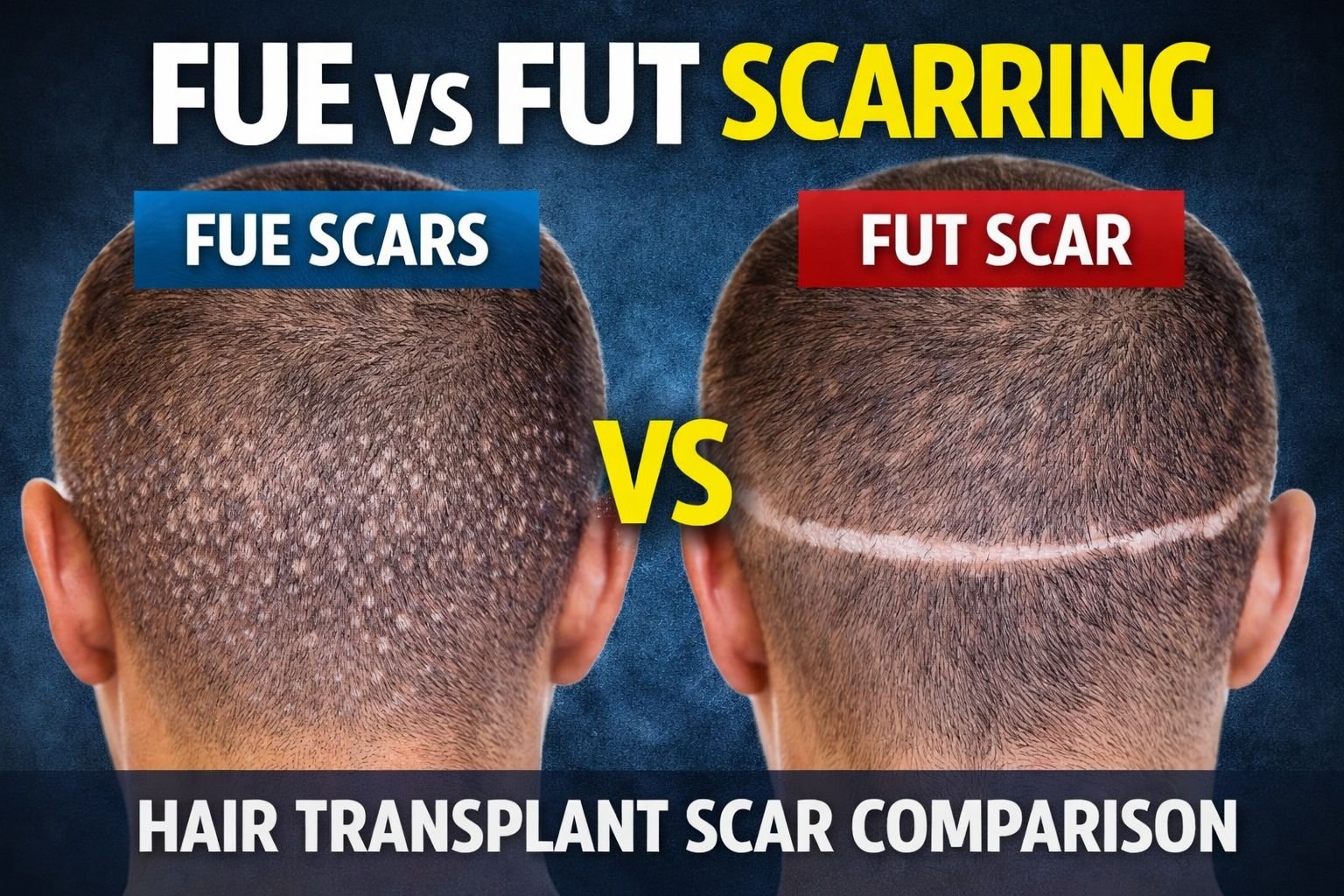
FUT leaves a single linear scar while FUE creates scattered dot scars. FUE vs FUT techniques produce permanent scarring, but the pattern, visibility, and aesthetic impact differ significantly based on your hairstyle preferences and healing characteristics.
How FUE and FUT Create Different Scar Patterns
The fundamental difference between these techniques determines their scarring patterns. FUT is a strip excision method, where surgeons remove a thin strip of tissue from the donor area and dissect it under a microscope to obtain individual hair follicles. This creates one consolidated linear scar.
FUE is not a scarless procedure, despite common misconceptions. According to the International Society of Hair Restoration Surgery, FUE harvests hair through small circular incisions over a considerably larger area of the donor zone, leaving tiny, round, white scars measuring approximately 0.7 to 0.9 mm in diameter.
The key distinction: FUT concentrates scarring into one location, while FUE distributes it across the entire harvest area. In FUT, the scarring remains in one single line even after multiple procedures. In contrast, if you undergo a second or third FUE vs FUT procedure, the dot scars from subsequent sessions are added to those from the initial procedure.
| Characteristic | FUT Scarring | FUE Scarring |
|---|---|---|
| Pattern | Single linear scar | Multiple dot scars (0.7-0.9mm each) |
| Distribution | Concentrated in one line | Scattered across donor area |
| Multiple procedures | Same linear scar location | Cumulative dot scars added |
| Visibility with short hair | Always visible when shaved | Dots blend better but still present |
| Typical length/coverage | 15-25cm horizontal line | Hundreds to thousands of dots |
Long-Term Scar Visibility Across Hairstyle Lengths
Hair length dramatically affects how noticeable transplant scars become. For most patients, FUE scars are practically invisible with medium to long hair. The randomness of FUE excisions makes them far more difficult for the human eye to detect than a single, thin line positioned in the middle of the back of your head.
According to Cooley Hair Center, FUE scars can become virtually invisible due to their smaller size. However, if you prefer a close-shaved style, faint dots might be noticeable, though modern techniques ensure they blend in well.
FUT scars typically transform into a thin line hidden beneath the surrounding hair. FUE vs FUT scars are usually very thin, about the thickness of a pencil line, and the incision is hidden under surrounding hair so the scar won’t be visible to others under normal circumstances. However, any hairstyle shorter than the length needed to cover the horizontal scar will reveal it.
| Hair Length | FUT Scar Visibility | FUE Scar Visibility |
|---|---|---|
| Long (>5cm) | Completely hidden | Completely hidden |
| Medium (2-5cm) | Hidden with proper positioning | Nearly invisible |
| Short (5mm-2cm) | May be partially visible | Minimal, scattered dots |
| Buzzed (2-5mm) | Clearly visible linear scar | Faint dots may show |
| Shaved (<2mm) | Prominent white line | Scattered white dots visible |
Clinical Complications and Healing Differences
Dermatological research reveals significant differences in postoperative complications. According to Dermatology Times, FUE vs FUT is associated with more bleeding than FUE, a greater risk for hypertrophic scarring, and carries a higher potential for patients to perceive tightness or discomfort in the postoperative period.
The strip excision in FUE vs FUT creates tension along the closure line, which can contribute to wider scars in patients with poor skin elasticity or those prone to keloid formation. FUT is not suitable for patients with very tight scalps or those who have demonstrated hypertrophic scarring from previous surgeries.
FUE typically produces less postoperative discomfort and faster recovery. The scattered micro-wounds heal independently, and according to Vinci Hair Clinic, FUE offers minimal invasiveness, natural-looking results, faster recovery time, less post-surgery discomfort, and no linear scarring.
However, FUE carries its own risks. Over-harvesting from the same donor area can create visible thinning. A proper distribution of extracted hairs throughout the area helps avoid both unbalanced thinning and visible scars, but studies have shown that extraction of more than 40% donor density results in visible scarring and a ‘moth-eaten’ appearance.
Multiple Procedure Considerations and Cumulative Scarring
The ability to undergo multiple procedures differs significantly between techniques. FUE vs FUT maintains the same linear scar location across multiple sessions. Surgeons can excise the previous scar during subsequent procedures, so you don’t accumulate additional linear scars.
FUE creates cumulative scarring challenges. FUE vs FUT new procedure adds dot scars to those already present. According to Bernstein Medical, this scarring can distort adjacent follicular units and make subsequent sessions more difficult.
The donor area becomes progressively depleted with each FUE session. Once you exceed the 40% extraction threshold across all procedures, the donor area shows visible thinning that cannot be reversed. This limits the total number of grafts available over a lifetime.
FUT generally offers higher graft yield per session. According to Vinci Hair Clinic, FUE vs FUT offers higher graft yield, with more grafts obtainable in a single session compared to FUE, making it suitable for extensive hair restoration. This can be advantageous for patients who need maximum coverage in fewer procedures.
Patient-Centered Decision Factors for Scar Management
Individual healing characteristics play a crucial role in outcomes. According to Trichogenics, factors such as the patient’s skin type, the extent of hair transplant scarring, and individual healing characteristics play a significant role in the long-term appearance of these scars.
Your lifestyle and hairstyle preferences should guide the decision. FUE is the best choice for patients who want the flexibility to wear very short hairstyles or those who engage in activities where a linear scar would be visible (swimming, athletics, military service). The scattered dot pattern remains less conspicuous even at short lengths.
FUT is not obsolete despite the popularity of FUE vs FUT. It remains the preferred option for patients requiring maximum graft yield in a single session, those with excellent skin elasticity, and individuals who consistently wear their hair at medium to long lengths. The consolidated scar is easily concealed and doesn’t limit future FUE procedures if needed.
A side-by-side clinical study comparing FUE vs FUT in the same patients found no meaningful difference in graft or hair survival, with outcomes varying slightly in both directions. The choice ultimately depends on scarring tolerance, hairstyle preferences, and the extent of restoration required rather than survival rates.
Frequently Asked Questions
Does FUE leave visible scars?
FUE leaves tiny circular scars measuring 0.7 to 0.9 mm in diameter scattered across the donor area. For most people, these scars are practically invisible, especially with medium to long hair. However, if you prefer a close-shaved style (below 2-3mm), faint dots might be noticeable. The randomness of FUE excisions makes them far more difficult to see than a linear scar.
What does a FUT scar look like long-term?
FUE vs FUT scars typically transform into a thin line about the thickness of a pencil line, hidden beneath the surrounding hair. The scar is consolidated into one single line even after multiple procedures, and remains in the same location. With proper surgical technique and healing, the linear scar can become very discrete, though it will be visible with very short haircuts or shaved heads.
Which hair transplant method has less visible scarring?
FUE generally offers less visible scarring for patients who want the flexibility to wear very short hairstyles. The scattered dot pattern is harder for the human eye to detect than a single linear scar. However, FUE can create cumulative scarring if multiple procedures are performed, as new dot scars are added to existing ones. The best choice depends on your hairstyle preferences and the extent of restoration needed.
Can FUT scars become hypertrophic or raised?
Yes, FUT carries a higher risk for hypertrophic scarring compared to FUE. According to dermatological research, FUT is associated with greater risk for hypertrophic scarring, more bleeding, and higher potential for patients to perceive tightness or discomfort in the postoperative period. Individual healing characteristics, skin type, and surgical technique all influence the final scar appearance.
How many FUE procedures can I have before scarring becomes visible?
Studies show that extraction of less than 40% donor density maintains natural hair density without visible scarring. Once more than 40% of the donor area has been extracted through multiple FUE sessions, scarring becomes visible and the area can start to look ‘moth-eaten.’ Each subsequent FUE procedure adds new dot scars to those from previous procedures, which can distort adjacent follicular units and make future sessions more difficult.
Read More: The Ultimate Winter Car Protection Checklist for UK Drivers
