


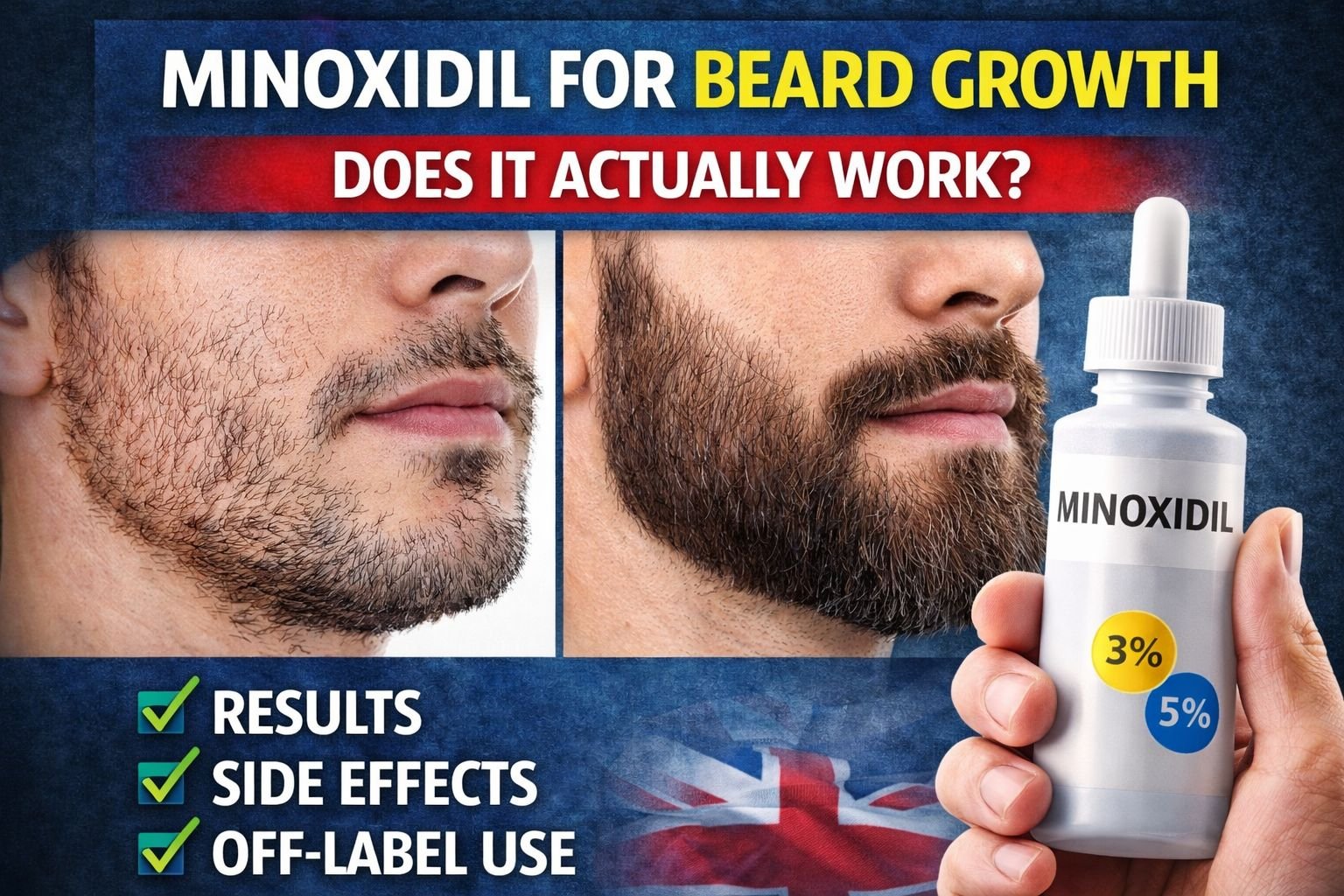
Minoxidil is a vasodilator originally developed for high blood pressure that’s now widely used off-label for Minoxidil for Beard Growth enhancement. Clinical trials show it can increase facial hair density and count when applied consistently for 16+ weeks, though it’s not licensed for this purpose and carries different risks than scalp application.
Clinical Evidence for Minoxidil on Facial Hair
The strongest evidence comes from a randomized, double masked, placebo-controlled study involving 48 Thai men who applied 3% minoxidil solution twice daily for 16 weeks. The trial demonstrated significant increases in facial hair counts compared to the placebo group.
According to research published in PMC, topical minoxidil 2% proved effective in improving facial hair growth after 3 and 6 months at both the chin and upper lip areas. The study concluded that “the application of topical minoxidil 2% was not harmful to promote facial hair growth.”
However, most research focuses on scalp hair, with only a handful of small studies examining beards specifically. According to Wimpole Clinic’s analysis, “much larger, longer-term studies are needed before we can fully understand how effective and safe minoxidil is for beard growth.”
Critical limitation: Minoxidil is not licensed for beard use in the UK, which means there’s considerably less safety data for facial application compared to scalp treatments.
| Study Parameter | Scalp Hair Research | Beard Growth Research |
|---|---|---|
| Number of clinical trials | 100+ peer-reviewed studies | 5-10 small trials |
| Largest sample size | 393 participants | 48 participants |
| Longest trial duration | 48 months | 6 months |
| Licensed indication | Yes (androgenetic alopecia) | No (off-label use) |
| Regulatory approval | FDA, MHRA approved | Not approved for facial use |
How Minoxidil Works for Beard Enhancement vs Scalp Application
Minoxidil’s mechanism for stimulating hair growth remains partially understood, but researchers believe it works by prolonging the anagen (growth) phase of the hair cycle and increasing blood flow to hair follicles. When applied to facial skin, the same biological processes occur, but with different considerations.
The key difference lies in facial skin characteristics. According to dermatology research on minoxidil for beard growth applications, facial skin is thinner and more vascular than scalp skin, which means greater systemic absorption and potentially more side effects.
For scalp application, minoxidil is typically formulated in alcohol-based solutions or foam preparations that dry quickly and minimise spread to unintended areas. When used on the face, the same formulations can cause:
- Greater absorption into the bloodstream due to thinner facial skin
- Unwanted hair growth on cheeks, forehead, or neck from solution dripping
- Increased skin irritation from contact with more sensitive facial tissue
- Higher risk of allergic contact dermatitis
Important distinction: minoxidil for beard growth for scalp hair loss treats a recognised medical condition (androgenetic alopecia), whilst beard enhancement is purely cosmetic, which affects both NHS availability and professional medical guidance.
| Application Factor | Scalp Use | Facial Use |
|---|---|---|
| Skin thickness | Thicker, less absorption | Thinner, more absorption |
| Licensed use | Yes | No (off-label) |
| NHS prescription | No (aesthetic treatment) | No (not indicated) |
| Typical concentration | 5% for men, 2% for women | 3% studied, 5% used off-label |
| Application precision | Easier to target area | Higher spread risk |
| Side effect profile | Well-documented 30+ years | Limited long-term data |
What Results Can You Realistically Expect?
Response rates vary dramatically between individuals, with genetics, age, and existing facial hair patterns playing significant roles. Clinical studies show average improvements, but your results may differ substantially.
In the Thai study, participants saw an average increase of 5.5 hairs per square centimetre after 16 weeks of twice-daily 3% minoxidil application. Whilst statistically significant, this translates to moderate visible improvement rather than transforming a completely bare face into a full beard.
Most users report three distinct phases:
- Weeks 1-8: Initial shedding of existing vellus hairs, possible skin irritation
- Weeks 8-16: New vellus hair growth becomes visible as fine, light-coloured hairs
- Months 4-12: Some vellus hairs convert to thicker terminal hairs
Reality check: Minoxidil cannot create follicles where none exist. If you have no facial hair follicles in an area due to scarring or genetics, minoxidil won’t help. It only reactivates dormant or weak follicles.
The quality of results also depends heavily on consistency. Missing applications reduces effectiveness, and stopping treatment typically causes newly grown hairs to shed within 3-6 months. Sons’ information on minoxidil emphasises that “continuous use is required to maintain results.”
| Timeline | Expected Changes | User Experience Reports |
|---|---|---|
| 0-4 weeks | Possible initial shedding, skin adjustment | Dryness, flaking common |
| 4-12 weeks | Fine vellus hair appears | Patchy coverage, uneven growth |
| 3-6 months | Vellus hairs thicken slightly | Noticeable improvement in density |
| 6-12 months | Some terminal hair conversion | Variable – some see dramatic gains, others minimal |
| 12+ months | Maintenance phase | Debate over whether results become permanent |
Risks and Side Effects Unique to Facial Application
Common side effects include facial skin dryness, peeling, redness, and contact dermatitis. These occur more frequently with facial application than scalp use due to thinner skin and higher product absorption rates.
According to Sons’ guide on minoxidil side effects, “if you experience rapid heartbeat, dizziness, chest pain, or swelling, stop using minoxidil immediately and speak to your healthcare provider.” These systemic effects result from the drug entering your bloodstream through absorption.
Less commonly discussed but particularly relevant for beard application: unwanted hypertrichosis (excessive hair growth) on areas where the solution spreads. If minoxidil drips down your neck or touches your forehead, you may develop unwanted hair in those regions.
Critical safety note: minoxidil for beard growth is extremely toxic to cats. If you have feline companions, wash your hands thoroughly after application and avoid letting them lick your face during treatment hours.
The alcohol content in most minoxidil solutions (typically 30-50%) also causes irritation, particularly on recently shaved skin. Many users report burning sensations, especially during the first few weeks.
Long-term facial use data remains limited. Since beard application is off-label, there are no multi-year safety studies specifically examining this use case. The NHS doesn’t prescribe it for beard growth partly due to this lack of comprehensive safety data.
| Side Effect | Frequency | Severity | Management Strategy |
|---|---|---|---|
| Skin dryness/flaking | Very common (40-60%) | Mild | Moisturiser after solution dries |
| Facial redness | Common (20-30%) | Mild-Moderate | Reduce to once daily application |
| Contact dermatitis | Occasional (5-10%) | Moderate | Switch to foam formulation or discontinue |
| Unwanted hair spread | Occasional (5-15%) | Mild-Moderate | Careful application, wash hands immediately |
| Rapid heartbeat | Rare (<2%) | Serious | Discontinue immediately, seek medical advice |
| Dizziness/chest pain | Very rare (<1%) | Serious | Emergency medical attention |
Alternatives and Combination Approaches
Several alternatives exist, though none have the clinical backing of minoxidil for beard enhancement. Beard growth supplements containing biotin, vitamins, and minerals are widely marketed but lack robust scientific evidence for facial hair specifically.
Microneedling combined with minoxidil for beard growth shows promise in early research, with the theory that creating micro-injuries in facial skin enhances absorption and stimulates follicles through the wound-healing response. However, this approach increases side effect risks and requires proper sterilisation techniques.
According to research on redensyl versus minoxidil, some newer ingredients claim to stimulate hair growth through different mechanisms. Redensyl, a patented blend of molecules, targets stem cells in hair follicles but has minimal independent clinical research for beard application.
Hormone-based approaches (like testosterone supplementation) are occasionally discussed online but carry significant health risks and should never be attempted without medical supervision. Low testosterone is not typically the cause of patchy beards in otherwise healthy men.
The most evidence-based approach remains:
- Topical minoxidil 3-5% applied consistently for 12+ months
- Patience and realistic expectations
- Monitoring for side effects
- Professional medical consultation before starting
For those seeking hair growth support through nutrition, products like beard growth supplements may complement minoxidil but shouldn’t replace it if you’re aiming for clinically-backed results.
Should You Try Minoxidil for Your Beard?
The decision depends on your expectations, patience, and willingness to accept potential side effects for a cosmetic outcome. Minoxidil for beard growth is a viable option backed by limited but positive clinical evidence, though it’s not a guaranteed solution.
Consider minoxidil if you:
- Have patchy areas with existing follicles that aren’t producing terminal hair
- Can commit to twice-daily application for at least 6-12 months
- Understand this is off-label use with limited long-term safety data
- Accept that results vary and discontinuation may cause hair loss
Avoid minoxidil if you:
- Have sensitive skin or existing facial dermatitis
- Take medications that interact with minoxidil (check with your GP)
- Have cardiovascular conditions that may worsen with vasodilators
- Live with cats (toxicity risk)
- Expect dramatic transformation in weeks
According to UK guidance, you can’t get minoxidil for beard growth on the NHS for beard growth as it’s classified as an aesthetic treatment. However, it’s available over-the-counter from pharmacies and online suppliers without a prescription.
Bottom line: Speak to a clinician before using minoxidil off-label on your beard, especially if you have existing health conditions or take other medications. Whilst the evidence suggests it can work for beard enhancement, individual results vary dramatically, and the treatment requires significant time commitment with no guarantee of success.
Read More: FUE vs FUT: Understanding Scarring and Long-Term Aesthetic Outcomes
Frequently Asked Questions
How long does minoxidil take to work on beard growth?
Most clinical trials show noticeable improvements in beard density after 16 weeks of consistent twice-daily application. However, some users report seeing initial vellus hair growth (fine, light hairs) within 6-8 weeks. Full results typically require 6-12 months of continuous use, and stopping application may cause newly grown hairs to shed.
Is 3% or 5% minoxidil better for beard growth?
Clinical studies on facial hair specifically used 3% minoxidil with positive results. Whilst 5% concentration is more commonly available for scalp hair loss, there’s limited research comparing the two strengths for beard application. Higher concentrations may increase the risk of side effects like facial skin irritation and unwanted hair growth on adjacent areas like cheeks or forehead.
Can minoxidil cause permanent beard growth?
Some users report that beard hairs grown with minoxidil for beard growth become permanent terminal hairs after 12-24 months of use, allowing them to stop application without losing gains. However, this isn’t clinically proven, and results vary significantly between individuals based on genetics, age, and hormonal factors. Many dermatologists recommend continuing application to maintain results.
What are the side effects of using minoxidil on facial hair?
Common side effects include facial skin dryness, flaking, redness, and irritation at the application site. Some users experience unwanted hair growth on adjacent facial areas where the solution spreads. Less common but more serious effects can include rapid heartbeat, dizziness, chest pain, or swelling due to systemic absorption. If you experience these symptoms, stop use immediately and consult a healthcare provider.
Is using minoxidil for beard growth legal in the UK?
Yes, using minoxidil for beard growth is legal in the UK. Topical minoxidil for beard growth is available over-the-counter without a prescription. However, it’s licensed only for scalp hair loss, meaning beard application is considered off-label use. The NHS won’t prescribe it for beard growth as it’s classified as an aesthetic treatment rather than a medical necessity, but you can purchase it from pharmacies or online retailers.
Read More: 5 Evidence Based Ways to Fade Hyperpigmentation Treatment Faster
