


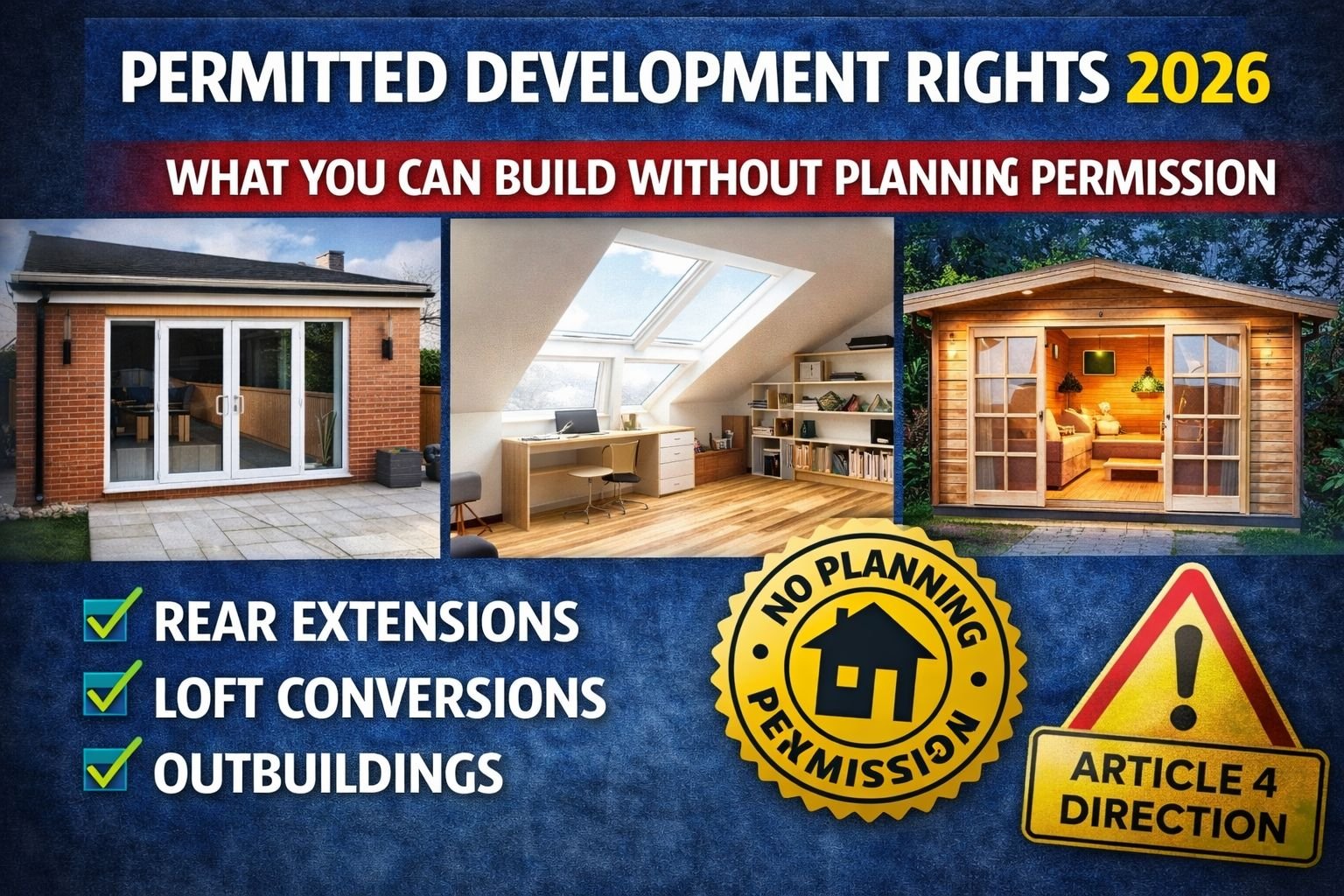
Permitted development rights allow homeowners to extend their properties without planning permission, subject to specific size and position limits. Permitted development is a streamlined planning process that covers single-storey rear extensions, loft conversions, and certain outbuildings. Permitted development isn’t a complete exemption from regulation—projects must still comply with building regulations and may require prior approval.
Understanding Permitted Development Rights in 2026
Permitted development rights are set out in Schedule 2 of the General Permitted Development Order and entitle homeowners to make reasonable improvements to their properties without submitting a full planning application. According to the HomeOwners Alliance, these rights cover common home improvement projects such as extensions, loft conversions, and solar panel installations.
The system exists to reduce bureaucracy for straightforward residential projects while maintaining planning controls for more significant developments. However, the rules are complex and subject to numerous conditions based on property type, location, and existing site coverage.
While the government proposed changes to permitted development rights in 2024—including removing the 50% curtilage limit and allowing unlimited loft space conversions—no final decisions have been announced as of February 2026. According to House of Commons Library research, the government continues to keep permitted development rights under review but has made no substantive changes beyond a minor 2025 amendment to electric vehicle charging regulations.
Rear Extension Size Limits and Prior Approval Requirements
The most common use of permitted development rights involves single-storey rear extensions. The maximum depth depends on your property type: detached houses can extend up to 8 metres from the original rear wall, while semi-detached, terraced, and other houses are limited to 6 metres.
However, these maximum depths trigger prior approval requirements. According to DeVis Architecture, any rear extension exceeding 4 metres for detached properties or 3 metres for other properties requires a prior approval application, which involves consulting neighbouring properties. This process typically takes 6 weeks and gives neighbours the opportunity to raise concerns about loss of light or privacy.
| Property Type | Standard Limit (No Prior Approval) | Maximum with Prior Approval |
|---|---|---|
| Detached house | 4 metres | 8 metres |
| Semi-detached house | 3 metres | 6 metres |
| Terraced house | 3 metres | 6 metres |
| Other house types | 3 metres | 6 metres |
Height restrictions also apply to rear extensions built under permitted development. The maximum height is 4 metres for pitched roofs or 3 metres for flat roofs. Where the extension is within 2 metres of a boundary, eaves are typically limited to 2.5 metres in height. These measurements are taken from ground level at the point where the extension meets the existing building.
All measurements are taken from the “original rear wall” of the house, not the current rear wall if previous extensions exist. This is a crucial distinction that catches many homeowners by surprise when planning their projects.
London Specific Restrictions and Article 4 Directions
London homeowners face additional restrictions on permitted development rights due to the prevalence of conservation areas and Article 4 directions. An Article 4 direction is a planning tool that enables local authorities to remove specific permitted development rights across defined areas.
According to the Planning Portal, Article 4 directions are most common in conservation areas where the character of an area would be threatened by unrestricted development. The National Planning Policy Framework advises that Article 4 directions should be applied in a measured way and based on robust evidence.
Several London boroughs have implemented extensive Article 4 directions. Islington Council has removed permitted development rights in 40 of its 42 conservation areas, requiring planning permission for minor alterations including changing external doors and windows or painting brickwork. The City of London has adopted an Article 4 direction removing the right to convert offices to residential use across the entire Square Mile.
| London Borough Example | Area Covered | Rights Removed |
|---|---|---|
| Islington | 40 conservation areas | Minor external alterations |
| Waltham Forest | Town centres & employment areas | Office to residential conversion |
| City of London | Entire Square Mile | Office to residential conversion |
To determine whether an Article 4 direction affects your property, contact your local planning authority or consult with a planning specialist familiar with London restrictions. Proceeding with development work in an area covered by an Article 4 direction without obtaining planning permission can result in enforcement action and costly remediation.
Flats and maisonettes never qualify for permitted development rights for extensions, regardless of location. This is a blanket exclusion that applies across England.
Common Permitted Development Misconceptions and Mistakes
The most prevalent misconception about permitted development is that it represents a “free pass” for home extensions. In reality, permitted development comes with strict limitations and conditions that must be met for the rights to apply. According to Compact Building, many homeowners wrongly assume their project doesn’t require planning permission when Article 4 directions or other restrictions apply.
The 50% curtilage rule is one of the most frequently misunderstood aspects of permitted development. This rule states that extensions and outbuildings cannot cover more than 50% of the land surrounding the original house. Crucially, this calculation includes all previous extensions, conservatories, sheds, and outbuildings—not just your current proposal. According to Planning By Design, ignoring the curtilage rule is one of the biggest mistakes homeowners make and can lead to enforcement notices requiring removal of the extension.
Another common error involves measurement points. Rear extension depth is always measured from the original rear wall of the house, not from any subsequent extensions. Bay windows count as part of the original rear wall, pushing the measurement point forward. This means if your house originally had a bay window and you’ve since added a small extension, your new extension is measured from the bay window, not from the later addition.
Homeowners also frequently confuse permitted development rights with building regulations approval. Permitted development is a planning exemption that determines whether you need planning permission. Building regulations approval isn’t automatically granted when you have permitted development rights—it’s a separate legal requirement covering structural safety, insulation, drainage, and fire safety. Even if your project qualifies for permitted development, you must still obtain building regulations approval before construction begins.
The proposed 2026 changes to permitted development rights, which were widely discussed in 2024, have not been implemented. According to GOV.UK consultation documents, the government consulted on removing the 50% curtilage restriction and allowing unlimited loft conversions, but no final decisions have been announced. Homeowners should not assume these proposed changes are in effect.
Listed buildings are always excluded from permitted development rights. If you live in a listed building, you must apply for listed building consent for virtually all alterations, both internal and external. This is a blanket exclusion that applies regardless of the scale of the work.
Side Extensions and Additional Permitted Development Allowances
Side extensions fall under permitted development rights but are subject to more restrictive conditions than rear extensions. Side extensions must be single-storey and cannot exceed 4 metres in height. The width is limited to no more than half the width of the original house, ensuring that side extensions don’t dominate the street scene.
Where a side extension is within 7 metres of a boundary facing a highway, additional restrictions apply. In these cases, the extension cannot extend beyond the building line formed by the principal elevation of the original house. This prevents side extensions from protruding forward and affecting the street character.
Ground coverage rules apply to side extensions in the same way as rear extensions. All extensions, outbuildings, and hard surfacing must not cover more than 50% of the curtilage of the original house. This cumulative calculation often surprises homeowners who have gradually developed their properties over time with multiple smaller projects.
Loft conversions also benefit from permitted development rights, provided specific volume limits are met. According to the Planning Portal guidance, terraced houses can add up to 40 cubic metres of additional space, while detached and semi-detached houses can add up to 50 cubic metres. These volume allowances include any enlargement to the roof, such as dormer windows.
| Extension Type | Maximum Size | Key Restrictions |
|---|---|---|
| Side extension | 4m height | Cannot exceed 50% of original house width |
| Loft conversion (terraced) | 40 cubic metres | No higher than highest point of existing roof |
| Loft conversion (other) | 50 cubic metres | No higher than highest point of existing roof |
| Outbuilding | 4m height (pitched roof) | Must be 2m from boundaries if over 2.5m high |
For homeowners planning substantial extensions that combine rear and side elements—commonly known as wrap-around extensions—permitted development rights may still apply if each component individually meets the criteria. However, professional advice from experienced extension specialists is strongly recommended for complex projects to avoid enforcement issues.
Outbuildings such as garden rooms, sheds, and summer houses can be built under permitted development, but they must be genuinely incidental to the enjoyment of the main house and not used as independent living accommodation. Where outbuildings exceed 2.5 metres in height, they must be positioned at least 2 metres from any boundary to qualify for permitted development rights.
Protecting Your Investment with Lawful Development Certificates
While permitted development rights mean you don’t need to apply for planning permission, obtaining formal confirmation of your rights provides valuable protection. A Lawful Development Certificate (LDC) is a formal document issued by your local planning authority confirming that a proposed development is lawful and complies with permitted development requirements.
Applying for an LDC before construction begins offers several important benefits. First, it provides certainty that your project meets all the relevant criteria and won’t face enforcement action. Second, it creates a permanent record of approval that will be valuable when you come to sell your property, as buyers and mortgage lenders often require proof that extensions were built lawfully.
The LDC application process involves submitting detailed plans and specifications to your local planning authority, which then has 8 weeks to determine the application. According to the Federation of Master Builders, the application fee is typically lower than for full planning permission, but the level of scrutiny is similar. If the authority doesn’t respond within the statutory period, the certificate is deemed to be granted.
If you proceed without an LDC and your extension doesn’t actually meet permitted development criteria, you face several potential consequences. The local authority can issue an enforcement notice requiring you to remove the extension or apply for retrospective planning permission. Retrospective applications have lower success rates than applications submitted before construction, and the costs of removal and rebuilding can be substantial.
For properties in conservation areas, designated areas, or locations where Article 4 directions apply, obtaining professional advice is particularly important. The rules become more complex in these situations, and the consequences of getting it wrong are more severe. Many London homeowners choose to work with architects and planning consultants who specialize in navigating these local restrictions.
Building regulations approval remains mandatory regardless of whether you obtain an LDC. The building control process runs parallel to planning considerations and covers structural calculations, thermal performance, drainage design, and fire safety measures. Local authority building control or approved inspectors must inspect the work at key stages throughout construction to ensure compliance.
Frequently Asked Questions
What is permitted development in 2026?
Permitted development rights are national planning regulations that allow homeowners to extend or renovate their homes without submitting a full planning application. These rights are set out in Schedule 2 of the General Permitted Development Order and cover common projects including rear extensions, loft conversions, and the installation of solar panels. However, strict size, height, and position limits apply to all permitted development projects.
How big can my rear extension be under permitted development?
Under permitted development rights, detached houses can build rear extensions up to 8 metres deep, while semi-detached, terraced, and other houses are limited to 6 metres. However, any extension longer than 4 metres for detached homes or 3 metres for other property types requires prior approval, which involves consulting your neighbours. The extension must also be single-storey with a maximum height of 4 metres for pitched roofs or 3 metres for flat roofs.
Do Article 4 directions affect permitted development rights in London?
Yes, Article 4 directions can remove permitted development rights in specific areas. Many London boroughs have implemented Article 4 directions in conservation areas and designated zones to protect historic streetscapes and control overdevelopment. For example, Islington has removed permitted development rights in 40 of its 42 conservation areas. You should always check with your local planning authority to determine if an Article 4 direction applies to your property.
What is the 50% curtilage rule for permitted development?
The 50% curtilage rule states that any extension built under permitted development cannot cover more than 50% of the land surrounding the original house (known as curtilage). This measurement includes all previous extensions and outbuildings, not just your planned project. This is one of the most commonly misunderstood aspects of permitted development and can cause enforcement issues if ignored.
Were there any changes to permitted development rights in 2026?
The government proposed significant changes to permitted development rights in a 2024 consultation, including removing the 50% curtilage limit and allowing unlimited loft conversions. However, as of February 2026, the government has not announced any final decisions on these proposals. The only recent change was a 2025 amendment to Class D of Part 2, which updated rules for electrical vehicle charging outlets. Homeowners should continue following the existing permitted development guidelines until official changes are announced.
Read More: 7 Apartment Building Security Trends Property Managers Can’t Ignore in 2026
