


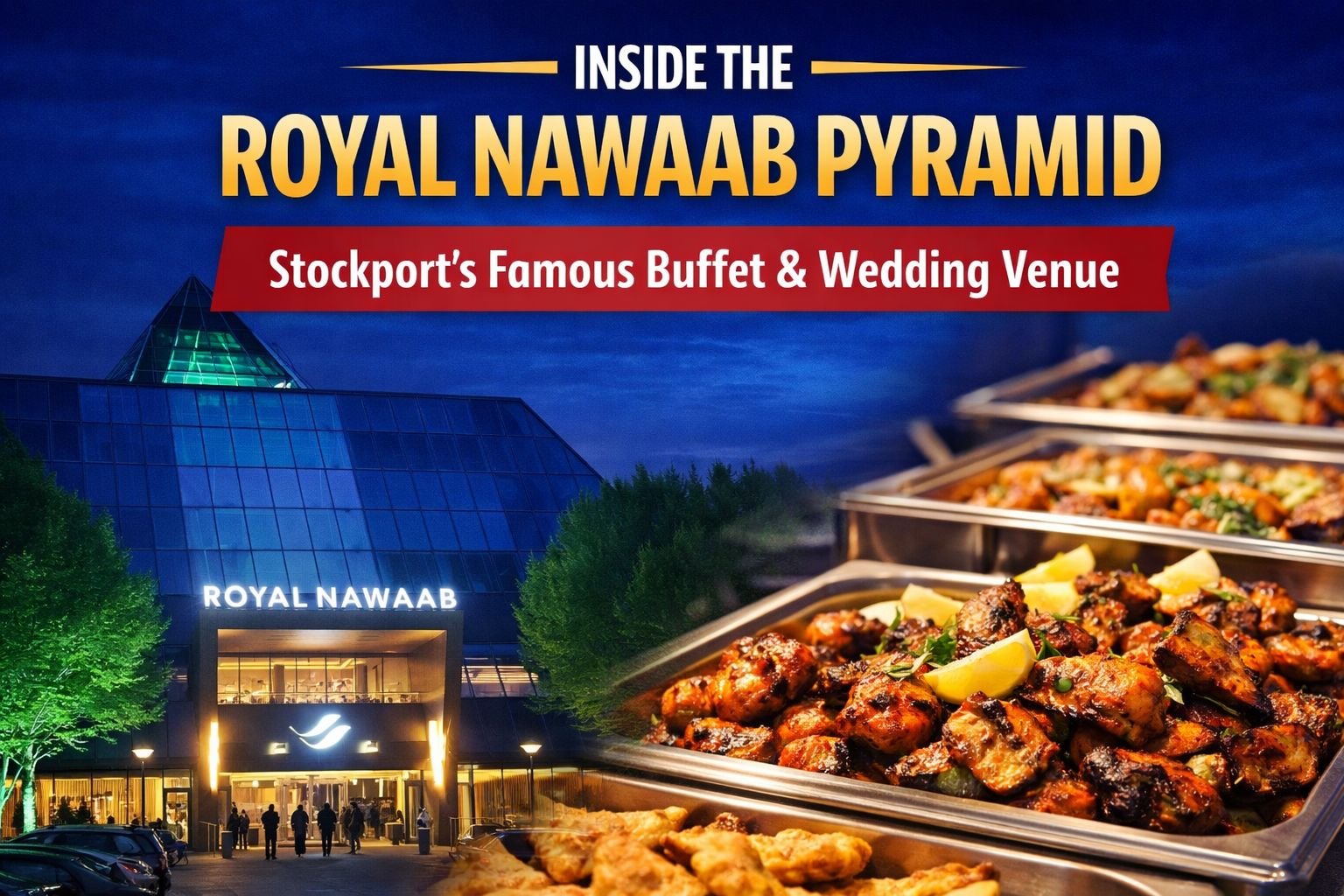
Most nights, drivers passing the M60 near Kings Valley notice the same thing. The famous glass structure that once housed office workers now glows across the skyline, lit in gold and blue as cars steadily pull into the car park below.
Inside, Royal Nawaab Pyramid is serving what may be the most talked-about South Asian buffet in Greater Manchester. Hundreds of diners move between the counters on busy evenings, plates stacked with grills, curries and desserts as families settle in for long celebratory meals.
For years the pyramid stood largely unused after corporate tenants moved out. Today it has been reborn as a vast dining and events venue, drawing visitors from across the city region who want to see what a grand buffet inside one of Stockport’s most unusual buildings actually feels like.
The story behind Royal Nawaab Pyramid
The name Royal Nawaab Pyramid was already familiar to many Manchester diners before the glass landmark reopened. The Royal Nawaab brand built its reputation through large banqueting restaurants serving South Asian buffet dining to families and community groups across the region.
Taking over the Stockport Pyramid changed the scale of that idea dramatically.
The building itself has been part of the local skyline since the early 1990s, when it originally opened as a corporate office complex beside the M60. Its striking glass shape made it one of the most recognisable buildings in Greater Manchester, but after offices moved elsewhere it sat quiet for years.
The transformation into Royal Nawaab Pyramid has brought the site back to life. Inside, office floors have been replaced with large dining halls, grand staircases and banqueting spaces capable of hosting hundreds of guests.
For locals who drove past the empty building for years, the change has been hard to miss.
What the experience is actually like
Arriving at Royal Nawaab Pyramid feels more like pulling up outside a hotel or wedding venue than a typical restaurant.
On busy evenings the car park fills quickly with families arriving for birthday dinners, couples celebrating anniversaries and large groups meeting for a night out. Pushchairs, balloons and gift bags appear as guests make their way towards the entrance.
Inside, a reception area manages the steady flow of diners. Staff move through reservation lists while walk-ins wait along the glass walls, especially on Friday and Saturday nights.
Once you step into the main dining hall, the scale becomes clear. Chandeliers hang above long rows of tables while diners move constantly between seats and buffet counters.
The atmosphere is lively rather than quiet. Children weave between chairs, relatives compare dishes and staff circulate with fresh plates and jugs of water.
At peak times it can feel hectic, but that energy is part of the appeal. Royal Nawaab Pyramid is built for big gatherings rather than quiet dinners.
Inside the buffet at Royal Nawaab Pyramid
The centre of attention inside Royal Nawaab Pyramid is the buffet itself. Long counters stretch through the dining area, stocked with starters, grills, curries, rice dishes and desserts.
The layout encourages diners to return multiple times. Most people start with lighter dishes before gradually building a full plate of grilled meats and rich curries.
Starters are often the most popular section. Fresh batches of pakoras, samosas, spicy chicken wings and seekh kebabs appear regularly, disappearing quickly as diners keep an eye on the counters for newly filled trays.
The main dishes reflect the restaurant’s South Asian roots, with a range of North Indian and Pakistani-inspired recipes.
Typical options include:
- Chicken tikka and grilled kebabs
- Lamb and chicken curry dishes
- Biryani and pilau rice
- Lentil and vegetable curries
- Fresh naan and breads
Because Royal Nawaab Pyramid operates as a buffet, diners are free to mix and match different dishes rather than committing to a single curry.
On busy evenings the kitchen works continuously to refill trays. When cooking for hundreds of people at once, some dishes inevitably vary slightly from batch to batch, but the variety is part of what keeps visitors returning.
Read More: Salt and Pepper Manchester: From Arndale Stall to City Centre Favourite
Desserts and finishing touches
Desserts are another reason many diners leave room for a final trip to the counter.
Traditional sweets such as jalebi and kheer sit alongside cakes, ice cream and chocolate sauces. Children often make the dessert section their first stop before eventually returning with another plate later in the evening.
Tea and soft drinks help round off the meal as families settle back into conversation.
For groups celebrating birthdays or special occasions, the relaxed buffet format means nobody feels rushed. Tables often stay occupied for a long time as guests eat, chat and make several trips back to the counters.
Why Royal Nawaab Pyramid is becoming a Manchester food landmark
It has not taken long for Royal Nawaab Pyramid to become a talking point across Greater Manchester.
Part of that attention comes from the building itself. The glass pyramid beside the motorway has always stood out, but now it has a new identity that people associate with weddings, family dinners and large celebrations.
The venue’s upper floors hold large banqueting halls designed for weddings and community events. Stages, decorative lighting and flower displays regularly transform the space for celebrations.
Among many British Asian families in Manchester, invitations to weddings “at the pyramid” have quickly become a familiar phrase.
The restaurant also draws large crowds during Ramadan and around Eid, when families gather for communal meals and evening celebrations.
Visitors often travel from across the region, including Oldham, Rochdale, Bolton and south Manchester, turning Royal Nawaab Pyramid into a destination restaurant rather than a casual neighbourhood stop.
Location and accessibility
Although commonly associated with Manchester’s dining scene, Royal Nawaab Pyramid sits within Stockport’s Kings Valley development near the M60 motorway.
For drivers it is straightforward to reach, with the glass structure visible from the motorway and nearby slip roads leading directly to the site.
Public transport options are available through nearby bus routes, while taxis frequently arrive and depart throughout the evening.
The location adds to the sense of occasion. Unlike restaurants along the Curry Mile in Rusholme, Royal Nawaab Pyramid is somewhere diners deliberately travel to rather than simply passing by.
Final thoughts
Royal Nawaab Pyramid is not designed to be a quiet, candlelit curry restaurant.
It is loud, busy and unapologetically large. Hundreds of diners share the space on peak nights, and the atmosphere often feels closer to a celebration than a typical dinner service.
But that scale is exactly what makes it memorable. A glass pyramid beside the motorway now filled with families, wedding guests and buffet counters has turned a dormant landmark into one of Greater Manchester’s most talked-about dining venues.
Whether people arrive out of curiosity or for a major family celebration, Royal Nawaab Pyramid has already secured its place on the region’s food map.
And for anyone driving past the M60 at night, the glowing pyramid now offers a very different sight from the silent office building it once was.
Read More: Joe and the Juice Manchester: How the Scandi Chain Is Reshaping the City Centre Café Rush
