


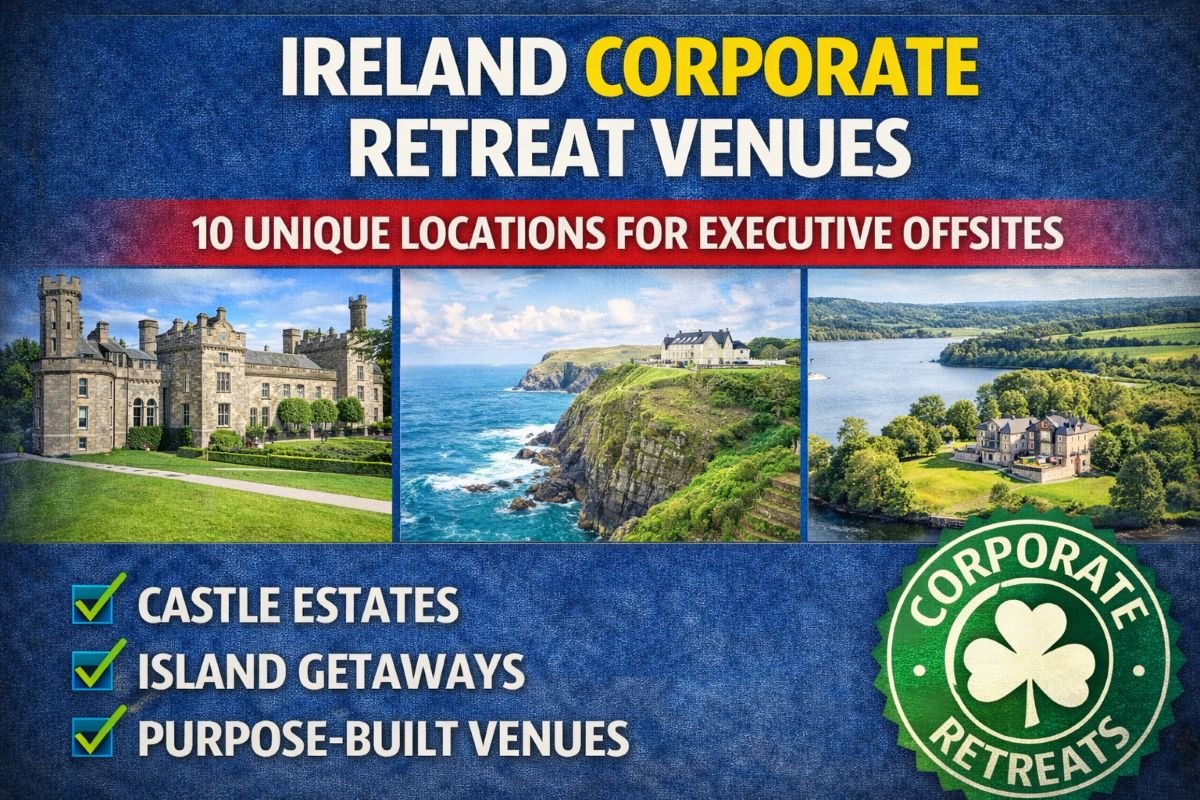
Corporate retreats aren’t about boardrooms and PowerPoints anymore. Today’s most effective strategic sessions happen in environments that inspire fresh thinking, encourage collaboration, and create memorable experiences. Ireland offers a distinctive alternative to conventional conference centres with venues that blend authentic heritage, natural landscapes, and modern business facilities. These locations provide the infrastructure needed for productive work sessions while offering the cultural immersion that transforms a standard offsite into a strategic milestone.
Why Ireland Stands Out for Corporate Retreats
Ireland’s corporate retreat market has evolved significantly in recent years. According to the global MICE market analysis, Europe dominated the MICE market with a 51.71% market share in 2025, with the meetings segment accounting for 63.12% of total market activity. Ireland’s position within this landscape is strengthened by its accessibility, English-speaking workforce, and unique blend of modern infrastructure with authentic cultural experiences.
The country’s retreat venues offer more than scenic backdrops. Strategic planners are increasingly seeking incentive travel destinations in Ireland that provide dedicated facilities for executive sessions, breakout rooms for team workshops, and outdoor spaces for experiential team-building activities. Ireland delivers all three while maintaining the intimacy and exclusivity that larger conference centres cannot match.
Research from industry analysts indicates that corporate retreats planned 3-6 months in advance achieve higher engagement rates, with exclusive-use venues showing particularly strong results for executive strategy sessions. This isn’t about escaping the office; it is about creating an environment where strategic thinking flourishes.
What Makes a Corporate Retreat Venue Strategic
| Facility Type | Strategic Benefit | Ireland Advantage |
|---|---|---|
| Exclusive-use estates | Complete privacy for sensitive strategy discussions | 500-1,000 acre private estates available |
| Historic properties | Memorable environment that reinforces company culture | 15th-18th century castles with modern AV infrastructure |
| Coastal locations | Natural environment proven to enhance creative thinking | Wild Atlantic Way coastline accessible within 3 hours from Dublin |
| Boutique hotels | Intimate settings for executive teams under 50 people | Family-run properties with personalised service |
Ireland’s retreat venues aren’t generic event spaces. They are purpose-built environments where the setting itself becomes part of the strategic process.
1. Luttrellstown Castle: 567 Acres of Executive Privacy
Luttrellstown Castle operates on a strict exclusive-use basis, which isn’t just a luxury feature but a strategic necessity for C-level retreats. This 15th-century castle spans 567 acres of private parkland just 30 minutes from Dublin Airport, providing immediate accessibility without compromising seclusion.
The venue accommodates up to 40 overnight guests across the main castle and estate cottages. According to venue specialists at Celtic Castles, the property features dedicated boardroom facilities with integrated AV systems, breakout spaces in restored Georgian rooms, and outdoor team-building options including archery, clay shooting, and falconry.
What sets Luttrellstown apart: Full property exclusivity means your executive team isn’t sharing dining spaces or overhearing competitor conversations in hallways. The castle’s layout naturally creates informal networking spaces in the library, billiards room, and various drawing rooms where strategic conversations continue beyond formal sessions.
Strategic use case: Board level strategy sessions requiring absolute confidentiality, executive team off-sites for companies with 25-40 senior leaders, or high-value client entertainment combined with strategic planning.
2. Lough Rynn Castle: Purpose Built Conference Infrastructure
While many Irish castles have retrofitted modern facilities into historic spaces, Lough Rynn Castle was designed with corporate events as a core function. The estate features a purpose-built conference centre integrated within 19th-century architecture, providing 14 meeting rooms ranging from intimate boardrooms for 8 people to a 220-capacity main hall.
The venue’s position on the shores of Lough Rynn provides natural break-out spaces for walking meetings, a practice increasingly recognised by organisational psychologists for enhancing creative problem-solving. Research from AWD Group highlights that executives report higher engagement in venues offering both formal meeting infrastructure and natural outdoor environments.
Facility specifications:
- 82 guest rooms with business-grade WiFi
- 14 configurable meeting spaces
- Dedicated breakout zones with charging stations
- 500-acre estate for outdoor team activities
- On-site spa for post-session relaxation
Strategic use case: Multi-day strategy sessions for teams of 50-100 people, departmental off-sites requiring parallel breakout sessions, or annual leadership conferences combining keynote presentations with workshop sessions.
Comparing Ireland’s Castle Retreat Venues
| Venue | Capacity | Meeting Spaces | Unique Feature | Best For |
|---|---|---|---|---|
| Luttrellstown Castle | 40 overnight | 5 formal spaces | Exclusive-use only | Executive confidentiality |
| Lough Rynn Castle | 164 guests | 14 meeting rooms | Purpose-built conference centre | Large-scale strategic planning |
| Markree Castle | 60 guests | 3 main rooms | 500-acre private estate | Mid-size team retreats |
| Ballinlough Castle | 25 guests | 2 formal spaces | 17th-century family estate | Intimate executive sessions |
3. Ballintubbert House: Sustainability Meets Strategy
Corporate retreat venues are increasingly evaluated on environmental credentials, not just meeting room specifications. Ballintubbert House positions itself as Ireland’s leading sustainable corporate retreat venue, appealing to organisations where environmental values align with business strategy.
The estate operates on regenerative agriculture principles across its working farm, sources 80% of dining ingredients from the property itself, and maintains carbon-neutral operations through renewable energy and offsetting programmes. According to Ballintubbert’s corporate retreat programme, companies report that the sustainability focus creates natural conversation starters about organisational values and long-term thinking.
What this isn’t: This is not a greenwashing exercise or a rustic retreat without modern amenities. The venue provides full business infrastructure including high-speed connectivity, presentation equipment, and climate-controlled meeting spaces. The sustainability aspect is about operational practice, not compromised functionality.
Strategic use case: Companies developing sustainability strategies, ESG-focused leadership teams, organisations seeking to align retreat choices with public environmental commitments, or businesses in industries facing climate-related disruption.
4. Cliff at Lyons: Culinary-Focused Strategy Sessions
Executive decision-making is influenced by more factors than meeting room layouts and PowerPoint presentations. According to behavioural research, shared dining experiences create stronger team cohesion than formal team-building exercises. Cliff at Lyons leverages this principle through its partnership with Michelin-level culinary teams and integration with Orangeworks team-building programmes.
The venue sits in Kildare countryside, 40 minutes from Dublin, across a restored 18th-century canal-side village. Rather than a single building, the property consists of interconnected historic structures including mill buildings, workers’ cottages, and manor houses. This creates natural separation between meeting spaces, dining areas, and accommodation.
Culinary integration isn’t superficial:
- Farm-to-table ingredient sourcing creates discussion points around supply chains and local economies
- Chef-led team challenges function as practical exercises in delegation, time management, and creative problem-solving
- Multi-course dining formats extend strategic conversations beyond formal sessions
- Whiskey tastings and food pairings create informal networking opportunities
Strategic use case: Sales team retreats where relationship-building matters as much as strategy, client entertainment combined with strategic planning, or creative industry teams where inspiration and ideation are primary retreat objectives.
5. The Wicklow Escape: Adventure-Based Strategic Thinking
Traditional corporate retreats separate business sessions from leisure activities with a clear schedule: morning meetings, afternoon team-building, evening socialising. The Wicklow Escape integrates these elements through adventure-based learning methodologies where strategic challenges are embedded within outdoor activities.
Nestled in Wicklow Mountains National Park, according to The Wicklow Escape’s corporate programme, the venue specialises in combining outdoor expeditions with facilitated strategic discussions. Navigation challenges become exercises in decision-making under uncertainty. Summit hikes incorporate stop-points for strategy sessions with natural landscapes as the backdrop.
This isn’t team-building theatre: Activities are designed by organisational psychologists to mirror real business challenges. Groups navigate uncertain terrain with incomplete information, make resource allocation decisions under time pressure, and adapt plans when conditions change. The outdoor context removes corporate hierarchy signifiers, encouraging more authentic communication.
Strategic use case: Technology companies and startups familiar with agile methodologies, sales organisations focused on competitive strategy, or leadership teams addressing change management and organisational resilience.
6. Lyrath Estate: Scale and Flexibility Combined
Some corporate retreats require the capacity to host 100+ participants across multiple tracks while maintaining the intimacy of smaller breakout sessions. Lyrath Estate in Kilkenny addresses this challenge through its 170-acre campus design, 141-room capacity, and 16 configurable meeting spaces.
According to venue analysis from Perk UK’s Ireland retreat guide, Lyrath Estate excels at multi-department company events where different teams require parallel sessions before regrouping for all-hands sessions. The estate’s layout allows simultaneous activities without interference: executive sessions in the boardroom, department breakouts in smaller meeting rooms, and outdoor team challenges on the estate grounds.
Infrastructure specifications:
- 16 meeting rooms with independent AV systems
- 450-capacity ballroom for keynote sessions
- 170-acre grounds including formal gardens and woodland trails
- On-site spa and leisure facilities
- 90-minute drive from Dublin or Cork airports
Strategic use case: Annual company retreats for organisations with 75-150 employees, multi-division strategy sessions requiring parallel tracks, or industry association conferences seeking boutique venue atmosphere with convention-centre capacity.
Meeting Space Configuration Options
| Space Type | Capacity Range | Optimal Use | Ireland Venue Examples |
|---|---|---|---|
| Boardroom | 8-16 people | Executive strategy, sensitive discussions | Luttrellstown, Ballintubbert |
| Breakout rooms | 12-30 people | Department sessions, workshop groups | Lough Rynn, Lyrath Estate |
| Theatre-style | 50-200 people | Keynote presentations, all-hands meetings | Lyrath Estate, Lough Rynn |
| U-shape | 20-40 people | Interactive sessions, training | Cliff at Lyons, Wicklow Escape |
7. Ballygarry Estate: Wellness-Integrated Retreats
Executive burnout is a strategic risk, not just an HR concern. According to workplace psychology research, retreats that integrate wellness elements alongside business sessions report higher post-retreat productivity than purely work-focused events. Ballygarry Estate in County Kerry builds wellness integration into its corporate retreat model through spa facilities, mindfulness programmes, and structured corporate wellness packages.
The venue isn’t a spa resort with meeting rooms added as an afterthought. It is a purpose-designed corporate retreat centre where wellness facilities support business objectives. Morning yoga sessions prepare teams for focused strategy work. Afternoon spa treatments create natural break periods that research shows improve information retention. Evening mindfulness sessions decompress high-intensity planning days.
Wellness integration serves strategic purposes:
- Reduced decision fatigue through structured break periods
- Improved team cohesion through shared wellness experiences
- Demonstrated organisational commitment to employee wellbeing
- Enhanced creative thinking through stress reduction
Strategic use case: Companies addressing workplace stress and retention issues, organisations in high-pressure industries seeking to model healthy work practices, or leadership teams planning intensive multi-day strategy sessions requiring sustained focus.
8. Markree Castle: Historic Intimacy for Executive Teams
Not every corporate retreat requires 100 participants and conference hall infrastructure. Executive teams of 15-30 senior leaders often achieve better strategic outcomes in intimate settings where every participant contributes meaningfully to discussions. Markree Castle in County Sligo was built in 1802 as a private residence, and this origin is evident in the venue’s layout and atmosphere.
The castle accommodates 60 overnight guests across the main building and estate cottages. According to Storied Collection’s castle venue analysis, the property’s three primary meeting spaces seat 12, 20, and 30 people respectively, which naturally prevents the passive observation that occurs in larger venue configurations.
Architectural advantages for strategy work:
- Drawing room layout encourages face-to-face discussion rather than presentation mode
- Library setting creates informal atmosphere for sensitive conversations
- 500-acre estate provides walking routes for one-on-one strategic discussions
- Historic setting removes corporate hierarchy signals present in traditional venues
Strategic use case: C-suite strategy sessions, board retreats, executive team development for senior leadership groups, or confidential M&A planning sessions.
Read More: Formby Beach from Manchester: Is It Worth It in 2026?
9. Belle Isle Estate: Exclusive Island Retreat
Strategic planning often benefits from physical separation from daily operations. Belle Isle Estate takes this principle literally as a private island estate on Upper Lough Erne in County Fermanagh. Access is via the estate’s private causeway, creating natural barriers that eliminate drop-in interruptions and enforce dedicated focus time.
According to Belle Isle’s corporate events programme, the island setting creates psychological effects beyond the practical benefits. Research in environmental psychology suggests that water-surrounded environments enhance creative problem-solving while the bounded geography creates a sense of commitment and presence that open-access venues cannot replicate.
The estate operates on an exclusive-use basis for groups of 20-40 people, combining the main manor house accommodation with meeting spaces in restored estate buildings. This isn’t a remote wilderness retreat; the venue sits 90 minutes from Belfast and 2 hours from Dublin, maintaining accessibility while providing seclusion.
Unique strategic advantages:
- Complete environmental control for confidential planning
- Natural boundary reinforces commitment to retreat objectives
- Water activities (kayaking, fishing) provide active break options
- Island setting creates memorable experiences that strengthen team identity
Strategic use case: Merger integration planning requiring confidentiality, turnaround strategy sessions for companies in crisis, family business succession planning, or executive teams addressing sensitive organisational changes.
10. Ballynahinch Castle: Wild Atlantic Way Setting
Ireland’s western coastline along the Wild Atlantic Way offers a distinctly different environment from the country’s more manicured eastern estates. Ballynahinch Castle in County Galway sits on a 700-acre estate in Connemara, where rugged landscapes and dramatic weather create an atmosphere that influences strategic thinking in measurable ways.
Environmental psychology research indicates that exposure to wild, natural environments enhances long-term strategic thinking while reducing focus on immediate tactical concerns. The castle’s location within Connemara National Park provides this environmental context while maintaining full business infrastructure including WiFi, AV equipment, and climate-controlled meeting spaces.
The venue isn’t choosing aesthetics over functionality:
- 48 rooms and suites accommodate mid-size executive teams
- Dedicated boardroom and three additional meeting spaces
- Outdoor activity options including fishing, hiking, and falconry
- Proximity to Galway city (90 minutes) provides cultural activities
- Shannon Airport access (90 minutes) maintains international connectivity
According to luxury DMC specialists, the Wild Atlantic Way location particularly appeals to North American and European companies seeking authentic Irish experiences rather than Anglicised country house settings. The landscape is distinctly Irish in character: stone walls, bog lands, Atlantic coastline, and mountain ranges that feature in traditional Irish culture.
Strategic use case: International companies seeking authentic Irish cultural immersion, creative industry teams requiring inspiration-focused environments, outdoor-focused organisations whose values align with wild landscape settings, or leadership teams planning transformational rather than incremental strategies.
Ireland Corporate Retreat Planning Timeline
| Timeline | Planning Activities | Key Considerations |
|---|---|---|
| 6+ months before | Venue selection, initial outreach, budget approval | Peak season (May-September) requires advance booking |
| 3-6 months before | Contract negotiation, programme design, travel logistics | Exclusive-use venues often require longer lead times |
| 6-12 weeks before | Agenda finalisation, speaker coordination, activity booking | Outdoor activities weather-dependent, need backup plans |
| 2-4 weeks before | Final attendance confirmation, dietary requirements, AV needs | Irish venues excel at customisation with adequate notice |
Selecting Your Ireland Corporate Retreat Venue
Venue selection isn’t about choosing the most impressive property or the longest activity list. Strategic retreat planning starts with defining retreat objectives, then matching venue characteristics to those goals.
Confidential strategy sessions require exclusive-use properties like Luttrellstown Castle or Belle Isle Estate where privacy is architectural, not just contractual. Large-scale company events need the infrastructure flexibility of Lyrath Estate or Lough Rynn Castle where parallel sessions and all-hands meetings coexist. Values-driven organisations should consider Ballintubbert House where sustainability practices align with corporate commitments. Creative teams may achieve better outcomes at Cliff at Lyons or Wicklow Escape where culinary and adventure elements spark innovation.
According to corporate event research from Moniker Partners, the most successful retreats share common characteristics regardless of venue choice: clear pre-defined objectives, balanced schedules combining focused work with genuine break periods, and post-retreat action plans that translate strategic discussions into operational changes.
Ireland’s corporate retreat venues provide the setting and facilities. The strategic outcomes depend on how those resources are deployed. A castle estate is simply an expensive hotel unless the programme design leverages its unique characteristics. An island retreat is just inconvenient unless the isolation serves strategic purposes. Culinary programmes are entertaining dining unless they connect to retreat themes.
Practical Considerations for Ireland Corporate Retreats
Access and connectivity: Dublin Airport serves as the primary international gateway, with Cork and Shannon providing western Ireland access. Most venues are 60-120 minutes from major airports. Ireland’s compact geography means no retreat venue is more than 3.5 hours from any airport, a significant advantage over larger countries where remote venues may require domestic flights.
Seasonality matters more than climate: Ireland’s weather is famously unpredictable, but temperature variation is minimal (10-18°C year-round). The strategic consideration is daylight hours and outdoor activity feasibility. May-September offers 16+ hour days enabling evening outdoor activities, while November-February’s limited daylight focuses energy on indoor sessions. Neither is superior; both serve different retreat objectives.
Dietary and accessibility considerations: Irish venues have modernised rapidly in recent years regarding dietary requirements and accessibility. However, historic properties may have architectural limitations. Advance communication with venue operators about specific requirements is essential, particularly for wheelchair accessibility in castle properties with protected architectural status.
Beyond the Venue: What Makes Ireland Strategic
Corporate retreats aren’t solely about meeting rooms and accommodation. Ireland’s broader characteristics influence strategic value:
Cultural accessibility for international teams: English is the primary business language, EU membership maintains regulatory alignment with European operations, and historical ties to North America create cultural familiarity for US and Canadian participants. This reduces the friction that international retreats to non-English-speaking countries may encounter.
Authentic experiences without logistical complexity: Traditional music sessions, whiskey distillery visits, and cultural activities are genuine rather than staged tourist performances, yet they are easily integrated into corporate programmes through established DMC partnerships. Companies seeking authentic cultural immersion find it more accessible in Ireland than destinations where language barriers or complex logistics create obstacles.
Strategic geographic positioning: Ireland sits between North America and continental Europe, making it a practical meeting point for transatlantic companies. Time zones (GMT/GMT+1) enable same-day communication with both US West Coast and Asian offices, a consideration for retreats requiring ongoing operational connectivity.
Read Also: Avanti Superfare: Is the £20 Train Ticket Actually Worth It for Manchester Travellers?
Frequently Asked Questions
What is the ideal group size for Ireland corporate retreat venues?
Ireland’s retreat venues specialise in different capacity ranges. Exclusive-use castle properties like Luttrellstown Castle and Belle Isle Estate accommodate 20-40 people, ideal for executive teams and board-level strategy sessions. Mid-size estate properties including Markree Castle and Cliff at Lyons handle 40-80 participants comfortably for department retreats. Larger conference-focused venues like Lyrath Estate and Lough Rynn Castle can host 100-200 people across multiple meeting spaces for company-wide events. The strategic question isn’t just capacity but group composition and whether retreat objectives benefit from intimacy or scale.
How far in advance should corporate retreats in Ireland be booked?
Planning timelines depend on venue type and seasonality. Exclusive-use properties operating on a single-group-at-a-time basis typically require 6-9 months advance booking, particularly for May-September peak season. Larger venues with multiple meeting spaces offer more flexibility, often accepting bookings 3-4 months ahead for off-peak periods. According to corporate event planners, ideal booking windows are 4-6 months before the retreat date, providing sufficient time for programme design and travel logistics while maintaining scheduling flexibility.
Do Ireland corporate retreat venues accommodate hybrid or virtual participants?
Post-pandemic corporate events increasingly include remote participants joining strategy sessions via video. Ireland’s retreat venues vary significantly in hybrid event infrastructure. Purpose-built conference centres like Lough Rynn Castle offer dedicated AV systems, technical support staff, and bandwidth capacity for seamless hybrid delivery. Historic castle properties may have architectural limitations requiring supplemental equipment rental. When hybrid participation is essential, venue infrastructure should be explicitly discussed during booking rather than assumed as a standard capability.
What team-building activities work best at Ireland corporate retreat venues?
Activity selection should align with retreat objectives rather than just venue offerings. Outdoor adventure activities including hiking, kayaking, and archery work well for teams building resilience and decision-making under uncertainty. Culinary programmes such as chef challenges and whiskey tastings excel at relationship-building and creative problem-solving. Cultural immersion experiences including traditional music sessions and craft workshops strengthen team identity through shared experiences. According to team development research, activities are most effective when explicitly connected to business themes rather than treated as recreational breaks.
How do Ireland’s corporate retreat venues compare to UK alternatives?
Ireland and the UK both offer strong corporate retreat infrastructure, but serve different strategic purposes. Ireland provides greater cultural distinctiveness and authentic immersion experiences, particularly for North American companies seeking European settings that feel genuinely different from home operations. UK venues offer superior transport infrastructure and urban proximity, beneficial for retreats requiring easy access to major cities. Cost considerations increasingly favour Ireland as UK venue pricing has escalated faster than Irish alternatives. Neither destination is objectively superior; strategic fit depends on retreat objectives, participant demographics, and organisational culture.
Read More: Passivhaus Architecture: Why UK Architects Are Adopting the Standard in 2026
