


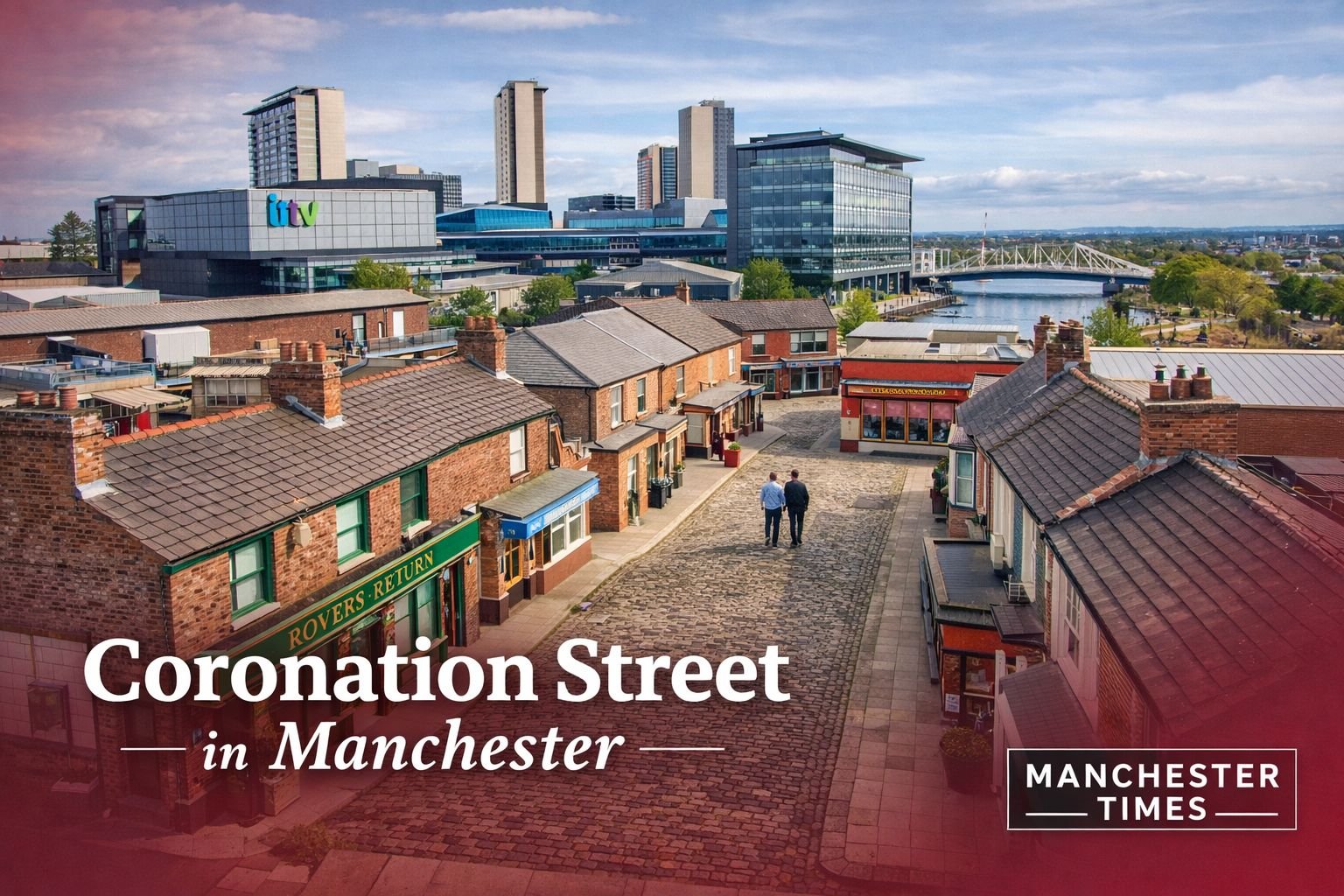
For many people across Greater Manchester, Coronation Street is far more than just another ITV soap. It is a Manchester institution that films on our doorstep, sustains skilled local employment and quietly shapes how millions of viewers imagine life in this region.
First broadcast in 1960, Coronation Street has grown from a black and white drama rooted in back-to-back terraces into one of the world’s most recognisable long-running soaps. Yet despite global reach, it still trades on the rhythms, humour and resilience associated with northern working-class life.
From Quay Street to the Trafford Set
For more than fifty years, Coronation Street was filmed at Granada’s Quay Street studios just off Deansgate. The original set became part of Manchester folklore, sitting within sight of city-centre offices, pubs and match-day crowds heading towards Old Trafford.
In 2014, production moved to a purpose-built Trafford set at MediaCity, on the banks of the Manchester Ship Canal. The relocation secured the long-term future of Coronation Street in Greater Manchester, allowing ITV to modernise facilities while carefully recreating the iconic cobbles of Weatherfield.
The multi-acre Trafford set was designed around high-definition production standards, expanded exterior streets and upgraded studio capacity. That investment ensured CoronationStreet could evolve technically without losing the familiar visual language that audiences expect.
Today, the studio complex sits just a short walk from MediaCity tram stops and The Lowry, anchoring a cluster of creative, hospitality and cultural jobs stretching across Salford Quays and Trafford.
An ITV Production Powerhouse on the Ship Canal
Behind each episode of Coronation Street is a substantial ITV production operation. Writers, directors, camera crews, set designers, costume teams and editors work from the Trafford and MediaCity base, many of them drawn from the North West’s established freelance network.
The expansion of exterior areas such as Victoria Street and Weatherfield Precinct has given Coronation Street greater flexibility while keeping filming controlled within the Manchester studio environment. The Weatherfield Precinct build introduced a multi-storey block with shops, flats and open space, enabling more ambitious storylines without constant off-site shooting.
ITV has also adopted advanced filming techniques, including virtual production methods used for rooftop scenes and complex sequences. By investing locally, Coronation Street reinforces Trafford’s reputation as one of the UK’s key non-London television hubs.
As one of Europe’s largest continuing drama productions, Coronation Street strengthens Greater Manchester’s position in national broadcasting strategy. That consistency provides long-term confidence for regional suppliers and creative professionals.
Weatherfield, Visitors and Manchester Pride
Although Weatherfield is fictional, its DNA is unmistakably Northern. The cadence of dialogue, pub culture and tight-knit street dynamics reflect real communities across Salford, Trafford, Stockport and inner Manchester.
The Coronation Street Experience now formalises that connection. Guided tours around the Trafford set allow visitors to walk the cobbles, stand outside the Rovers Return and explore working production areas when filming permits. The presence of Coronation Street in Trafford has become a structured part of the visitor economy.
Tourism linked to Coronation Street feeds into local hotels, restaurants and retail, encouraging overnight stays rather than day trips. For MediaCity and the wider Salford Quays area, the ITV soap provides steady footfall beyond broadcast audiences.
For residents, the pride is often quieter. Whether or not viewers follow every storyline, most recognise that Coronation Street carries Manchester’s voice into living rooms across the UK.
Cultural Weight of a Long-Running Soap
Few television dramas can claim the longevity of Coronation Street. As one of the longest-running television soap operas of its kind, it has documented shifting social realities for more than six decades.
Storylines have addressed deindustrialisation, changing family structures, LGBTQ+ representation, domestic abuse and mental health. While dramatic licence is inevitable, Coronation Street has often grounded national conversations in recognisable terrace houses and corner shops.
In an era dominated by streaming platforms, linear audiences across the industry have softened compared with peak decades. Even so, Coronation Street remains one of ITV’s cornerstone programmes, delivering reliable live audiences and significant catch-up engagement through digital platforms.
That durability matters locally. Stable scheduling and sustained investment signal that Coronation Street is not a legacy project drifting toward retirement, but a production with ongoing strategic importance.
A Direct Manchester Economic Footprint
Across Trafford and Salford, Coronation Street underpins skilled and semi-skilled roles in production, post-production, security, catering, cleaning and transport. Local construction firms contribute to set builds, while regional creative companies often collaborate through shared staff or specialist services.
For students studying media, drama or technical production in Manchester and Salford, the visibility of Coronation Street makes the television industry feel accessible. Placements, training schemes and occasional extras work provide tangible entry points into a sector often perceived as London-centric.
Casual conversations about Coronation Street still surface in Trafford Park offices, Cheetham Hill barbers and queues at the Trafford Centre. That everyday presence reinforces the show’s embedded status in Greater Manchester life.
You can follow our wider reporting on regional broadcasting and MediaCity developments here:
[See our latest Manchester TV coverage]
What Happens Next for Coronation Street?
The television landscape is evolving rapidly. Streaming services, social media and mobile viewing habits continue to reshape how audiences consume drama.
Industry observers regularly debate how established soaps, including Coronation Street, will adapt through scheduling adjustments, digital extensions and audience engagement strategies. However, recent investment in the Trafford set indicates that ITV remains committed to the long-term future of Coronation Street in Manchester.
New exterior builds, technical upgrades and production expansion all point to continuity rather than contraction. While specific future storylines remain unconfirmed until announced by ITV, the infrastructure surrounding Coronation Street suggests confidence in its ongoing role.
A Grounded Conclusion for Greater Manchester
For a city-region that has fought to retain media jobs outside the capital, Coronation Street represents more than heritage television. It is a functioning studio complex in Trafford, a fictional Weatherfield rooted in recognisable Northern streets and a flagship ITV soap that projects Manchester identity nationwide.
As the broadcasting industry continues to change, the balance between tradition and innovation will define the next chapter. What remains certain is that Coronation Street continues to anchor Trafford’s television industry while reflecting the humour, endurance and community spirit associated with Greater Manchester.
For residents passing the studios on the Metrolink or welcoming visiting relatives to the set tours, Coronation Street is not abstract television history. It is part of the working landscape of modern Manchester.
Read More: Kelvin Fletcher Wife Liz’s “Red Flag” Remark Sparks Manchester Reaction
