

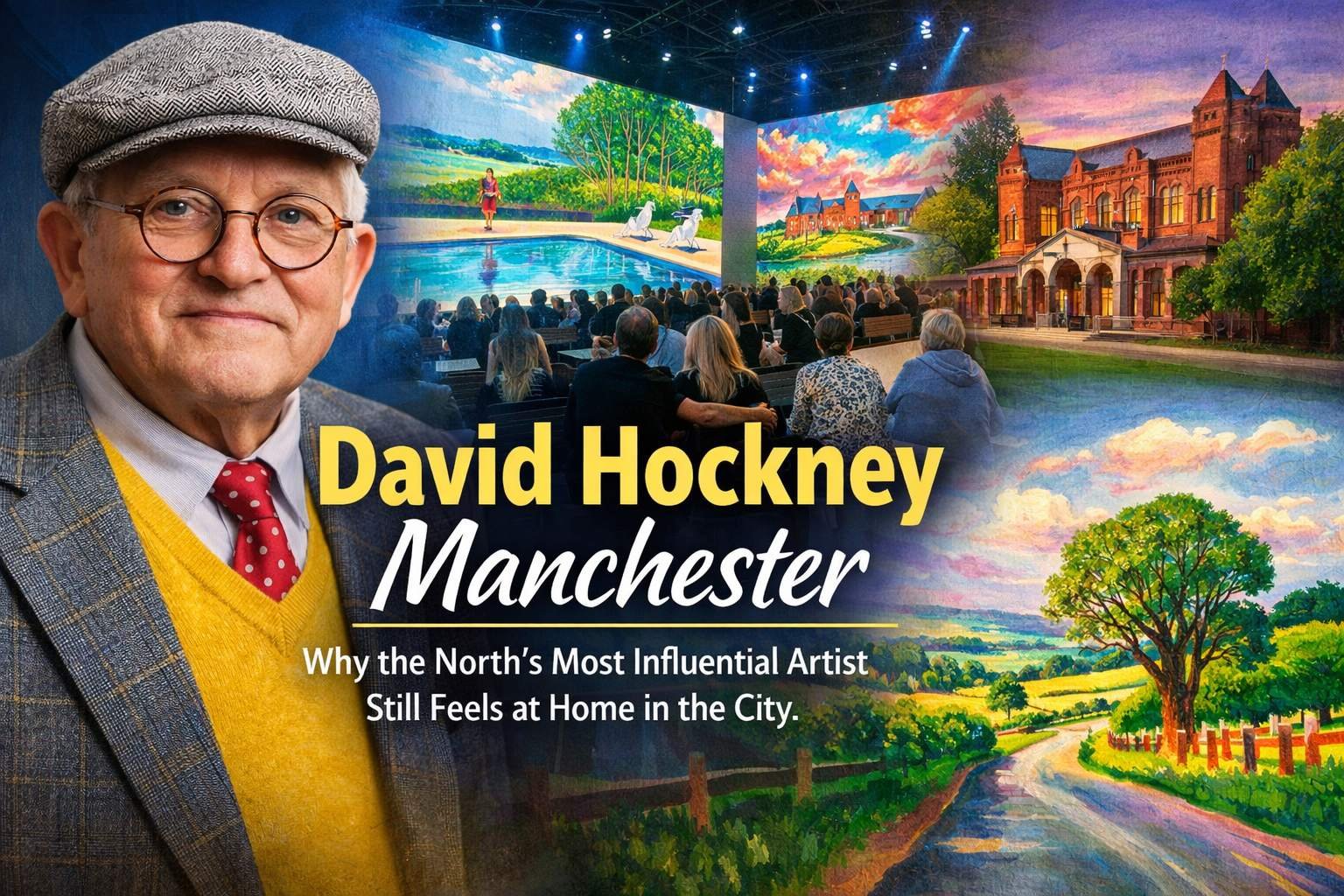
When the lights dim inside Aviva Studios and four vast walls burst into colour, Manchester audiences don’t just see an exhibition they see something familiar. The sold-out return of Bigger & Closer (not smaller & further away) has reinforced what many in the city already feel David Hockney Manchester is not a passing headline, but a cultural relationship that keeps renewing itself.
Hockney’s work may span Yorkshire lanes, Californian swimming pools and operatic stage sets, yet Manchester responds to it in a distinctly local way. This is a city that recognises artists who carry the North with them, no matter how global their reputation becomes.
Why David Hockney Still Resonates in Manchester
Manchester has always gravitated toward creative figures who challenge convention without smoothing out their roots. The David Hockney Manchester connection is grounded less in geography and more in shared outlook: independence, experimentation, and a refusal to be defined by London’s cultural gravity.
Born in Bradford in 1937, David Hockney emerged from a post-war northern upbringing that prized self-expression over conformity. That background still matters here. Manchester audiences see in Hockney a familiar northern trajectory working class origins, early opportunity through education, and a determination to do things differently.
Manchester’s Long Relationship with Hockney’s Art
Unlike cities that only discovered Hockney once his reputation was secure, Manchester engaged early. The Whitworth Art Gallery began acquiring his work in the 1960s and staged one of his first major exhibitions as far back as 1969. That early confidence matters in the David Hockney Manchester story it signals a city willing to back contemporary art before it was universally celebrated.
The Whitworth’s 2012 exhibition Hockney to Hogarth: A Rake’s Progress deepened that relationship, placing Hockney’s reimagining of Hogarth alongside questions of sexuality, cultural exchange and artistic freedom. Manchester audiences engaged with it seriously, seeing reflections of their own city’s evolution from industrial powerhouse to confident cultural centre.
Aviva Studios and the Return of Bigger & Closer
The decision to bring Bigger & Closer back to Aviva Studios through January 2026 has turned David Hockney Manchester into a lived, shared experience rather than a one-off event. The North Warehouse’s 360-degree projections and immersive soundscape suit Hockney’s lifelong fascination with perception and scale, even as they spark debate about how art should be viewed.
That debate is part of the appeal. Manchester audiences are rarely passive. Some visitors revel in the spectacle; others question what is lost when paintings become cinematic. Both reactions point to a city confident enough in its cultural literacy to argue with one of Britain’s most celebrated artists and keep coming back.
Northern Identity and Creative Confidence
What keeps David Hockney Manchester relevant is recognition rather than nostalgia. Manchester understands the tension between regional identity and international ambition. Hockney never denied that tension; he worked through it.
His later return to Yorkshire landscapes, painting the Wolds and coastal roads with the same seriousness once reserved for California, resonated deeply across the North. For Manchester, those works reinforced a simple truth: northern places and lives are worthy of bold colour, innovation and global attention.
A Living Influence, Not a Distant Icon
Hockney’s influence in Manchester is ongoing rather than historical. Students study his use of technology and perspective. Curators debate his immersive turn. Artists measure themselves against his refusal to stand still.
That’s why David Hockney Manchester continues to feel alive. He is not frozen as a museum piece but remains part of current conversations about digital art, accessibility and the future of exhibition spaces—conversations Manchester is eager to lead rather than follow.
What David Hockney Manchester Means Today
For Manchester people, David Hockney represents more than artistic success. He embodies the possibility that northern voices can shape global culture without losing their accent or their values. His career mirrors Manchester’s own confidence in doing things its own way experimentally, independently, and with ambition.
As Aviva Studios fills and the Whitworth’s permanent works remain on the walls, David Hockney Manchester stands as a reminder that this city doesn’t just host world-class art. It understands it, debates it, and makes it part of its own story.
In a Manchester that now builds its future on culture as much as commerce, Hockney’s presence temporary or permanent feels exactly right: a northern original whose colours continue to reflect the city back to itself.
Read More: Suella Braverman Defects to Reform UK as Manchester Politics Enters a Volatile New Phase