


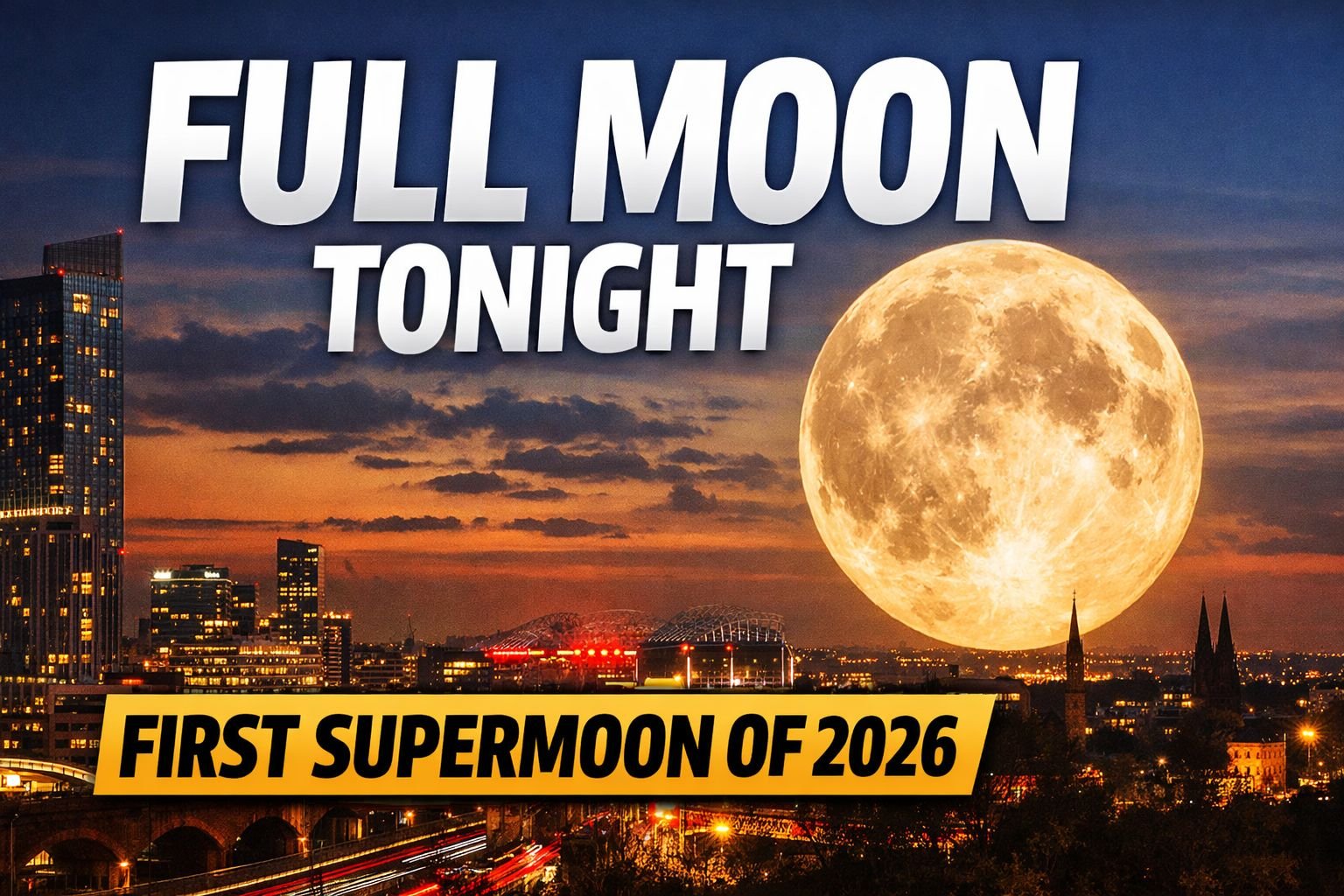
A bright, low-hanging Moon will dominate Manchester’s skyline this weekend as the first full moon of 2026 reaches peak brightness, appearing larger and whiter than many people are used to seeing. The full moon today will be easy to spot from almost anywhere in Greater Manchester, with the best views in the early evening as it rises over rooftops and tower blocks to the east.
The Moon reaches its fullest point on Saturday morning, 3 January, but to the naked eye it will look full both tonight and tomorrow night. In Manchester, it climbs above the horizon during late-afternoon twilight, creating that classic “huge Moon over the city” effect as it clears the urban skyline.
What the full moon today means
A full moon happens when the Earth sits directly between the Sun and the Moon, allowing us to see the lunar surface fully illuminated. The full moon today is also widely classed as a supermoon, meaning the Moon is close to the point in its orbit where it comes nearest to Earth, known as perigee.
When the full phase lines up with this closer part of the orbit, the Moon appears slightly larger and noticeably brighter than a more distant “micromoon”. The size difference is subtle unless images are compared side by side, but the increase in brightness is often clear to the naked eye. This first full moon of the year is traditionally known as the January “Wolf Moon”, a name commonly used in northern cultures for a bright midwinter Moon.
For Manchester readers, the practical meaning is simple: a very bright Moon that can cast faint shadows, wash out many of the fainter stars, and give the city a crisp, wintry glow whenever cloud breaks allow it through.
Full moon today in Manchester: what to expect
In early January, Manchester remains in deep winter, with sunset shortly after 4pm and long hours of darkness. Tonight, the Moon rises over the eastern side of the city not long after sunset, so by early evening it will be sitting comfortably above the horizon for anyone heading home from work or out for the night.
Typical January weather in Greater Manchester often brings cold conditions, sometimes close to freezing after dark, with a risk of icy pavements and lingering frost in the suburbs and on higher ground. Forecasts around this full moon period suggest a mix of clear spells and cloud, meaning there should be decent windows when the Moon breaks through, particularly later in the evening once any low cloud thins.
Even in the city centre, the full moon today will be bright enough to cut through most haze and light pollution. On clearer nights, observers should be able to make out the main dark “seas” on the lunar surface and brighter impact craters along the edge using nothing more than the naked eye or a simple pair of binoculars.
Best places in Manchester to see the full moon
Manchester is not known for dark skies, but for a full moon that is not a problem. The contrast of bright moonlight against the city can make for dramatic views, and several locations in and around Greater Manchester work particularly well for seeing the full moon today.
Heaton Park, north Manchester
The city’s largest park offers wide views and fewer tall buildings, especially on higher ground near the reservoir and the Temple. From here, you can watch the Moon lift above the city with relatively less streetlight glare than in the inner ring road.
Salford Quays and MediaCityUK
Along the water at Salford Quays, open eastern and southern horizons allow clear views, and reflections of the full moon today in the basin can be striking on a still night. The combination of glass, water and moonlight also suits casual photography, with tram stops close by.
Chorlton Water Park and the Mersey Valley
South Manchester’s riverside paths and nature reserves offer a noticeably darker feel than the main arterial roads. Around Chorlton Water Park and along the Mersey, the Moon appears above trees and playing fields rather than tower blocks, creating a more countryside-style view within the M60.
Rivington, Werneth Low and nearby hills
For those willing to travel 30–40 minutes, areas such as Rivington in the West Pennine Moors or viewpoints like Werneth Low provide darker skies and sweeping views back towards the Manchester skyline. Seeing the full moon rise above distant city lights from higher ground can be particularly atmospheric.
Peak District edges
The western edges of the Peak District, reached via Glossop or along the A6, offer some of the more accessible darker skies near the city. While perfect darkness is not essential for a supermoon, these locations allow more stars to remain visible around the Moon.
Wherever you go, safety comes first. Stick to known paths, avoid unlit car parks in remote areas, and take care on frozen ground during a cold January night.
Why this full moon is noteworthy
This is the first full moon of the calendar year and is traditionally called the Wolf Moon, a name rooted in European and North American midwinter folklore where wolves were more often heard during cold, lean months. The term remains widely used in modern almanacs and by UK observatories when describing January’s full moon.
In 2026, it is also regarded as a supermoon, meaning it occurs when the Moon is slightly closer to Earth than average. For people across Manchester, that means the full moon today will appear particularly bright on wet pavements, frost or any lingering snow, and it will wash out more background stars than usual. Arriving during the darkest stretch of winter, just after the festive period, it acts as a quiet marker on the slow return towards lighter evenings.
Astronomers also note that the bright planet Jupiter appears nearby in the sky, forming an eye-catching pairing. Close to the Moon, you should notice a steady, very bright point of light that does not twinkle much this is Jupiter, currently one of the most prominent objects in the night sky.
Common questions answered
Does the full moon affect sleep?
Research into sleep patterns and the lunar cycle suggests there may be a small effect for some people, though many notice no difference. Around a full moon, some individuals fall asleep slightly later or sleep less deeply.
Light is the most likely explanation. Brighter nights can subtly disrupt the body’s internal clock, especially where curtains are thin or people stay up longer because the evening feels less dark. Compared with everyday factors such as screen use or stress, the effect is usually modest, so there is no need for concern if you sleep well through the full moon today.
Is it really a supermoon?
By the commonly used modern definition, yes. A supermoon is a full moon that occurs when the Moon is close to its nearest point to Earth. During these events, the Moon appears slightly larger and brighter than average.
The difference is subtle without direct comparison, but side-by-side photographs show that the full moon today sits at the brighter end of the normal range. In Manchester’s light-polluted sky, that extra brightness can actually help, making the Moon stand out clearly even through urban haze.
Can you photograph it with a phone?
Most modern smartphones can capture the full moon today with reasonable results. Holding the phone steady — ideally against a railing, wall or tripod — makes the biggest difference.
If your phone offers a manual or “pro” mode, lower the exposure to avoid a pure white disc, keep ISO low to reduce grain, and avoid heavy digital zoom. While you will not get telescope-level detail, framing the Moon above Manchester landmarks, canals or high-rises can produce atmospheric, shareable images.
A calm, clear way to enjoy the night
The full moon today does not bring mystical effects or guaranteed disruption. It simply offers a bright midwinter moment to look up and notice the sky above Greater Manchester. On a clear evening, you can step outside in Ancoats, Wythenshawe or Oldham and see the same glowing disc being watched across the UK.
With no special equipment required just warm clothing and a safe spot with a view towards the east or south this January supermoon is one of the easiest astronomical events of the year to enjoy. In a city often focused on traffic, trams and routines, a bright full moon over the rooftops offers a quiet reminder that Manchester still shares a sky with the wider universe.
Read More: Sienna Miller: Biography, Career, Movies, Net Worth, and Latest News
