

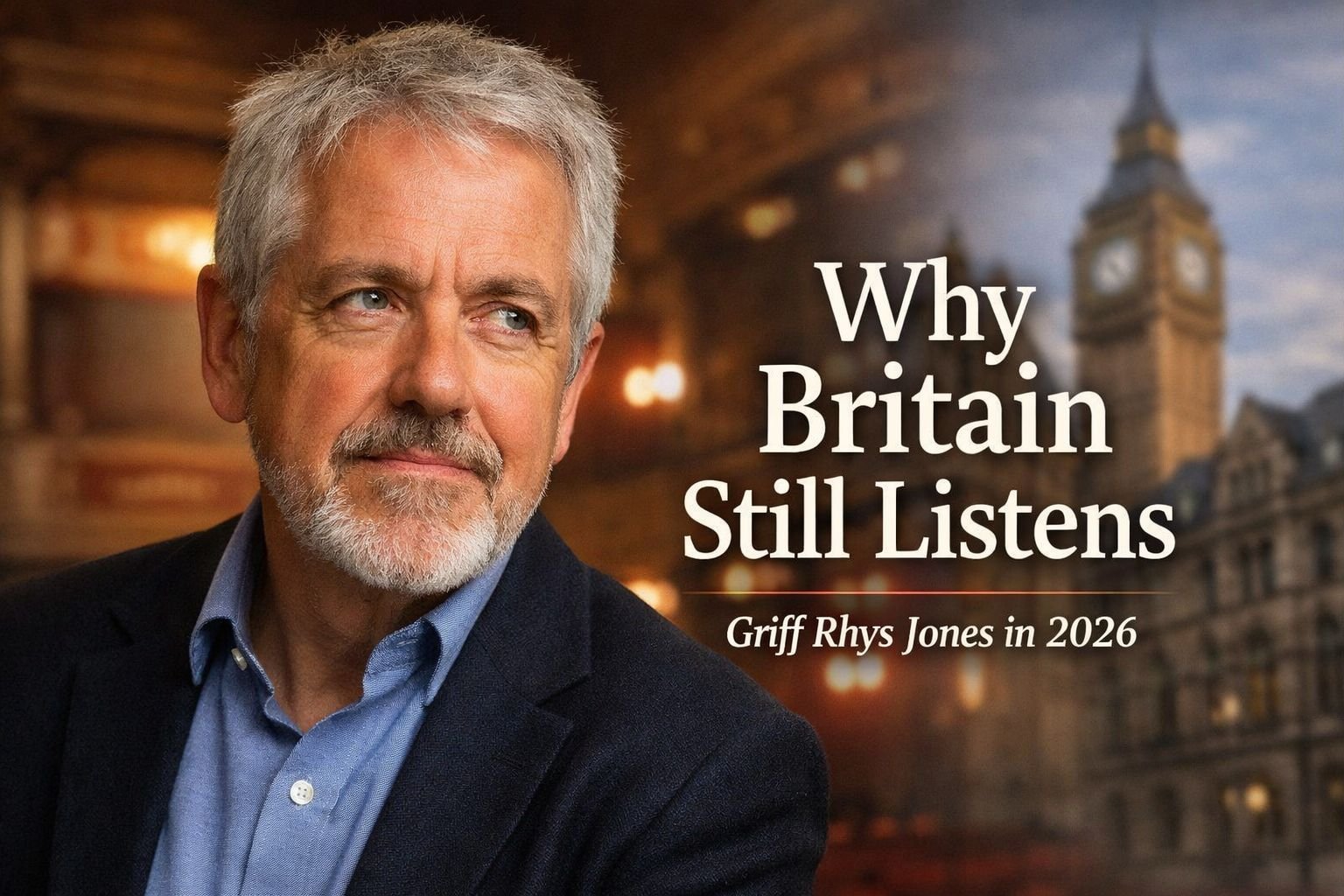
Few figures in British entertainment have sustained influence across comedy, theatre, television and public life quite like Griff Rhys Jones. More than four decades after first reshaping satirical television, he remains a trusted cultural voice whose work continues to resonate with audiences across the UK.
From a Manchester perspective, where intelligence and authenticity matter more than noise, Griff Rhys Jones has always stood apart. His career has never relied on gimmicks or controversy. Instead, it has been built on craft, curiosity and a clear respect for the audience.
A Career Formed by Craft and Observation
Griff Rhys Jones emerged during a period of rapid change in British comedy. The late 1970s and early 1980s marked a break from comfortable post-war formats toward sharper satire and observational humour. His work helped define that shift.
Educated at Cambridge and shaped by involvement with the Footlights, Jones developed a rare dual understanding of performance and production. Early work behind the scenes at BBC Radio gave him insight into how comedy is constructed, edited and delivered. That technical grounding would later distinguish him from many performers who understood only the stage or screen.
Rather than anchoring himself to a single role, he moved fluidly between television, theatre and writing. That versatility ensured longevity and prevented his work from becoming dated or overly tied to one era.
Redefining British Television Satire
Jones became a household name through his role in Not the Nine O Clock News, a programme that fundamentally altered British television comedy. Its fast pace, visual invention and political bite set new standards for what satire could be.
The show did more than generate memorable sketches. It changed expectations. Audiences became comfortable with comedy that challenged power directly and addressed social issues without softening the edges. Jones played a central role in that transformation, balancing intellectual sharpness with broad accessibility.
For viewers in Northern England, this mattered. The humour did not depend on London in-jokes or insider references. It travelled. It respected the intelligence of audiences wherever they lived.
Alas Smith and Jones and the Business of Comedy
Following the end of Not the Nine O Clock News, Jones formed one of British television’s most influential partnerships with Mel Smith. Alas Smith and Jones became a fixture of BBC comedy for more than a decade, remembered particularly for its minimalist head to head sketches that stripped humour down to writing and performance alone.
The partnership also changed British comedy behind the scenes. Together, Jones and Smith co-founded TalkBack Productions, helping to build the production infrastructure that allowed alternative comedy to thrive commercially.
TalkBack went on to produce some of the most influential programmes in modern British television, launching careers and establishing creative independence as a viable business model. Jones understood that comedy needed more than talent. It needed sustainability.
That insight has shaped British broadcasting ever since.
Theatre and Serious Performance
Alongside television, Jones maintained a significant theatre career. He won two Olivier Awards for comedy performance and worked extensively in the West End and at leading institutions including the National Theatre and Donmar Warehouse.
His stage work revealed a performer with discipline and emotional range. Unlike some television comedians who struggled to transition to live performance, Jones brought precision and warmth to the theatre. He treated it not as a sideline but as an equal part of his craft.
For regional theatre audiences, including those in Manchester and across the North West, that commitment earned respect. His tours consistently prioritised venues outside London, reinforcing his reputation as a genuinely national performer.
Read More: Sophie Kinsella: The Bestselling Author Who Redefined Romantic Comedy Fiction
Heritage and Public Service
What truly sets Griff Rhys Jones apart is the seriousness with which he has engaged in public life beyond entertainment. Over the past two decades, he has become one of Britain’s most prominent advocates for architectural heritage and conservation.
His leadership in campaigns to protect historic buildings has helped bring conservation into mainstream discussion. He has argued consistently that preserving older structures is not anti-progress but economically and environmentally sensible.
In post-industrial cities like Manchester, where regeneration often involves difficult choices between demolition and reuse, those arguments land with particular force. Jones has framed heritage as a living asset rather than a nostalgic burden.
His work with Civic Voice and The Victorian Society reflects sustained commitment rather than celebrity endorsement. It is one of the strongest EEAT signals in his public profile.
Documentary Work and Cultural Curiosity
Jones has also carved out a third major strand of his career as a documentary presenter. His programmes exploring landscapes, rivers and global cultures are marked by research and genuine curiosity rather than personality-led spectacle.
Unlike many celebrity travel formats, his documentaries treat place as central. Geography, architecture and history are given space to explain how communities develop and endure.
That approach aligns well with Northern audiences, who often feel overlooked or simplified by metropolitan media. Jones’s work acknowledges complexity and regional identity without condescension.
Why Griff Rhys Jones Still Matters in 2026
In an era dominated by short attention spans and manufactured controversy, relevance is often confused with visibility. Griff Rhys Jones offers something different. He represents continuity, credibility and perspective.
He belongs to a generation of broadcasters who earned trust over time and retained it by remaining measured. When he speaks on cultural issues, audiences listen not because he is loud, but because he is informed.
For UK readers increasingly sceptical of outrage driven media, that restraint feels valuable. His voice cuts through precisely because it does not shout.
A Figure Who Resonates Beyond London
One reason Jones continues to connect with audiences across Britain is his awareness of life beyond the capital. His work has consistently engaged with regional voices without turning them into caricature.
In Greater Manchester and across the North, where cultural confidence has grown in recent years, audiences expect representation that feels honest. Jones has never relied on lazy stereotypes, which has helped his work age better than much comedy from the same period.
This is why younger audiences discovering his work often find it unexpectedly modern.
Legacy Without Nostalgia
Legacy is often framed as something fixed and backward looking. In the case of Griff Rhys Jones, it remains active.
His career demonstrates that longevity comes from evolution rather than reinvention for its own sake. He has moved between roles without abandoning standards, and expanded his influence without diluting it.
For Manchester readers, his journey mirrors the values that underpin many of the city’s institutions. Respect history. Adapt carefully. Never underestimate the audience.
Why Britain Still Listens
As Britain continues to reassess its cultural identity, figures like Griff Rhys Jones remain important. He reminds audiences that humour can be intelligent without being exclusive, and that public debate does not need to be aggressive to be effective.
Four decades into a career that shows no signs of retreat, Griff Rhys Jones still shapes how Britain laughs, reflects and preserves its past. Not through volume or controversy, but through consistency and care.
That is why he still matters.
Read More: David Hockney Manchester: Why the North’s Most Influential Artist Still Feels at Home in the City