


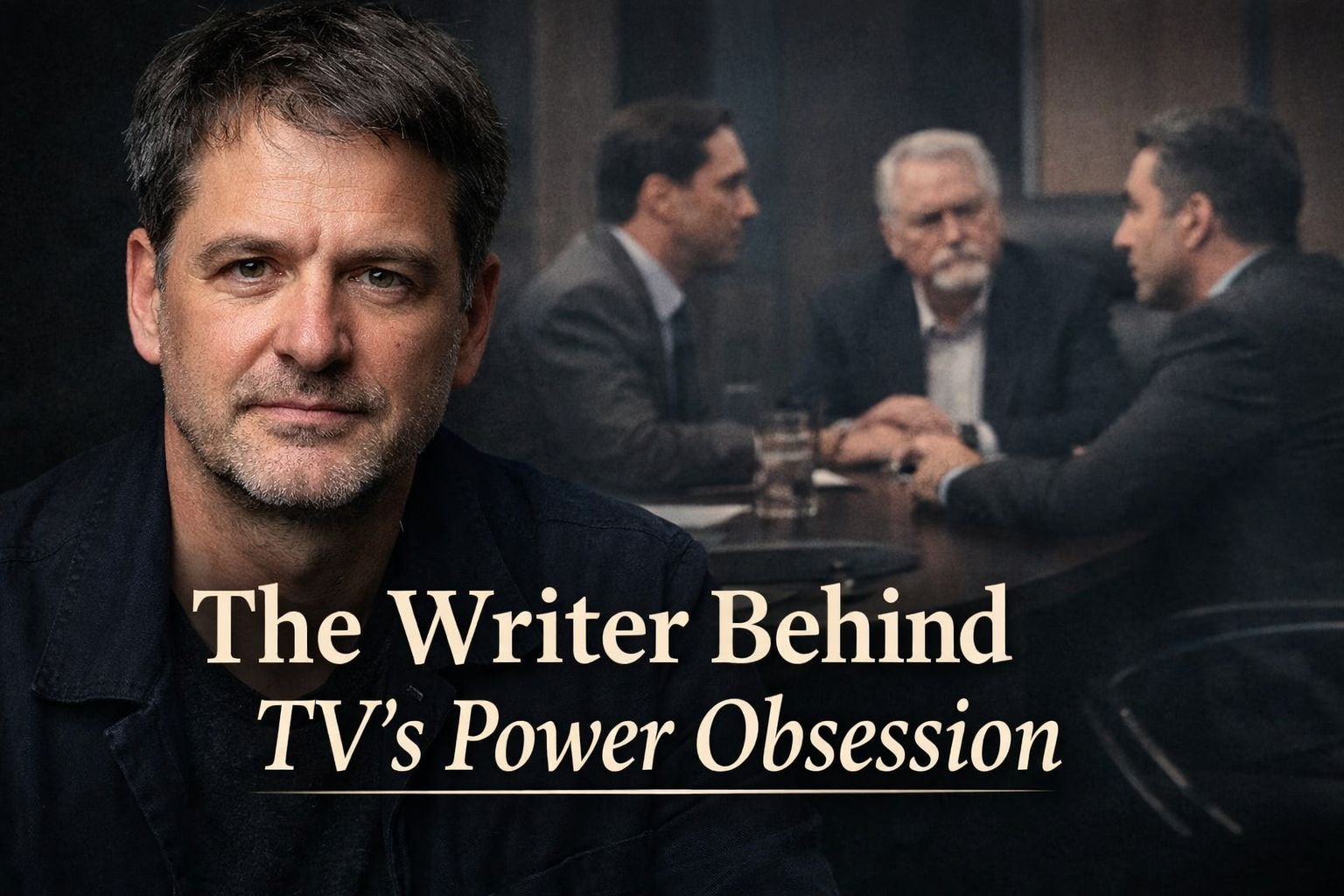
In modern television, few writers have reshaped the language of power as precisely as Jesse Armstrong. From the claustrophobic awkwardness of early Channel 4 comedy to the global success of Succession, his work has consistently explored how authority operates behind closed doors through language, insecurity, and quiet brutality. For UK audiences, his career represents one of the most successful transitions from British satire to global prestige television.
Who Jesse Armstrong Is
Jesse David Armstrong was born on 13 December 1970 in Oswestry, Shropshire, near the England–Wales border. Raised in a household that valued education and storytelling — his father later became a crime novelist Armstrong developed an early interest in how narratives shape behaviour and belief.
He studied American Studies at the University of Manchester, including a year in the United States, before completing postgraduate work in American history. This academic grounding in US politics, media, and culture would later inform his sharply observed portrayals of American power structures, giving his work an authenticity rarely matched by non-US writers.
Before breaking into television, Armstrong held a series of modest jobs and worked briefly in political research. These experiences helped shape his sensitivity to class, hierarchy, and institutional language themes that would define his writing career.
Early Career and British Breakthrough
Armstrong’s first major breakthrough came with Peep Show, co-created with Sam Bain. Premiering on Channel 4 in 2003, the sitcom revolutionised British comedy through its use of point-of-view filming and internal monologue, placing viewers directly inside the minds of deeply flawed characters.
The show ran for nine series and became one of the most influential British comedies of the 21st century. Its legacy lies not just in popularity but in how it reshaped tone: humour rooted in discomfort, moral compromise, and emotional exposure. For many critics, Peep Show marked a turning point in what mainstream British comedy could be.
From Channel 4 to Global Prestige Television
While Armstrong continued to work on British projects such as The Thick of It and Fresh Meat, his international breakthrough arrived with Succession. The HBO drama followed the Roy family, owners of a global media empire, as they battled for control in a world defined by wealth and influence.
Although set in the United States, the series carried a distinctly British sensibility sceptical, restrained, and deeply suspicious of power. Its dialogue, sharp and rhythmically precise, became one of its defining features. Critics frequently noted that Succession felt less like a traditional US drama and more like a transatlantic satire with Shakespearean undertones.
Under Armstrong’s leadership, the series became one of the most critically acclaimed television dramas of its era, earning sustained attention from both cultural commentators and industry peers.
A Distinctive Writing Style
At the centre of Armstrong’s work is an obsession with power and self-deception. His characters rarely speak plainly; instead, they hide behind jargon, jokes, and veiled threats. Language itself becomes a weapon a way to dominate, deflect, or humiliate.
Another defining trait of Jesse Armstrong’s writing is his refusal to provide moral comfort. There are no clear heroes, no redemptive arcs designed to reassure the audience. Instead, viewers are asked to sit with ambiguity and recognise uncomfortable truths about ambition, loyalty, and complicity.
This approach gives his work longevity. It rewards close attention and repeat viewing, qualities increasingly valued in the streaming era.
Awards and Industry Recognition
Armstrong’s body of work has received extensive industry recognition, particularly for Succession, which earned multiple major awards across its run. His writing has been repeatedly singled out for its precision, consistency, and control of tone.
Importantly, this recognition did not alter his creative approach. Rather than softening his style for wider appeal, Jesse Armstrong maintained the sharpness and restraint that defined his early British work, demonstrating that uncompromising writing can still achieve global success.
Cultural Impact in the UK and Beyond
For British television, Armstrong’s success holds particular significance. He demonstrated that UK writers could shape global storytelling without abandoning their cultural voice. His influence is visible in a new generation of dramas and comedies that prioritise complexity, moral uncertainty, and linguistic realism.
Beyond television, Succession entered wider cultural discourse. Its depiction of corporate life, inherited power, and media influence became reference points in discussions far beyond entertainment a rare achievement for a scripted drama.
Current Work and Creative Direction
Following the conclusion of Succession, attention has turned to Armstrong’s next projects, including work that expands his focus beyond television. While details have been deliberately limited, his continued interest in wealth, technology, and power suggests a thematic continuity rather than a radical shift.
Rather than pursuing visibility for its own sake, Jesse Armstrong has remained selective, reinforcing his reputation as a writer focused on craft over output.
Legacy of a Modern British Writer
What sets Armstrong apart is not just success across formats, but consistency of vision. Across decades of work, he has returned to the same fundamental questions: how power distorts relationships, how language masks intent, and how systems reward moral flexibility.
For UK audiences, his journey from Channel 4 comedy to global prestige television represents more than personal achievement. It confirms the enduring relevance of British satire in an international industry increasingly shaped by scale rather than subtlety.
Conclusion
Jesse Armstrong has redefined what television satire can achieve. From the intimate discomfort of Peep Show to the operatic power struggles of Succession, his work exposes ambition without romanticism and authority without reverence.
In an industry often driven by trend and spectacle, Armstrong’s writing stands out for its discipline and restraint. That is why his influence continues to grow not through hype, but through work that has already changed the rules of modern television.
FAQs
Who is Jesse Armstrong best known for?
Jesse Armstrong is best known as the creator of Succession and the co-creator of Peep Show. His work spans British comedy and American prestige drama, with a focus on power, language, and institutional behaviour.
Is Jesse Armstrong British?
Yes. Jesse Armstrong is a British writer who began his career in UK television before achieving international recognition through HBO. His writing is strongly influenced by British satire and comedy traditions.
What makes Jesse Armstrong’s writing style unique?
His writing is defined by sharp dialogue, moral ambiguity, and an emphasis on how power shapes human behaviour. Characters often use language as a weapon, revealing insecurity beneath authority.
Did Jesse Armstrong work on Peep Show?
Yes. He co-created Peep Show, one of Channel 4’s most influential comedies. The show helped redefine British sitcoms through its use of internal monologue and uncomfortable realism.
Why is Succession considered culturally significant?
Succession is widely regarded as culturally significant because it blends satire with drama to examine media power, wealth, and family dynamics. Its influence extends beyond television into political and business discourse.
What is Jesse Armstrong working on now?
Following the conclusion of Succession, Jesse Armstrong has been developing new projects that continue his interest in power and wealth, while expanding beyond long-running television series.
Read More: Sophie Kinsella: The Bestselling Author Who Redefined Romantic Comedy Fiction
