


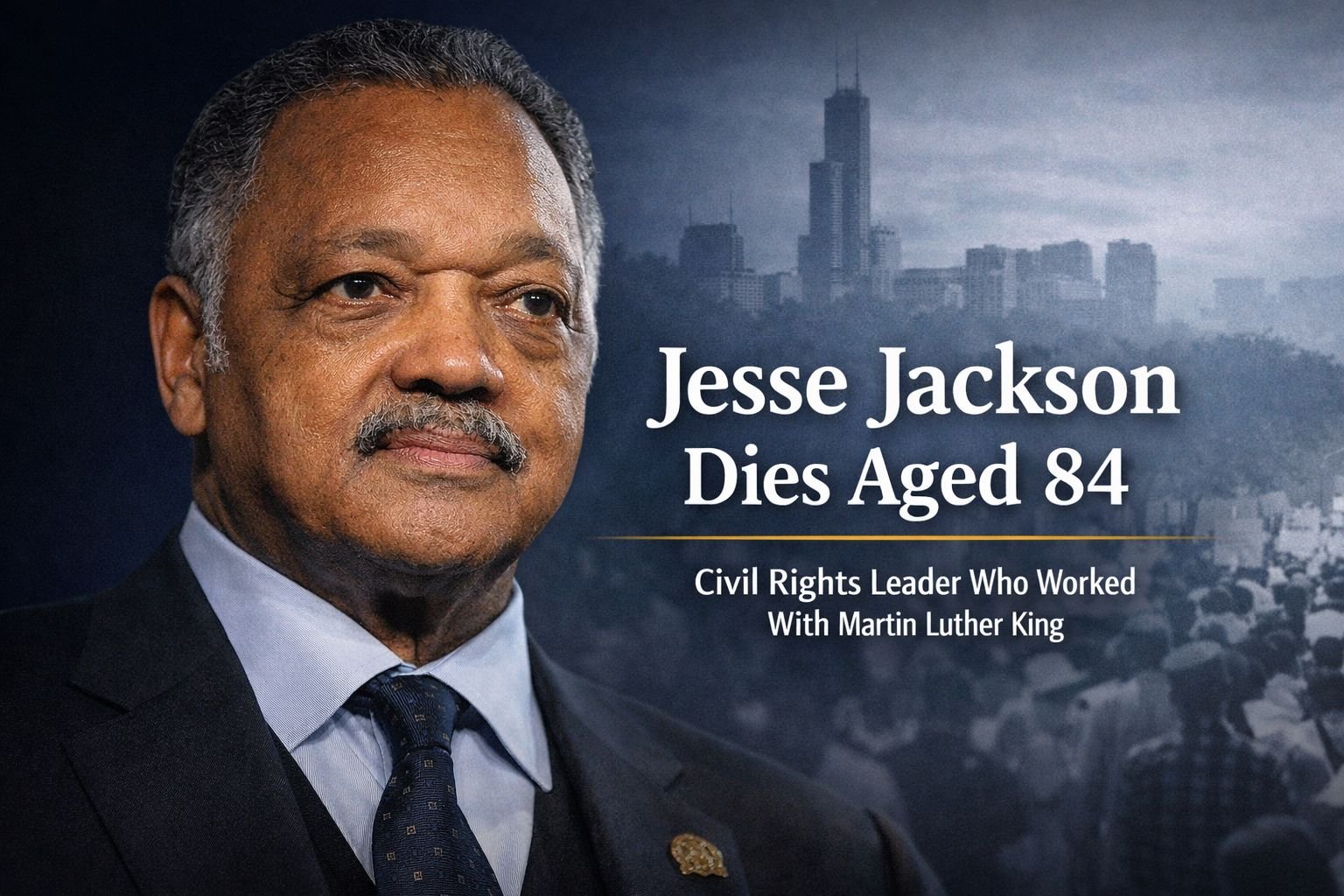
Veteran US civil rights leader Jesse Jackson has died aged 84, closing a defining chapter in modern activism that reshaped American politics and influenced equality movements far beyond the United States.
His death marks the passing of one of the most recognisable figures of the post 1960s civil rights generation, a man who bridged the era of Martin Luther King with contemporary debates over race, democracy and economic justice.
For British audiences, particularly in cities such as Manchester where questions of social equity remain central to civic life, his legacy resonates far beyond American borders.
A Life at the Centre of the Civil Rights Movement
Jesse Jackson died peacefully on Tuesday morning surrounded by family, according to statements released in the United States. The American pastor and long time activist had faced significant health challenges in recent years, including Parkinson’s disease and a progressive neurological condition that limited his public appearances.
Born in South Carolina in 1941 during segregation, Jackson rose to prominence as a young organiser within the Southern Christian Leadership Conference, the organisation led by Martin Luther King. He became known for his oratory, strategic organising and ability to translate street protest into political leverage.
After King’s assassination in 1968, Jackson emerged as one of the most visible figures determined to carry forward the movement’s moral authority. While the early civil rights struggle focused on dismantling legal segregation, he increasingly argued that political rights must be matched by economic opportunity.
That shift from desegregation to structural inequality would define much of his life’s work.
From Chicago Activism to National Politics
Based in Chicago, Jesse Jackson built an influential campaigning network that pushed issues such as voting rights, corporate accountability and anti poverty programmes onto the national agenda.
He founded Operation PUSH, later merging it with his Rainbow Coalition to create the Rainbow PUSH Coalition. Through negotiations with major corporations and sustained community pressure, the organisation sought jobs, contracts and representation for Black Americans and other marginalised groups.
His approach combined pulpit style rhetoric with practical political strategy. Jackson understood that moral persuasion alone was insufficient and had to be backed by institutional pressure.
In the 1980s he twice sought the Democratic presidential nomination. Although unsuccessful, his 1984 and 1988 campaigns broke historic ground. He became the first Black candidate to mount a serious nationwide bid within a major US party, winning multiple primaries and expanding voter participation.
Those campaigns broadened the scope of US political debate and reshaped perceptions of who could realistically aspire to national leadership.
Read More: Catherine O’Hara Dies at 71: Why Her Work Became Essential Viewing for British Audiences
The Enduring Link to Martin Luther King
The connection between Jesse Jackson and Martin Luther King has always shaped how his career is understood, particularly outside the United States.
Jackson was present in Memphis in April 1968 when King was assassinated, an event that profoundly influenced his public life. In the years that followed, he positioned himself as both custodian and interpreter of King’s philosophy, arguing that non violent protest must evolve to confront new forms of economic and institutional inequality.
For UK observers, that continuity helped frame the American civil rights movement not as a closed historical chapter, but as an ongoing global conversation about systems of power and resistance.
Why Jesse Jackson’s Death Matters in the UK
For Britain, and for Manchester in particular, the death of Jesse Jackson is more than an international headline.
The American civil rights movement has long informed how race, protest and democratic participation are understood in this country. Campaigners in northern cities have historically drawn parallels between struggles in Chicago and experiences of discrimination in housing, policing and employment across Britain.
Manchester’s civic traditions, from anti apartheid activism to contemporary equality campaigns, reflect similar coalition building strategies to those Jackson championed. His concept of a rainbow coalition of minorities, trade unionists, faith groups and progressive voters resonates in a city defined by diversity and political engagement.
In recent years, Britain has seen renewed debates over policing, institutional racism, the ethnic pay gap and economic deprivation in post industrial communities. Jackson’s insistence that racial justice cannot be separated from economic justice speaks directly to those concerns.
For UK policymakers grappling with widening inequality and political disengagement, his campaigns remain a case study in mobilising communities who feel excluded from mainstream politics.
A Generational Shift in Global Activism
The passing of Jesse Jackson also signals a generational transition. The cohort of leaders who worked directly alongside Martin Luther King is now almost gone. Their style of leadership, rooted in church networks, mass meetings and disciplined grassroots organising, contrasts sharply with today’s digitally driven activism.
What replaces that model remains an open question on both sides of the Atlantic.
As Manchester and other UK cities reflect on his life, the enduring lesson may be one of persistence. Jackson’s career spanned more than five decades, adapting to shifting political climates while maintaining a consistent moral message.
His voice may now be silent, but the issues he championed, racial equality, economic opportunity and democratic participation, remain deeply embedded in British political debate.
In that sense, the death of Jesse Jackson closes a chapter in history while leaving unfinished work that continues to shape conversations in Britain as much as in America.
Read More: James Van Der Beek Dies Aged 48 as UK Fans Mourn TV Icon
