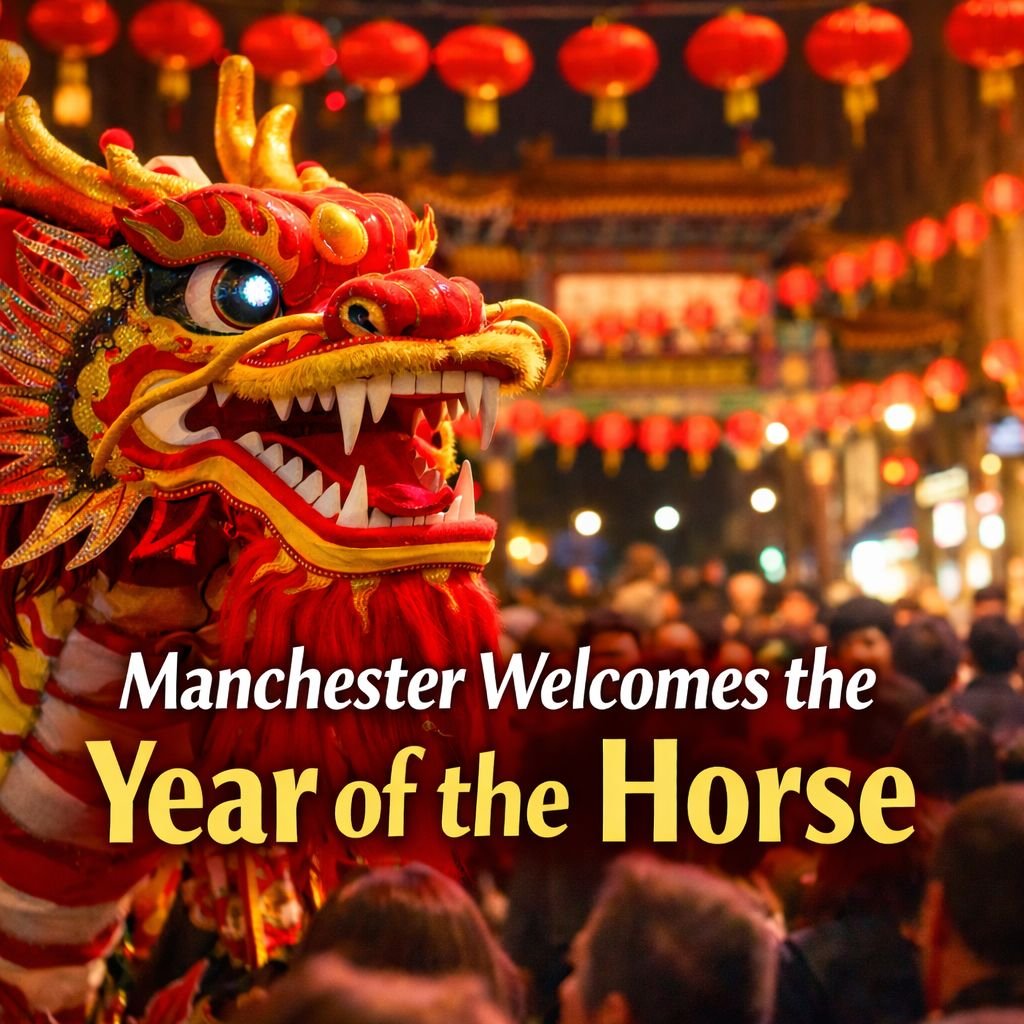
Manchester is preparing to welcome the Year of the Horse as Lunar New Year celebrations return with colour, culture and a powerful sense of community across the city centre and beyond.
From red lanterns lining Chinatown to packed streets for the famous Dragon Parade, Lunar New Year has become one of Manchester’s most anticipated cultural moments drawing families, students and visitors together during the quieter winter months.
For many Mancunians, this is no longer just a festival associated with one community. It has grown into a shared citywide celebration that reflects Manchester’s identity as one of the UK’s most diverse and outward-looking cities.
A Long-Standing Manchester Tradition
Manchester’s connection to Lunar New Year is deeply rooted in the city’s Chinese community, whose presence dates back more than a century. What began as modest, community-led celebrations has evolved into one of the largest Lunar New Year events outside London.
At the heart of the festivities is Manchester Chinatown, where preparations begin weeks in advance. Shopfronts are dressed in red and gold, restaurants prepare special menus, and community groups coordinate performances that blend tradition with Manchester’s modern energy.
Local organisers say the celebrations remain grounded in Chinese customs while welcoming Vietnamese, Korean and other East and Southeast Asian communities who also observe the Lunar calendar.
Dragon Parade and City Centre Celebrations
The centrepiece of Manchester’s Lunar New Year programme is the Dragon Parade, which traditionally draws tens of thousands of spectators into the city centre.
Carried by skilled performers and accompanied by drummers, dancers and lion dance troupes, the dragon weaves through Manchester’s main streets before concluding in Chinatown, where crowds gather for final performances.
Alongside the parade, a large cultural fair will operate across multiple city-centre locations, featuring street food vendors, craft stalls, live performances and family-friendly workshops. Visitors can expect calligraphy demonstrations, lantern-making activities and cultural storytelling designed to make Lunar New Year accessible to all ages.
Read More: Northern Quarter Manchester: Inside the Creative Heart of a City That Refuses to Conform
How Manchester Families Mark Lunar New Year
Away from the crowds, Lunar New Year is marked more quietly in homes across Greater Manchester. Families clean their houses to sweep away bad luck, decorate with red for prosperity and gather around shared meals built around symbolic foods such as dumplings, fish and long noodles.
For second and third generation Mancunians, the festival offers a chance to pass traditions to younger family members while still feeling firmly rooted in life in the UK.
Students studying in Manchester, particularly those living far from home, often say the city’s celebrations help ease homesickness and reinforce a sense of belonging.
Cultural and Economic Impact on the City
Beyond its cultural importance, Lunar New Year delivers a significant boost to Manchester’s local economy. Chinatown restaurants regularly report some of their busiest trading days of the year, while independent shops, performers and vendors benefit from increased footfall.
City leaders and community groups increasingly recognise that events like Lunar New Year are not just celebrations, but investments in social cohesion. Free, accessible festivals bring people together at a time when community connection matters more than ever.
The celebrations also reinforce Manchester’s reputation as a globally connected city, shaped by migration, international students and long-standing cultural ties.
The Year of the Horse and What It Symbolises
The Year of the Horse is traditionally associated with strength, movement and optimism qualities that many Mancunians feel reflect their city perfectly.
As Manchester continues to evolve, these themes resonate strongly. For the city’s East Asian communities, Lunar New Year remains a time of reflection, renewal and hope. For the wider population, it has become a reminder that shared celebration can strengthen neighbourhoods and bring people closer together.
A City United by Celebration
As lanterns sway above the streets and the drums fall silent, Lunar New Year leaves behind more than memories. It reinforces a sense of belonging in a city defined by movement, resilience and shared experience.
In welcoming the Year of the Horse, Manchester once again shows how tradition and modern city life can thrive side by side and why Lunar New Year now holds a permanent place in the city’s cultural calendar.
Read More: Salmon of Knowledge Manchester: How a New Irish Bar Became Peak Manchester
FAQs
When is Lunar New Year celebrated in Manchester?
Lunar New Year celebrations in Manchester usually take place across the weekend closest to the official Lunar New Year date, with major events held in the city centre and Chinatown.
Are Manchester’s Lunar New Year events free?
Yes. Most Lunar New Year events in Manchester, including the Dragon Parade and cultural performances, are free and open to the public.
Where is the best place to watch the Dragon Parade?
Popular viewing spots include the city-centre parade route and areas around Chinatown. Arriving early is recommended due to large crowds.
Is Lunar New Year only celebrated by the Chinese community?
No. While rooted in Chinese tradition, Lunar New Year is also observed by Vietnamese, Korean and other East and Southeast Asian communities, and Manchester’s celebrations welcome everyone.
What food is traditionally eaten during Lunar New Year?
Traditional foods include dumplings, fish, noodles and sweet treats, all symbolising prosperity, longevity and good fortune.
Read More: Best Burger in Manchester, Where Locals Actually Eat, Not the Hype