


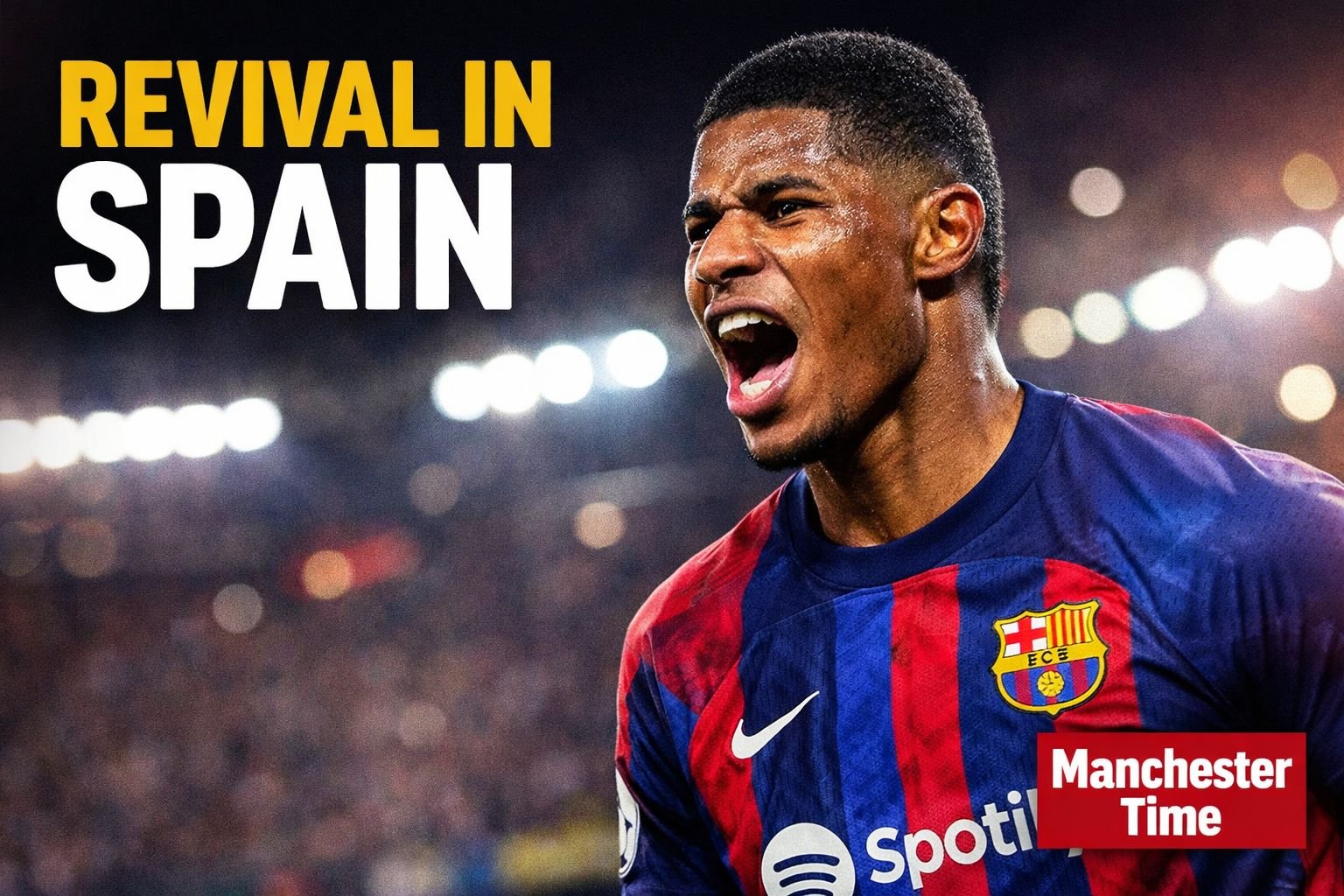
Old Trafford shaped him. The Stretford End carried him. Yet this season, Marcus Rashford has found renewed clarity in Catalonia.
Watching from Manchester, there is still something unusual about seeing a Wythenshawe academy graduate cutting inside at Camp Nou rather than on Sir Matt Busby Way. But the numbers are concrete. Marcus Rashford has delivered 10 goals and 10 assists across all competitions by mid February, already matching his total goal contributions from the previous campaign, with months still to play.
For those who covered his final stretch at United, the contrast is obvious. A player whose role had narrowed late last season is now operating with defined purpose under Hansi Flick. The shift has been tactical as much as psychological.
Current form and tactical role
Marcus Rashford did not settle instantly in Spain. His first three La Liga appearances came from the bench without a goal involvement. Since September, however, the output has been consistent.
In La Liga, Marcus Rashford has produced four goals and six assists in 21 appearances. In the Champions League, he has added five goals and three assists in eight matches, contributions that have arrived in high pressure fixtures rather than routine outings.
Flick has used Marcus Rashford predominantly from the left, encouraging him to hold width early before attacking the inside channel once the ball progresses. The difference from his final months in England is structural. Barcelona’s pressing scheme demands immediate pressure after turnovers, with short distances between the front three. Marcus Rashford’s defensive work rate has visibly increased within that system.
Heat map data reflects the adjustment. Instead of drifting centrally in build up phases, Marcus Rashford is receiving higher and wider, driving directly at full backs and timing diagonal runs into the box. His expected assist output has risen, while his average touches inside the penalty area are up compared with last season. Decisions in the final third are quicker and more decisive.
What it means for Manchester United
From a Manchester United perspective, clarity is approaching. The loan agreement includes a reported €30m option to make the move permanent this summer, and the club’s public stance has been firm on valuation.
Marcus Rashford leaves behind a substantial United legacy. He made 426 appearances and scored 138 goals in all competitions. His 30 goal campaign in 2022 to 23 remains one of the most productive individual seasons by a United forward in the post Ferguson era.
Yet relationships in football evolve. By the end of last season, tactical direction and squad planning had shifted. United now sit fourth in the Premier League on 45 points after 26 matches, pushing for Champions League qualification under a more controlled structure. The left sided attacking profile that Marcus Rashford provides, direct running, vertical threat and space stretching width, is not currently replicated elsewhere in the squad following Alejandro Garnacho’s departure.
Around Old Trafford, sentiment has changed. Earlier frustration has given way to acceptance that Marcus Rashford required a reset. The conversation among match going supporters is less about return and more about long term squad balance.
Marcus Rashford’s England outlook under Tuchel
Form in Spain has re established Marcus Rashford in England discussions. Thomas Tuchel included him in his first squad in March 2025 and has retained him in subsequent camps, citing defensive intensity and positional discipline as key improvements.
Marcus Rashford’s versatility remains valuable. He can operate as a left forward in a front three or as a wider outlet when England require direct transitional threat. Tournament football rewards pace and decisiveness in isolated duels, qualities he has rediscovered this season.
Selection will ultimately depend on sustained output rather than short bursts. If Marcus Rashford maintains current production levels through the spring, his case for inclusion in the 2026 World Cup squad strengthens considerably.
Data backed performance comparison
A direct seasonal comparison illustrates the reset.
| Metric | 2024/25 (Man Utd + Villa) | 2025/26 (Barcelona, current) |
|---|
| Appearances | 41 | 34 |
| Goals | 11 | 10 |
| Assists | 9 | 10 |
| Goal contributions | 20 | 20 |
Marcus Rashford has already equalled last season’s total goal involvements in fewer appearances. The difference lies in efficiency and context. Conversion rate has improved, touches inside the box have increased, and a greater proportion of contributions have arrived in European competition.
His 2022 to 23 peak remains the benchmark, but underlying indicators in Spain, progressive carries, expected goal involvement and defensive pressures, suggest movement back towards that level.
Measured outlook
From Manchester, the narrative carries a degree of inevitability. Marcus Rashford emerged as a teenager under Louis van Gaal, lifting Old Trafford with a debut double in Europe. Two decades at one club create identity as much as career.
The coming months will determine whether Barcelona activate their purchase option. United appear prepared for that possibility as part of a broader squad reshaping, even if it closes a significant academy chapter.
For Marcus Rashford, the immediate task is consistency. Sustained productivity for Barcelona, continued tactical discipline and maintained physical output will define how this season is judged. If those elements hold, the move from Manchester to Catalonia will stand not as an escape, but as a recalibration at a pivotal stage of his career.
Read More: England land Spain and Croatia in heavyweight Nations League draw
