


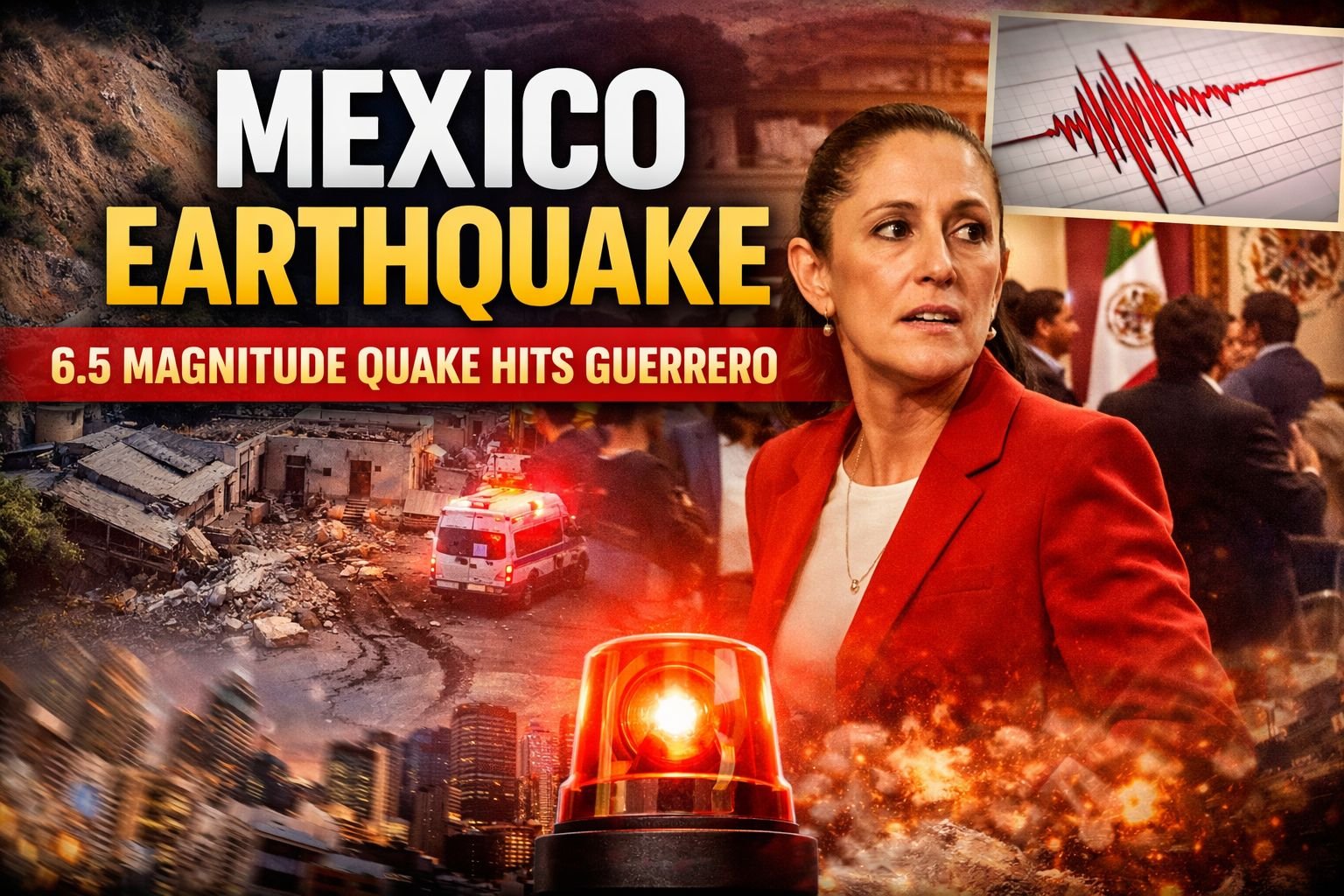
A Mexico earthquake measuring magnitude 6.5 struck southern regions early Friday morning, sending tremors across central Mexico and briefly interrupting a live presidential press conference in Mexico City. The quake, centred near San Marcos in Guerrero state, triggered seismic alarms and prompted precautionary evacuations, though authorities reported no immediate serious casualties.
The tremor occurred shortly before 8:00 a.m. local time, a moment captured live on national television as emergency sirens echoed through the National Palace.
What We Know So Far
According to Mexico’s National Seismological Service, the Mexico earthquake struck at 7:58 a.m. local time (13:58 GMT) on January 2, 2026, with an epicentre approximately 15 kilometres southwest of San Marcos, Guerrero. Initial assessments placed the depth between 5 and 10 kilometres, increasing the intensity of surface shaking.
The United States Geological Survey (USGS) recorded the quake at magnitude 6.5, locating it near Rancho Viejo, roughly 57 miles northeast of Acapulco. The shallow depth and proximity to populated areas meant the tremor was felt across a wide area of southern and central Mexico, including the capital.
Presidential Palace Evacuated During Live Broadcast
President Claudia Sheinbaum was delivering her first press briefing of the year at the National Palace when seismic alerts activated throughout Mexico City. Live footage showed the president calmly instructing journalists and staff to evacuate as protocol dictates.
The briefing resumed minutes later once safety checks were completed. “We are back after the earthquake alert,” Sheinbaum told reporters, confirming that no serious damage had been reported in the capital or Guerrero at that stage.
Impact Assessment Across Guerrero and Mexico City
Authorities in Guerrero state reported no confirmed fatalities following the earthquake. However, landslides were detected near Acapulco and along state highways, prompting inspections and temporary travel disruptions in some areas.
Communications were briefly affected in coastal zones southeast of Acapulco, with residents reporting difficulties contacting relatives. In Mexico City, the seismic alert system provided early warning, allowing residents to evacuate buildings before stronger shaking arrived.
At Hospital La Raza, ceiling panels fell in one parking structure, though officials confirmed no injuries. Minor impacts elsewhere included wall cracks, falling debris, and precautionary evacuations of residential buildings and hospitals.
A 4.2-magnitude aftershock was recorded shortly after the main quake, keeping emergency services on alert
Official Statements and Expert Insight
Mexico City Civil Protection chief Myriam Urzúa confirmed that inspections across the capital found no significant structural damage, though evaluations continued. Guerrero Governor Evelyn Salgado said civil protection teams were assessing communities near the epicentre and monitoring aftershock activity.
Seismologists noted that earthquakes of this magnitude can be destructive, particularly when shallow, but said the overall impact was mitigated by preparedness measures and early-warning systems.
Why Earthquakes Are Common in Mexico
Mexico is one of the world’s most seismically active countries due to its position along the Pacific Ring of Fire, where several tectonic plates converge. The Cocos Plate, which subducts beneath the North American Plate, is responsible for most major earthquakes along the southern Pacific coast.
Mexico City faces heightened risk despite its inland location. Built on the former lakebed of Lake Texcoco, the city’s soft clay sediments amplify seismic waves, sometimes intensifying shaking many times over compared to surrounding regions built on solid rock.
This geological reality contributed to the devastating 1985 Mexico City earthquake, which remains one of the deadliest natural disasters in the country’s history.
Safety Guidance for Residents and Travellers
Authorities urged residents to remain cautious as aftershocks remain possible following the Mexico earthquake. Civil protection agencies recommend:
- Staying away from damaged buildings
- Checking gas and electrical connections
- Keeping emergency kits accessible
- Following official updates only
Mexico’s Seismic Alert System (SASMEX) once again proved effective, providing advance warning in Mexico City before strong shaking arrived.
What Happens Next
Mexico’s National Seismological Service continues to monitor aftershock activity, with civil protection teams conducting detailed assessments in Guerrero and surrounding states. Engineers are inspecting roads, bridges, and utilities, particularly in areas affected by landslides.
The Pacific Tsunami Warning Center confirmed no tsunami threat following the earthquake.
While the immediate impact was limited, officials stressed that the event highlights the importance of earthquake preparedness in a country that experiences thousands of seismic events each year, most too small to be felt.
FAQs
1. Where did the Mexico earthquake occur?
Near San Marcos in Guerrero state, off Mexico’s southern Pacific coast.
2. What was the magnitude of the Mexico earthquake?
The earthquake registered a magnitude of 6.5, according to the USGS.
3. Was Mexico City affected?
Yes, tremors were felt, and seismic alarms triggered evacuations.
4. Were there any casualties reported?
No confirmed fatalities have been reported as of official updates.
5. Did aftershocks occur?
Yes, at least one aftershock measuring 4.2 magnitude was recorded.
6. Why does Mexico experience frequent earthquakes?
Its location along the Pacific Ring of Fire exposes it to constant tectonic activity.
7. Was a tsunami warning issued?
No tsunami alert was issued following the earthquake.
8. What should residents do now?
Remain alert for aftershocks and follow guidance from civil protection authorities.
Read More: Full moon today over Manchester: when to look and why this January moon looks bigger
