


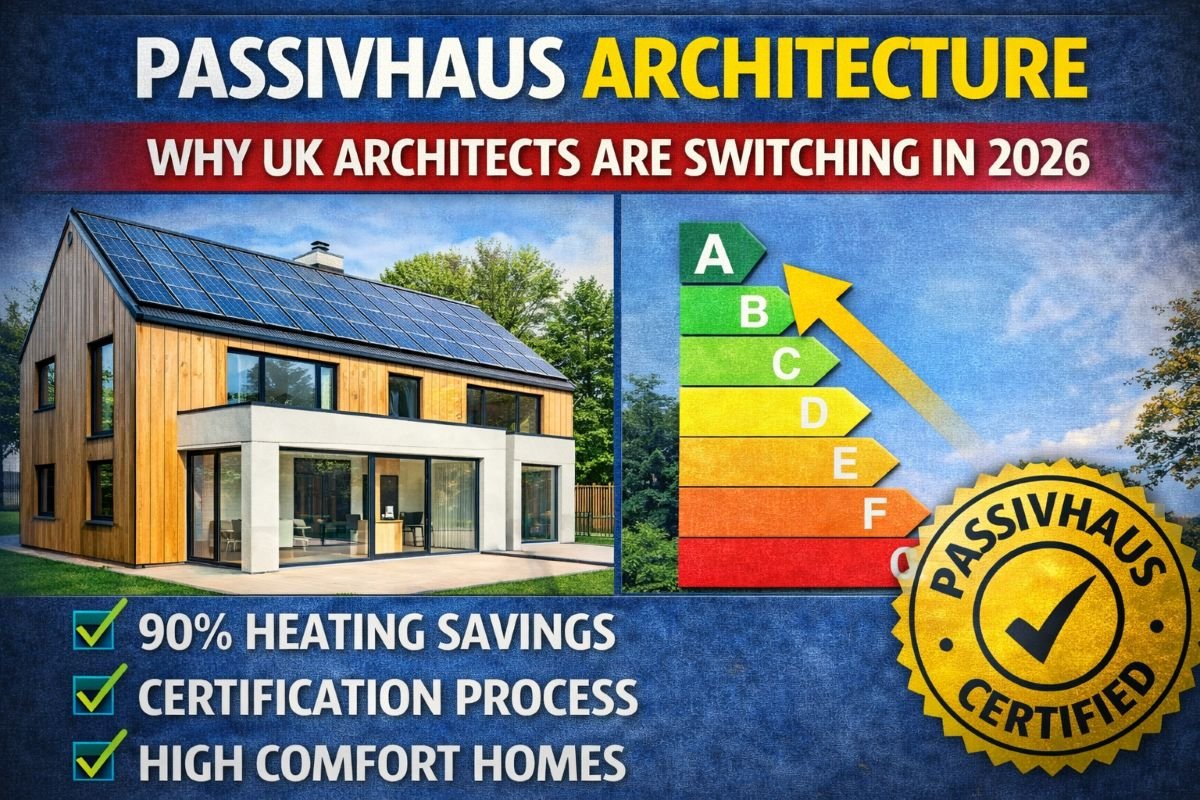
Passivhaus architecture delivers up to 90% heating energy savings compared to standard UK homes while maintaining superior thermal comfort year round. This German-origin building standard has gained significant traction among UK residential architects, particularly for London projects where energy efficiency and indoor air quality increasingly drive design decisions.
The Current State of Passivhaus Adoption in UK Residential Architecture
The UK Passivhaus Architecture movement has reached a pivotal milestone. According to the Passivhaus Trust, as of February 2025, there are over 2,250 certified Passivhaus homes in the UK, with more than 8,000 homes currently in the pipeline. Passivhaus now represents 1% of all new UK housing projects, assuming approximately 2,000 pipeline projects complete annually.
This growth trajectory has prompted the Passivhaus Trust to set an ambitious target of achieving 10% of all new UK homes by 2035—a tenfold expansion within a decade. The momentum stems from multiple factors: policy changes, funding initiatives, and the proven performance of Passivhaus architecture in addressing the energy bill crisis affecting UK households.
Regional adoption varies significantly. In Scotland, approximately 60% of new schools aim for Passivhaus standard, and the Scottish Government’s second policy consultation on a Passivhaus equivalent for new builds is scheduled for early 2026, with mandatory implementation expected in 2028. Meanwhile, in London, major developers including Barratt London announced in May 2025 that all their residential schemes will meet or exceed Passivhaus Architecture standards.
| Region | Passivhaus Projects | Key Driver | Timeline |
|---|---|---|---|
| Scotland | 60% of new schools | Government policy consultation | Mandatory by 2028 |
| London | Major developer commitments | Energy crisis response | Current rollout |
| England (broader) | 2,250+ certified homes | Voluntary adoption | 10% target by 2035 |
Proven Energy Performance: What the Data Shows for UK Passivhaus Projects
Real-world performance data validates Passivhaus claims. A comprehensive study examining 97 UK Passivhaus dwellings across 13 sites found mean observed space heating demand of 10.8 kWh per square metre annually, with no statistically significant difference from the predicted demand of 11.7 kWh per square metre annually. This contrasts sharply with the estimated 145 kWh per square metre annually for average UK homes a reduction exceeding 90%.
London-specific projects demonstrate even more impressive results. According to bere architects, the Camden Passivhaus Architecture London’s first certified Passive House achieved total metered gas and electricity consumption of just 65 kWh per square metre per annum, making it one of the lowest energy dwellings ever monitored in the UK. The two-bedroom house delivered 90% heating energy savings compared to existing housing stock.
A retrofit project in South-West London by RDA Architects showcased the Enerphit standard’s effectiveness for existing buildings. The modernist 1960s house refurbishment achieved energy consumption of 25 kWh per square metre 88% less than an average UK home. The photovoltaic panel system generates 7.8kW, accounting for 77% of the home’s total energy needs.
Passivhaus buildings consistently perform as designed, eliminating the notorious “performance gap” that plagues conventional UK construction. According to research published in Energy and Buildings, this reliability stems from the rigorous quality assurance process built into Passivhaus certification, ensuring theoretical models translate into real world performance one of the defining characteristics of Passivhaus architecture.
Financial Viability: Construction Costs and Long-Term Returns
The cost narrative around Passivhaus has shifted dramatically. According to the Passivhaus Trust, the typical cost uplift for Passivhaus Architecture certification is now less than 8% when factoring in savings from reduced heating equipment requirements and economies of scale. This represents a significant reduction from earlier estimates and reflects growing supply chain maturity for high-performance building components central to Passivhaus architecture.
Construction costs in the UK vary by project type. New passive house construction ranges from £1,500 to £3,000 per square metre, while retrofitting existing buildings to Enerphit standard costs £500 to £1,000 per square metre. These figures include materials, labour, design, and certification but must be contextualized against long-term operational savings.
Read More: Permitted Development Rights 2026: What You Can Build Without Planning Permission
The return on investment becomes compelling when examined over a building’s lifecycle. Homes achieving 90% heating energy reductions see proportional utility bill decreases, with the initial cost premium typically recovered within 15-20 years through energy savings alone. As energy prices continue rising, this payback period shortens further.
| Cost Category | New Build (per m²) | Retrofit (per m²) | Notes |
|---|---|---|---|
| Standard UK construction | £1,400-£2,200 | £400-£800 | Building Regulations compliant |
| Passivhaus certification | £1,500-£3,000 | £500-£1,000 | 8% typical uplift |
| Cost premium | ~£100-£800 | ~£100-£200 | Offset by equipment savings |
| Energy bill savings | 90% reduction | 88% reduction | Based on documented case studies |
Beyond direct energy savings, Passivhaus Architecture homes command premium resale values due to demonstrably lower operating costs and enhanced comfort levels. As building regulations tighten and buyer awareness grows, this value premium is expected to increase.
Health and Comfort Benefits: Beyond Energy Efficiency
While energy performance drives initial interest, occupant experience increasingly motivates UK architects to specify Passivhaus standards for residential projects. The mechanical ventilation with heat recovery (MVHR) systems central to Passivhaus design deliver continuous filtered fresh air, removing pollen, dust, and particulates regardless of outdoor conditions.
According to the Passivhaus Trust, the health implications are significant. Children in Passivhaus homes show dramatically reduced asthma development rates, while hay fever sufferers benefit from filtered fresh air delivery 24/7. Indoor air quality remains consistently high without the need to open windows, particularly valuable in urban London environments with poor outdoor air quality.
Thermal comfort represents another differentiating factor. Research demonstrates that internal temperatures in Passive Houses do not fall below 16 degrees Celsius even without active heating. Passivhaus homes maintain constant comfortable temperatures year-round in every room, eliminating cold spots common in conventionally built UK homes.
Acoustic comfort also improves substantially. The airtight construction, triple-glazed windows, and continuous insulation that characterize Passivhaus buildings provide excellent sound insulation. For residential architects in London working on projects near busy roads or in dense urban environments, this represents a significant quality-of-life improvement for occupants.
The superior building envelope also addresses summer overheating concerns. Contrary to misconceptions, properly designed Passivhaus homes avoid overheating through strategic window placement, external shading, and the MVHR system’s ability to provide night cooling. This holistic environmental performance underlines why Passivhaus architecture continues to gain momentum in the UK market.
The Certification Process: What UK Residential Projects Need to Know
Passivhaus certification involves rigorous third-party review throughout the project lifecycle. According to the Passivhaus Trust certification guidance, internationally accredited Passivhaus Certifiers review technical design, construction information, and Passive House Planning Package (PHPP) calculations at key project stages.
The process begins during design development. Certification is not a final check but an integrated quality assurance framework that guides decision-making from concept through completion. Certifiers verify that designs meet specific performance criteria before construction begins, including maximum heating demand of 15 kWh per square metre annually and primary energy demand under 120 kWh per square metre annually.
Construction phase verification ensures the built reality matches certified designs. This includes on-site inspections to verify insulation continuity, window installation quality, and airtightness testing results. The airtightness requirement maximum 0.6 air changes per hour at 50 Pascals pressure—demands exceptional construction quality rarely achieved in conventional UK builds.
For existing buildings, the Enerphit standard provides a relaxed alternative with maximum heating demand of 25 kWh per square metre annually. This recognizes the practical constraints of retrofitting heritage or structurally complex buildings while still delivering substantial performance improvements over standard renovations.
All accredited Passivhaus Certifiers working in the UK participate in the UK Certifiers Circle, chaired by the Passivhaus Architecture Trust. Bi monthly meetings review UK specific topics, share best practice, and pursue alignment, ensuring consistent certification standards nationwide. This collaborative framework supports architects specializing in residential architecture by providing clear guidance and reducing regional variation in interpretation.
Certification is awarded upon building completion after verifying all criteria have been met. The investment in certification both time and cost pays dividends through superior building performance, enhanced marketability, and qualification for various green building incentives key reasons why Passivhaus architecture is increasingly specified by forward-thinking UK architects.
Frequently Asked Questions
What is the difference between Passivhaus and Passive House?
Passivhaus and Passive House refer to the same building standard. Passivhaus is the original German term, while Passive House is the English translation. Both describe buildings meeting specific energy performance criteria set by the Passive House Institute, including a maximum heating demand of 15 kWh per square metre annually. In the UK, both terms are used interchangeably, though Passivhaus remains more common within the architectural profession.
How much does Passivhaus certification cost for a London residential project?
Passivhaus certification typically adds less than 8% to overall construction costs when factoring in savings from reduced heating equipment needs. For new builds in London, construction costs range from £1,500 to £3,000 per square metre, while retrofit projects cost £500 to £1,000 per square metre. The initial investment is offset by long-term energy bill savings, with homes achieving up to 90% heating energy reductions compared to standard UK housing.
Does Passivhaus work in the UK climate?
Yes, Passivhaus works exceptionally well in the UK climate. A large-scale study of 97 UK Passivhaus dwellings showed mean space heating demand of 10.8 kWh per square metre annually, closely matching predicted performance of 11.7 kWh per square metre annually. This compares to approximately 145 kWh per square metre annually for average UK homes. The UK’s moderate climate actually makes it ideal for Passivhaus Architecture standards, as buildings maintain comfortable temperatures year-round without extreme heating or cooling demands.
What are the five key principles of Passivhaus design?
The five key Passivhaus principles are: 1) Superior insulation with continuous thermal envelope eliminating cold bridges, 2) High-performance windows and doors (typically triple-glazed), 3) Airtight construction preventing uncontrolled air leakage, 4) Mechanical ventilation with heat recovery (MVHR) systems providing filtered fresh air, and 5) Thermal bridge-free design ensuring consistent insulation throughout. Together, these principles deliver maximum heating demand of 15 kWh per square metre annually and primary energy demand under 120 kWh per square metre annually.
Is Passivhaus certification mandatory in the UK?
Passivhaus certification is not currently mandatory for most UK residential projects, though Scotland is implementing a Passivhaus-equivalent standard for new builds expected to become mandatory in 2028. As of February 2025, approximately 1% of all new UK housing projects are built to Passivhaus Architecture standard voluntarily. The Passivhaus Trust aims to increase this to 10% by 2035. While not legally required, many forward-thinking architects and developers pursue certification to demonstrate superior energy performance and meet growing client demand for sustainable housing.
Read more: 7 Apartment Building Security Trends Property Managers Can’t Ignore in 2026
