


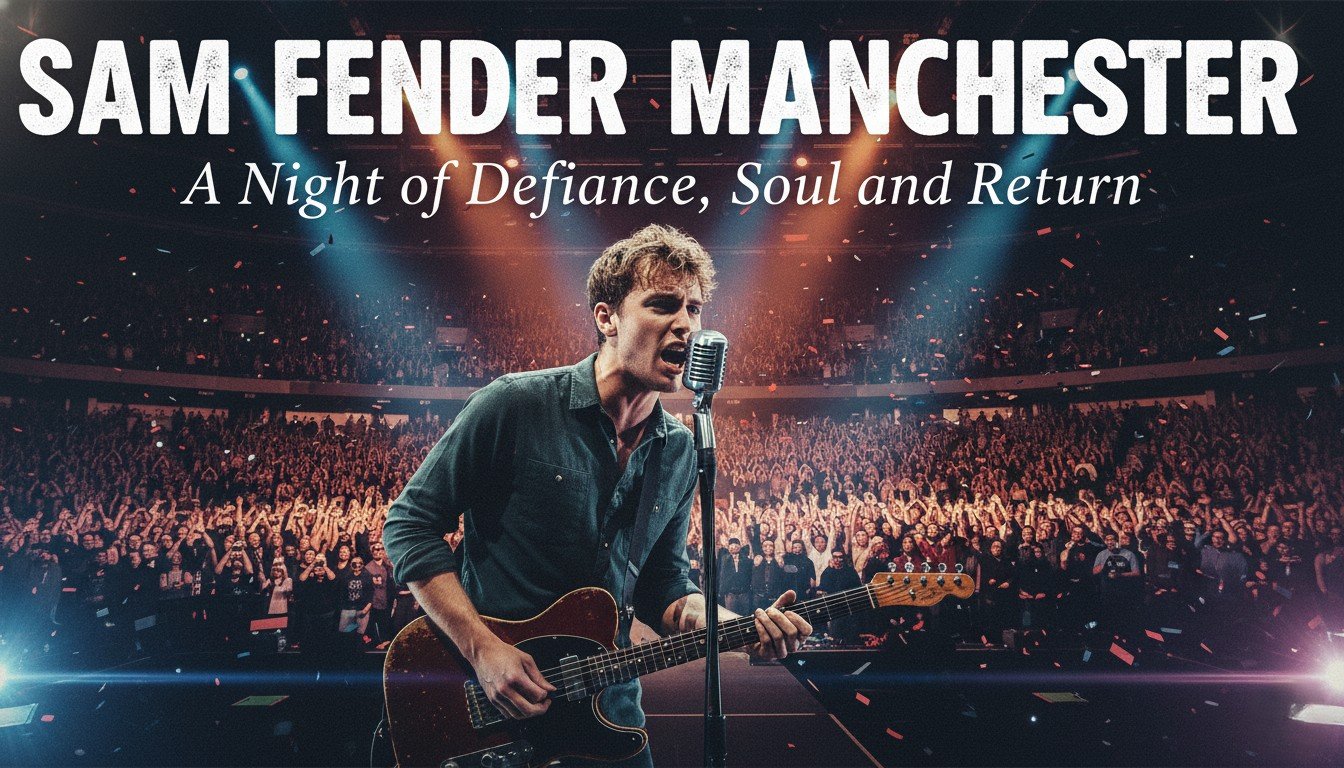
When Sam Fender rolled into Manchester, it wasn’t just another tour stop; it was a cultural waypoint. For the sam fender manchester show to resonate as deeply as it did, it meant more than loud guitars and shouted choruses — it meant an artist confronting the fractures of his identity, his roots, and his audience in one of Britain’s most storied live-music cities. In Manchester, Fender didn’t simply perform; he issued a call to arms for authenticity, class consciousness, and communal release.
In this feature, I’ll dissect how the same Fender Manchester moment became one of the most charged in his burgeoning career, why it matters, how it mapped his evolution, and what it tells us about the state of British rock today.
From North Shields to Manchester: Context and Stakes
While Fender hails from North Shields, far removed geographically and culturally from Manchester, that distance is part of the point. His journey — from small venues, working-class roots, earnest anthemic songwriting — to a Manchester show with the scope and intensity it carried, signals the gap he’s crossed, and the audience he seeks to bridge.
The same Fender Manchester performance was framed within his “People Watching” era, following his previous albums that rooted him in the North East and in working-class narratives. What Manchester offered was both symbolic and practical: a city with a rich rock lineage, an industrial past, and cultural swagger — and an audience that knows what it is to feel left behind.
This Manchester stop, therefore, was not just another date; it was a test of whether Fender could translate his personal geography into national resonance. He arrived with expectation, and he delivered.
Live from Wythenshawe Park: The Stage Is Set
One of the most memorable chapters of Sam Fender Manchester took place at Wythenshawe Park in South Manchester on 16 August 2025. The choice of outdoor setting — grass, open air, a city-on-a-good-day vibe — allowed Fender’s, at times, rough-hewn edge to find space and depth. The audience ranged from die-hard fans to those drawn in by word of mouth; the weather and setting combined to produce a live environment that felt simultaneously intimate and epic.
The set list reflected this dual ambition. He performed many of his recent tracks in Manchester, underscoring how Sam Fender Manchester was far from a nostalgia show. He laid out themes of resilience, identity, disillusionment, and hope sung loud but with a vulnerability that matched Manchester’s own story of grit and renewal.
Craft and Sound: How Fender Translated the Moment
Anthemic vs. Vulnerable
One of the defining tensions of Sam Fender Manchester was how the songs oscillated between large-scale rock anthems and finely wrought emotional moments. Fender’s voice — the high tenor, distinctly Geordie, gritty with lived testimony — was on full display. His guitar tone pulled from British rock tradition but also placed him firmly in 21st-century indie-rock reality.
In Manchester, that dichotomy was heightened: when the chorus of a track like “Seventeen Going Under” rang out, the crowd shouted back, but when the verses turned inward, you could hear a pin drop. The same Fender Manchester night thus became a study in scale: big enough for mass catharsis, intimate enough for self-reflection.
Working-Class Roots and Manchester Resonance
Fender rarely shies from class from the anxieties of youth, from the labouring body, from the silenced voice. In Manchester, with its rich heritage of industrial decline and musical protest, the connection was made. His lyrics drew on his upbringing, yet they translated the experience of marginalisation, the longing for connection, and the transformation of survival instincts into art. The fact that Manchester embraced him suggests that the same Fender Manchester chapter is also about universality.
Stagecraft and Crowd Engagement
The stage picture in Manchester — open-air park, dusk light, large crowd swelling into the horizon — gave Fender room to breathe, to move, to connect. The show felt raw and electric under the open sky. He invited the audience in rather than towering over them. That kind of energy is rare in stadium-like contexts, but the sam fender manchester approach made it feel like a communal event.
Why Sam Fender Manchester Matters for His Career
Validation of Scale
Manchester was a proving ground. The fact that Fender could sell out large venues, command a crowd, and not lose his edge means that Sam Fender Manchester wasn’t just a good night — it was a strategic pivot. It says: I’ve arrived at that next tier.
Regional Identity Meets National Platform
Fender’s rootedness in the Northeast, within a working-class narrative, has been core to his identity. But when the same Fender Manchester show connected so strongly in another city removed from his home turf, it signalled a translation of regional identity into national (and potentially international) currency. He’s no longer just the “North Shields lad” but a voice speaking across Northern experience more broadly.
Read More: Jasmine Harman’s Renovation in the Sun: A Dream Home Adventure
Cultural Signal: Rock Isn’t Dead
In a landscape where guitar-driven rock often feels sidelined by pop, hip-hop or electronic, the success of Sam Fender Manchester reinforces that there is still an appetite for rock with heart and edge. Fender, leveraging Manchester’s historical weight — think of the city’s past with bands, movements, and cultural shifts — points to rock’s ongoing relevance.
Manchester and the Legacy: What It Leaves Behind
Audience Memory and Local Impact
For Manchester audiences, a Sam Fender show in Manchester will likely become one of those nights people refer to, saying, “Remember when Sam Fender played Wythenshawe?” It builds local legend. It adds to the city’s live-music story. The ripple effect is both emotional (for fans) and practical (for local promoters, for Fender’s brand).
The “So What?”
If you’re wondering what Sam Fender Manchester means beyond one live show, here’s the takeaway: it signals an artist stepping from regional specificity into wider relevance, without diluting his voice. It’s a moment where the mythos of Manchester — industrial, musical, defiant — meets a musician who wants to innovate within tradition. And for culture critics, it marks a reaffirmation that rock music, with purpose and place, still finds its lifeblood.
Conclusion
The same Fender Manchester moment was more than a concert: it was a milestone. For Sam Fender, the night in Manchester wasn’t just about the songs — it was about proving that his narrative, his energy, his craft work at scale, in a city that demands authenticity. The night may end, but the echo remains: audiences want rock that feels real, rooted, unafraid.
In Manchester, he didn’t simply show up; he asserted. He didn’t just play; he connected. And as rock marches forward in a new decade, the same Fender Manchester chapter makes it clear: this is still a genre alive in community, in place, and in truth.
Read More: Carlos Alman, The Dominican Father Behind Cardi B
