

When Soho House Manchester quietly opened inside the former Granada Studios, it did more than add another luxury venue to the city. It reopened a long-running Manchester debate about creativity, exclusivity, and who the city is really being built for.
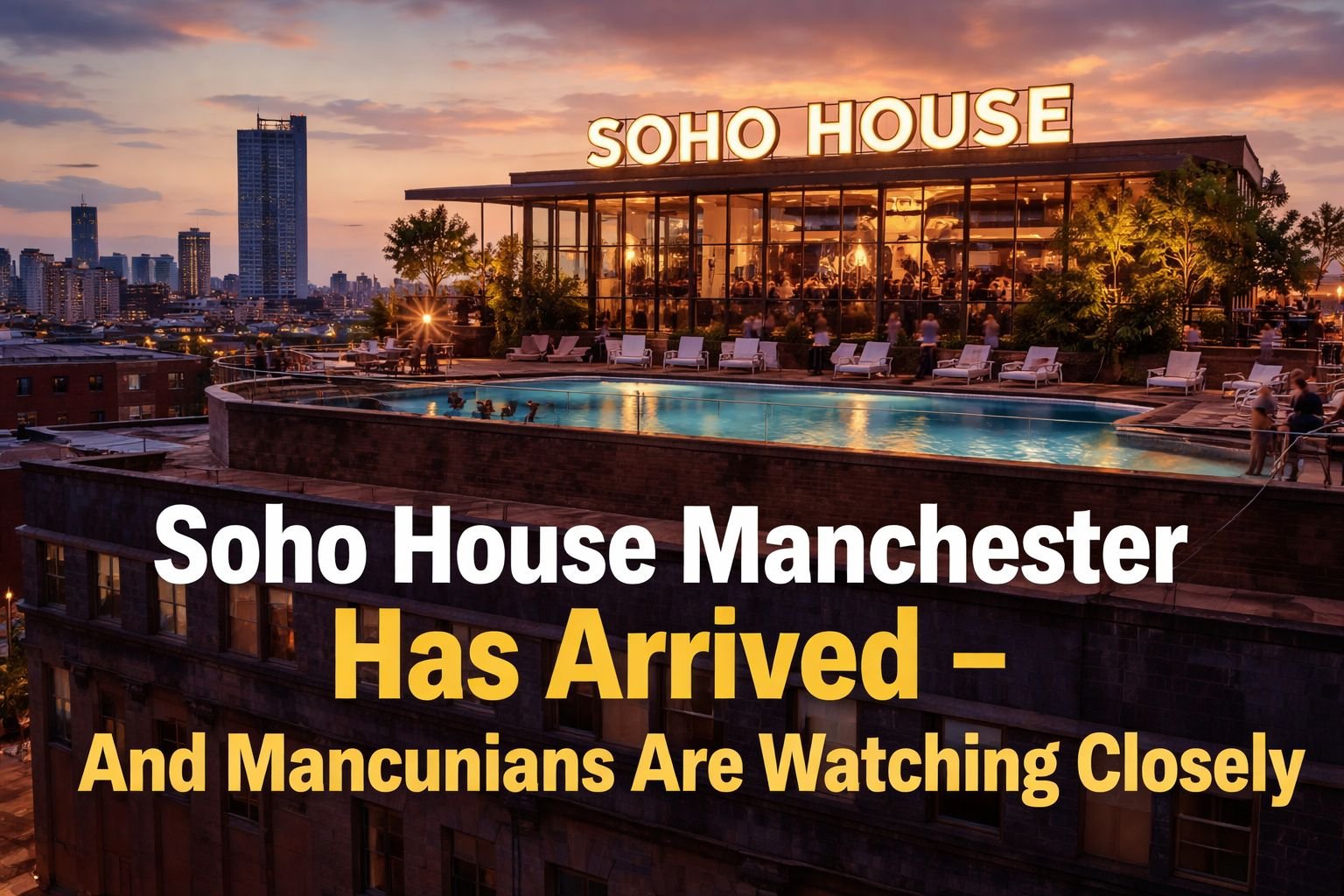
This is not just another bar or hotel launch. Soho House Manchester arrives with a heated rooftop pool overlooking the skyline, multi-level lounges, members-only bedrooms, wellness facilities, and a selective application process that has already sparked conversation across the city. For some, it represents overdue recognition of Manchester’s creative power. For others, it raises concerns about accessibility and the creeping influence of London-style exclusivity.
The real question is not whether Soho House Manchester will succeed. The question is whether it can feel genuinely Mancunian.
Why Soho House Manchester matters right now
Manchester’s timing matters as much as the opening itself.
The city’s creative and digital economy is at its largest point in history. Media, technology, design, and production industries now employ tens of thousands across Greater Manchester. City-centre regeneration has accelerated, late-night venues for professionals remain limited, and global brands are increasingly choosing Manchester with London-level confidence.
Soho House Manchester sits directly within this shift. It is not creating change on its own. It is stepping into a city already changing fast.
What Soho House Manchester is and why the city fits
Soho House began as a private members club aimed at creatives rather than corporate elites. Over three decades, it has expanded into a global network with locations across Europe, North America, and Asia.
Soho House Manchester is the brand’s first move into Northern England, and the decision is deliberate. Manchester offers scale, ambition, and cultural credibility without the saturation seen in London. For the brand, it is expansion into a mature but still hungry market. For the city, it is international recognition of a creative economy that has long operated without needing approval from the capital.
Manchester does not lack talent or ideas. What it has lacked is a single, premium space designed to blend work, leisure, networking, and nightlife under one roof.
Granada Studios and the symbolism locals notice
Soho House Manchester occupies upper floors of Granada Studios, a building deeply embedded in the city’s cultural memory. This was the birthplace of Coronation Street and a cornerstone of Northern broadcasting for decades.
After ITV’s departure to MediaCity, the studios fell silent. The St John’s regeneration project has since transformed the area into a mixed-use district combining culture, enterprise, hospitality, and residential space.
The symbolism is not lost on Mancunians. Granada Studios once represented Manchester exporting culture on its own terms. Now it houses a global private members club making its Northern debut. Whether that feels like progress or irony depends on who you ask.
Inside Soho House Manchester and what members actually get
Soho House Manchester spans more than 44,000 square feet across multiple floors.
Members have access to lounges designed for working and socialising, alongside dining spaces curated specifically for Manchester. Late-night areas host DJs and live programming, offering something the city has historically lacked at the premium end of nightlife.
There are 23 members-only bedrooms, ranging from compact rooms to larger suites, plus a private apartment designed for longer stays. A health club is also part of the offering, with gym facilities, Pilates, sauna and steam rooms planned.
The headline feature is the rooftop pool. Heated and designed for year-round use, it is Manchester’s first of its kind in a private members club. Given the city’s weather, the emphasis on all-season access feels practical rather than indulgent.
Together, these amenities position Soho House Manchester as a place designed for entire days, not just evenings.
Who Soho House Manchester is really for
Officially, Soho House Manchester prioritises creatives. Membership applications require professional details, recommendations from existing members, and approval by a committee. Local membership costs £2,400 per year, with higher tiers available for global access.
In reality, the definition of creative is broad. Manchester’s creative workforce includes designers, freelancers, agency owners, media professionals, tech founders, and consultants whose work sits somewhere between culture and commerce. Membership will inevitably skew toward those with stable incomes and established networks.
Discounted rates for younger members acknowledge early-career realities, but even reduced fees represent a serious commitment. This has fuelled debate about whether Soho House Manchester reflects Manchester’s traditionally open creative culture or creates a parallel space reserved for those who can afford it.
How Mancunians actually feel about Soho House Manchester
Reaction across the city has been mixed. Some welcome Soho House Manchester as overdue recognition of a city that has long punched above its weight creatively. Others question whether Manchester needs validation from a London-founded brand at all.
Concerns are less about gentrification in the abstract and more about access. Manchester’s creative success has historically been driven by affordability, collaboration, and strong grassroots scenes. A members club with high fees and selective entry inevitably excludes large parts of that ecosystem.
Comparisons with existing clubs are common. Manchester already has premium spaces at far lower cost. What sets Soho House Manchester apart is scale, brand power, and the promise of global connectivity. Whether that difference justifies the price remains a personal judgement.
Impact on Manchester nightlife and business culture
Manchester’s nightlife has always thrived on diversity, from underground venues to polished city-centre bars. Soho House Manchester occupies a distinct niche, blending workspace, dining, wellness, and late-night culture under one roof.
For freelancers and remote workers, it offers a consistent base beyond cafes and hotel lobbies. For founders and investors, it provides an environment where business conversations flow naturally into social ones.
Private members clubs have long functioned as informal deal-making spaces. If Soho House Manchester succeeds, it could become one of the city’s key meeting points for the creative and tech economy. If it fails, it risks being seen as an expensive bubble detached from the wider city.
How Soho House Manchester compares with London
London has multiple Soho House locations and a dense ecosystem of competing private clubs. Manchester does not. That gives Soho House Manchester less competition but higher expectations.
Design choices reference local history more directly than some southern locations, suggesting an effort to avoid exporting a London template wholesale. Pricing aligns with other UK houses, but Manchester’s creative workforce is generally younger and less internationally mobile, which may shape how much value members place on global access.
With fewer direct rivals, Soho House Manchester has a rare opportunity to define what a private members club looks like in the North.
What Soho House Manchester means for the city’s future
Soho House Manchester is both a signal and a test. It signals that Manchester is now seen as a city capable of supporting premium global brands. It tests whether that growth can coexist with the openness that has fuelled the city’s creative success.
The wider St John’s district aims to blend culture, work, and living into a single ecosystem. Soho House Manchester fits that vision as the social anchor. Whether the district remains inclusive will shape how it is perceived over time.
Community initiatives and genuine local engagement will matter. If Soho House Manchester invests meaningfully in Manchester’s talent, criticism may soften. If those efforts feel superficial, scepticism will harden quickly.
Read More: Parklife 2026: The Manchester Festival Explained by Someone Who Lives With It
The verdict from a Manchester perspective
Soho House Manchester is impressive, well-executed, and fills gaps the city genuinely had. The facilities are strong, the location is symbolic, and the ambition is clear.
But Manchester does not grant credibility based on price or pedigree. The city has built world-changing music, media, and creative movements without private members clubs or global brands. Whether Soho House Manchester becomes part of that story depends on how well it listens to the city around it.
For now, it is open, the pool is heated, and the debate is very much alive. In Manchester, credibility is never bought. It is earned slowly, locally, and without asking for permission.
Read More: Ducie Street Warehouse: Why Manchester’s Most Misunderstood Venue Might Finally Be Coming of Age