


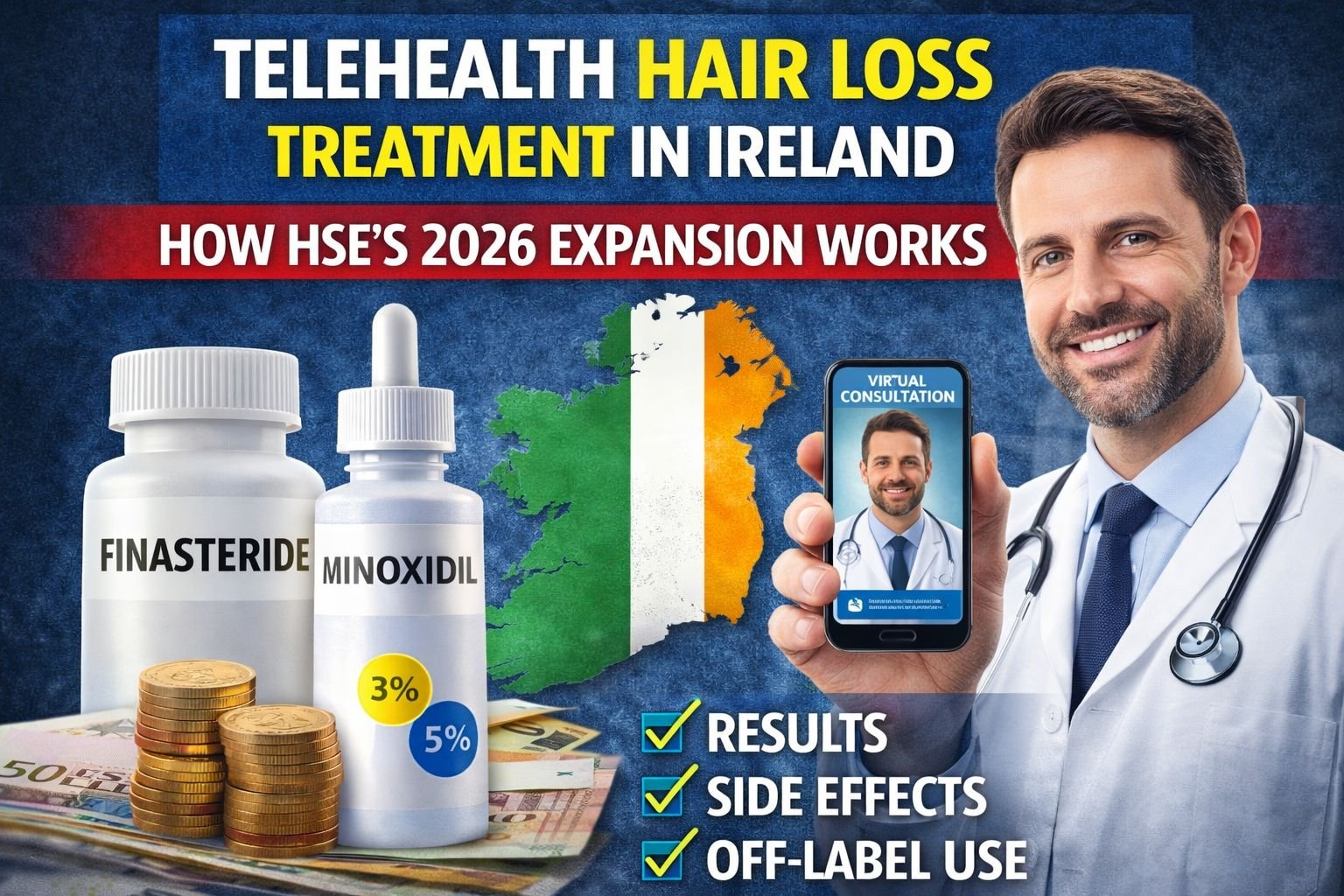
The HSE plans to sign contracts in Q2 2026 for a nationwide remote health monitoring rollout, enabling faster access to hair loss prescriptions through virtual consultations. This €15 million expansion will transform how Irish men access finasteride and minoxidil treatments.
What HSE’s €15 Million Telehealth Rollout Means for Hair Loss Patients
According to HSE’s official announcement, contracts with telehealth providers will be signed in Q2 2026, with nationwide implementation commencing around June 2026. The aim is to appoint a single supplier to deliver an end-to-end, vendor-managed solution enabling national rollout of remote health monitoring services across the Irish health system.
By the end of 2026, thousands more patients across Ireland will benefit from remote health monitoring in specialties including Respiratory, Cardiology, Oncology, Stroke, Maternity, and Older Persons services. While hair loss isn’t explicitly listed in the initial rollout, the infrastructure creates opportunities for private telehealth providers to integrate with HSE systems, potentially improving prescription pathways for treatments like finasteride.
Medical Independent reports that based on international and national experience, 20-25% of patients could benefit from remote health monitoring technologies. This expansion addresses long-standing access gaps in Ireland’s healthcare system, where specialist appointments can take months.
| HSE Telehealth Metric | 2026 Target | Impact on Hair Loss Care |
|---|---|---|
| Budget Allocation | €15 million | Infrastructure supporting private telehealth |
| Contract Signing | Q2 2026 | Standardized virtual care protocols |
| Nationwide Rollout | June 2026 | Regional service hubs for prescriptions |
| Patient Reach | 20-25% eligibility | Faster finasteride/minoxidil access |
The planning approach includes establishing regional service hubs and integration with existing virtual care models, which could streamline how telehealth platforms like Sons.ie coordinate with pharmacies and medical councils.
How Ireland’s Telehealth Regulations Currently Handle Hair Loss Prescriptions
According to the IBA Healthcare and Life Sciences Law Committee’s Ireland survey, there is no specific legislation addressing telemedicine services in Ireland. However, health service providers must still comply with applicable legislation, regulation, and Medical Council guidance.
Healthcare providers offering telemedicine services to patients within Ireland must be registered with the Medical Council. While Medical Council guidance has no statutory effect, derogations from the guidelines may constitute a breach of professional duty by medical doctors, as noted by the Law Society of Ireland.
For hair loss treatments, this means finasteride and minoxidil prescriptions require IMC-registered doctors to review patient questionnaires and approve treatment. According to WebDoctor.ie, one of their IMC-registered doctors reviews your answers and approves treatment if suitable, with digital prescriptions sent to a pharmacy of choice within 2-3 hours via secure Healthmail.
The Irish Medical Times emphasizes that telemedicine must meet the same ethical standards as traditional face-to-face consultations, with strong security measures and clear information policies required.
| Regulation Aspect | Current Requirement | 2026 HSE Impact |
|---|---|---|
| Doctor Registration | Medical Council mandatory | Standardized credentials across HSE hubs |
| Prescription Delivery | Secure Healthmail to pharmacy | Integrated regional hub coordination |
| Restricted Medications | Benzodiazepines limited via telehealth | Clearer protocols for controlled substances |
| Patient Safeguards | Security measures + information policies | National quality standards enforcement |
Regarding prescription restrictions, certain drugs like benzodiazepines, Z-drugs, and opioids should only be prescribed via telemedicine in limited situations. Finasteride and minoxidil fall outside these restrictions, making them ideal candidates for expanded telehealth access under the HSE’s 2026 framework.
The Current State of Online Hair Loss Treatment Access in Ireland
Irish men already access hair loss treatment through multiple telehealth platforms, with online consultations starting from €25. WebDoctor.ie and CareOnCall.ie offer finasteride prescriptions for as little as €25, while LloydsPharmacy Online Doctor and Superdrug Online Doctor provide similar services.
The process is straightforward: complete a short questionnaire, have an IMC-registered doctor review your answers, and receive a digital prescription sent to your chosen pharmacy within 2-3 hours. According to Healthwave.ie, your prescription will be sent directly to your pharmacy by secure email (Healthmail).
While the brand Propecia isn’t licensed in Ireland in this form, other treatments using the same active ingredient finasteride—like Fintrid and Proscar—are available. Doctors can prescribe Fintrid and Proscar on the basis of taking a quarter of a tablet daily, as noted by LloydsPharmacy Online Doctor IE.
Clinical effectiveness remains strong: in studies, finasteride has been shown to be up to 90% effective in slowing or reversing hair loss, though you need to take it daily for 3-6 months before seeing changes. Sons.ie is the Irish license holder for both finasteride and minoxidil, the only two treatments clinically proven for hair loss.
| Telehealth Provider | Consultation Fee | Prescription Time | Medications Offered |
|---|---|---|---|
| WebDoctor.ie | €25 | 2-3 hours | Finasteride (Fintrid, Proscar) |
| CareOnCall.ie | €25 | 2-3 hours | Finasteride, Minoxidil |
| Sons.ie | Varies | <1 minute recommendation | Finasteride, Minoxidil, Biotin |
| LloydsPharmacy Online | Varies | 2-3 hours | Finasteride |
The HSE’s 2026 expansion could integrate these private providers into regional service hubs, reducing prescription delivery times and enabling better monitoring of treatment outcomes through standardized virtual care protocols.
Why Remote Monitoring Matters for Long-Term Hair Loss Treatment Success
Hair loss treatment requires sustained adherence over months and years, making remote monitoring particularly valuable. According to PubMed research on finasteride, after 5 years of use, approximately 90% of men taking finasteride will either have more hair or the same amount of hair as they had at the start of treatment—but only if they maintain daily dosing.
The HSE’s telehealth roadmap emphasizes that virtual care helps patients avoid hospitalization and facilitates earlier discharge following hospital stays, whilst delivering efficiencies and cost savings. These same principles apply to chronic conditions like male pattern baldness, where continuous treatment is essential but frequent in-person consultations aren’t necessary.
Sons.ie’s subscription model exemplifies this approach: patients receive ongoing clinician support with medications delivered directly to their door, and can cancel or customize plans anytime. This is precisely the type of patient-centered care the HSE’s 2026 expansion aims to standardize across specialties.
Remote monitoring also enables data-driven treatment adjustments. If a patient reports side effects or inadequate hair regrowth after 6 months, clinicians can modify dosing or switch between finasteride and minoxidil without requiring an in-person appointment. The HSE’s end-to-end vendor-managed solution will likely incorporate these feedback mechanisms across all participating specialties.
| Treatment Phase | Traditional Care Challenge | Remote Monitoring Solution |
|---|---|---|
| Initial Prescription | Long wait for GP appointment | 2-3 hour questionnaire approval |
| 3-Month Check-in | Scheduling conflicts, time off work | Virtual progress photo review |
| 6-Month Adjustment | Repeat GP visit for dosage change | Instant clinician messaging |
| Long-Term Adherence | Prescription refill delays | Automatic subscription delivery |
The consolidation of existing virtual projects running through Q4 2026 will create standardized protocols that private telehealth providers can adopt, improving care quality across Ireland’s fragmented hair loss treatment landscape.
What Patients Should Expect When HSE’s System Launches
The HSE’s 2026 telehealth expansion will create infrastructure that private hair loss treatment providers can leverage for improved service delivery. While hair loss treatments remain privately paid (not covered by NHS or public health in Ireland), the standardization of virtual care protocols will benefit patients in several ways.
First, expect clearer regulatory guidance. Currently, Ireland relies on Medical Council guidance rather than comprehensive statutory telemedicine legislation. The HSE’s national rollout will likely formalize standards for virtual consultations, prescription security, and patient data protection.
Second, regional service hubs will improve coordination between telehealth platforms and local pharmacies. Instead of individual providers managing their own prescription delivery systems, the HSE’s single-supplier model could enable shared infrastructure that reduces delivery times and ensures consistent quality.
Third, integration with existing HSE digital health systems may enable better monitoring of treatment outcomes. If private providers adopt HSE telehealth standards, patients could have unified digital health records tracking their hair loss treatment alongside other medical care.
For patients currently using services like Sons.ie or WebDoctor.ie, the transition should be seamless. These platforms already comply with Medical Council requirements and will likely integrate with HSE protocols as they’re formalized throughout 2026.
Frequently Asked Questions
When will HSE’s telehealth expansion for hair loss treatment begin?
The HSE plans to sign contracts with telehealth providers in Q2 2026, with nationwide rollout commencing around June 2026. By the end of 2026, thousands more patients across Ireland will benefit from remote health monitoring, with an estimated €15 million budget allocated for the expansion. The system will enable faster access to hair loss prescriptions through virtual consultations and remote monitoring.
How does telehealth hair loss treatment work in Ireland?
Telehealth hair loss treatment involves completing a short online questionnaire reviewed by IMC-registered doctors. If suitable, your prescription is sent to a pharmacy of your choice within 2-3 hours via secure Healthmail. Services like Sons.ie offer finasteride prescriptions starting from €25, with ongoing clinician support and subscription delivery directly to your door. All healthcare providers must be registered with the Medical Council.
What hair loss medications can be prescribed via telehealth in Ireland?
Irish telehealth providers can prescribe finasteride (in forms like Fintrid and Proscar) and minoxidil for male pattern hair loss. While the brand Propecia is not licensed in Ireland, other finasteride formulations using the same active ingredient are available. Finasteride has been shown to be up to 90% effective in slowing or reversing hair loss when taken daily for 3-6 months.
Is telehealth hair loss treatment regulated in Ireland?
Yes. Although Ireland has no specific telemedicine legislation, healthcare providers must be registered with the Medical Council and comply with existing regulations. Telemedicine services must meet the same ethical standards as traditional face-to-face consultations, with strong security measures and clear information policies in place. Certain medications like benzodiazepines should only be prescribed via telemedicine in limited situations.
How much does telehealth hair loss treatment cost in Ireland?
Online consultations for hair loss treatment in Ireland start from €25 with services like WebDoctor and CareOnCall. Finasteride prescriptions are available through telehealth platforms, with ongoing subscription plans for convenient delivery. Hair loss treatment is not covered by the NHS or public health system in Ireland, so patients pay privately. The HSE’s 2026 expansion may improve cost-effectiveness through integrated virtual care models.
Read More: FUE vs FUT: Understanding Scarring and Long-Term Aesthetic Outcomes
