

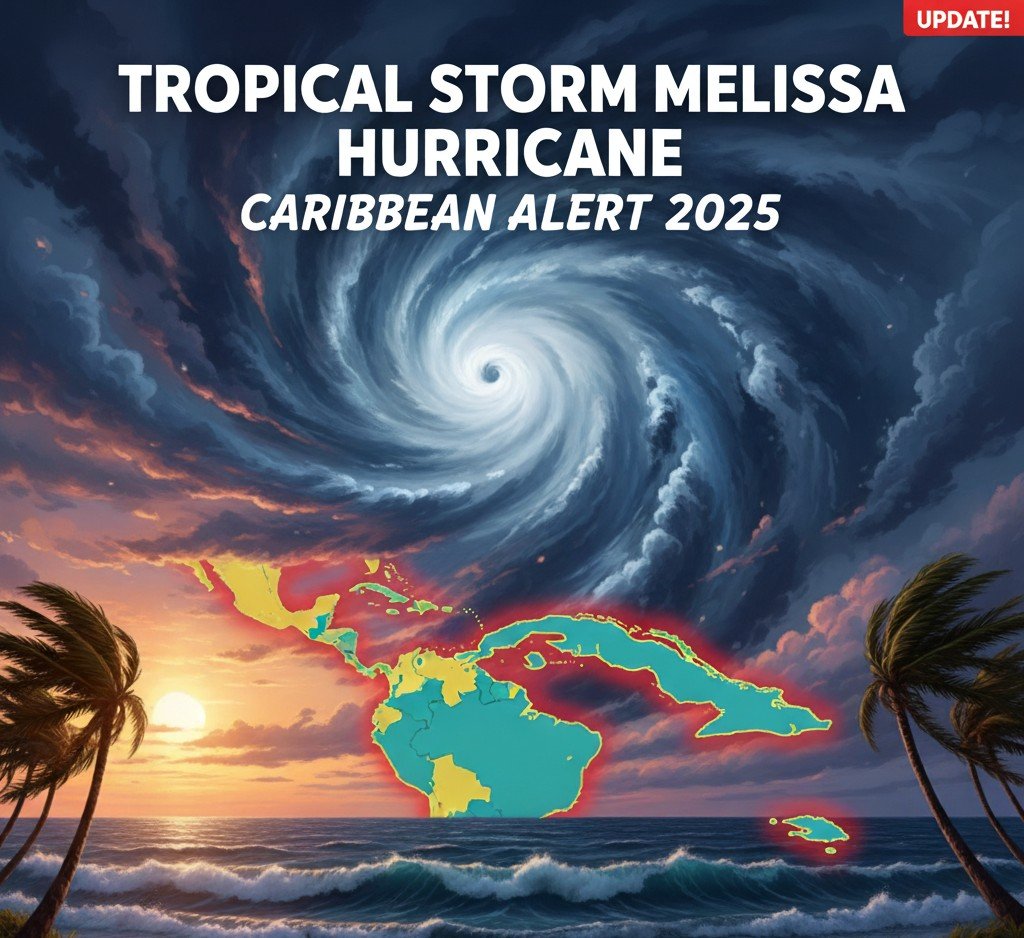
Tropical storm melissa hurricane has meteorologists issuing unprecedented warnings. The storm could unleash 130mph winds and 18 inches of rainfall. Over 3 million people face life-threatening conditions across the Caribbean. Will this become the season’s deadliest storm yet?
Tropical storm melissa hurricane formed on October 21, 2025, as the 13th named storm of the Atlantic hurricane season. Currently positioned 300 miles southeast of Kingston, Jamaica, Melissa maintains 50mph winds whilst moving at a crawling 2mph pace.
The National Hurricane Center has issued a hurricane watch for southwestern Haiti and a tropical storm watch for Jamaica. Expert forecasts predict Melissa will strengthen into a Category 3-4 hurricane by Monday, potentially becoming the fourth major hurricane of 2025. The storm’s exceptionally slow movement over 29-30°C waters creates perfect conditions for rapid intensification.
Historic Significance
Tropical storm melissa hurricane marks a historic milestone as the latest first Caribbean storm since 1997. This unprecedented timing has allowed sea surface temperatures to remain at 30°C or higher—conditions meteorologists describe as “extraordinarily favourable”.
The 2025 Atlantic season has already produced three Category 5 hurricanes, with only three previous seasons recording more than two such storms: 1932, 1999, and 2010. Hurricane researcher Phil Klotzbach from Colorado State University confirms this would make four of the first five hurricanes reaching Category 4 or above—a phenomenon recorded just three times previously.
The Caribbean has experienced an unusually quiet hurricane season, with no storms impacting the region until now. This absence has created a dangerous scenario where untapped warm waters provide exceptional fuel for tropical storm melissa hurricane development.
Storm’s Dangerous
Tropical storm melissa hurricane began as a tropical wave over the southern Caribbean on October 20, 2025. Within 24 hours, it had organised into a tropical depression before rapidly strengthening to tropical storm status.
The storm’s development occurred over exceptionally warm waters with temperatures 4-5 degrees above average. NOAA Hurricane Hunter aircraft have been conducting reconnaissance flights, revealing a compact inner core that meteorologists warn could trigger extremely rapid intensification.
AccuWeather Chief Meteorologist Bernie Rayno explains: “Water temperatures in the path of Melissa in the Caribbean are in the upper 80s F, which provides tremendous fuel for intensification”. The storm currently faces westerly wind shear, but computer models suggest this disruptive factor may ease, allowing for explosive strengthening.
Weather expert Matt Lanza notes: “Melissa is going to slam on the brakes and meander in the central Caribbean for several days, with potential to become a strong hurricane”. This slow movement over extraordinarily warm waters creates the perfect recipe for a major hurricane development.
Faith & Identity
The name Melissa carries particular significance, having replaced Hurricane Michelle after that storm caused 48 deaths and $2.4 billion in damage during 2001. Fortunately, previous tropical storms named Melissa in 2007, 2013, and 2019 remained at sea without causing casualties.
For Caribbean communities, tropical storm melissa hurricane represents more than meteorological phenomena—it embodies the annual test of resilience that defines island life. Jamaican Meteorological Service head Evan Thompson emphasises the spiritual preparation required: “This is considerable rainfall, and it is the primary concern we should focus on right now”.
The storm arrives during a season when many Caribbean residents have lowered their guard due to the unusually quiet activity. Local communities are drawing upon decades of hurricane experience and traditional knowledge passed down through generations to prepare for tropical storm melissa hurricane.
Read More: Bottomless Brunch Manchester: 2025’s Wildest Weekend Experience
Expert Analysis
Leading meteorologists express unprecedented concern about tropical storm melissa hurricane. AccuWeather Chief Meteorologist Jonathan Porter warns: “There is growing concern about the potential for a life-threatening flooding disaster in parts of the Caribbean, particularly near steep terrain in Cuba, Haiti, and Dominican Republic”.
Hurricane specialist Michael Lowry from WPLG-TV explains the technical challenges: “Steering currents will largely collapse, leaving Melissa to drift for several days south of Cuba and Hispaniola, bringing potential for prolonged periods of heavy rains”.
The storm’s slow movement creates maximum danger. CNN meteorologist analysis reveals: “The longer it lingers, the more rain it dumps”. Computer models show significant disagreement on the storm’s path, with forecast cones resembling circles rather than traditional tracks.
Weather expert Nash Rhodes from FOX 13 predicts: “Melissa could become a Category 3 hurricane by Monday morning because it is over warm water and will encounter little wind shear”. Most concerning, some models suggest rapid intensification to Category 5 status due to the compact vortex structure and exceptional ocean heat content.
Community Impact
Tropical storm melissa hurricane threatens over 3 million people across Jamaica, Haiti, Dominican Republic, and Cuba. The storm’s slow movement means prolonged impacts lasting days rather than hours.
Eastern Jamaica faces the highest risk, with AccuWeather meteorologists predicting “extreme” threats to life and property. Wind gusts of 80-100mph could affect the island from Thursday through Tuesday. Southern Haiti could receive up to 18 inches of rainfall, creating catastrophic flooding conditions.
The Dominican Republic has already experienced traffic disruptions and cancelled sporting events from early rainfall bands. Haiti’s deforestation combined with socioeconomic vulnerabilities heightens the landslide risk significantly.
Cuba’s mountainous terrain will enhance rainfall totals whilst weakening wind intensity. However, the slow storm movement means days of continuous flooding across the island’s southern regions.
Future Prospects
Tropical storm melissa hurricane faces two primary scenarios, neither favourable for the Caribbean. Scenario One involves continued westward drift, keeping Melissa south of Jamaica whilst strengthening to Category 4-5 intensity by Monday.
Scenario Two sees an earlier northward turn, bringing the storm directly over Hispaniola as a Category 1-2 hurricane this weekend. This path would limit intensity but maximise flooding impacts on densely populated areas.
The United States mainland faces minimal direct threat, though rough seas and rip currents could affect the East Coast next week. Florida remains outside the current forecast cone, with steering patterns expected to guide Melissa eastward into the Atlantic.
Long-term climatology suggests late-season Caribbean storms often intensify rapidly before recurving northeastward. However, tropical storm melissa hurricane’s unique positioning over record-warm waters creates unprecedented uncertainty for forecasters.
Read More: Snow Weather Forecast Met Office: Truth Behind UK Winter Predictions
Frequently Asked Questions
When will tropical storm melissa hurricane become a hurricane?
Melissa is forecast to reach hurricane status by Friday or Saturday, October 25-26, 2025.
What wind speeds could tropical storm melissa hurricane reach?
Computer models predict potential intensification to Category 3-4 status, with winds reaching 130mph or higher by Monday.
Which Caribbean islands face the greatest danger from melissa?
Eastern Jamaica, southern Haiti, and Dominican Republic face “extreme” threats from flooding, winds, and landslides.
How much rainfall will tropical storm melissa hurricane produce?
Southern Haiti could receive 18 inches, Jamaica up to 12 inches, with widespread 5-10 inch totals expected.
Will melissa impact the United States directly?
Current forecasts show minimal direct US threat, though rough seas and rip currents may affect East Coast.
Why is melissa moving so slowly through the Caribbean?
Weak steering currents and competing weather systems are causing the storm to nearly stall over warm waters.
What makes this storm particularly dangerous for the Caribbean?
The combination of slow movement, warm waters, and mountainous terrain creates maximum flooding and landslide risks.
How does melissa compare to previous Caribbean hurricanes?
Melissa is the latest first Caribbean storm since 1997, occurring over unprecedented warm water conditions.
What preparations should Caribbean residents take immediately?
Complete hurricane preparations by Thursday, including securing property and moving to higher ground in flood-prone areas.
Could melissa become a Category 5 hurricane?
Some meteorologists believe rapid intensification could produce Category 5 winds due to exceptional ocean heat content
Read More: manchester Time