

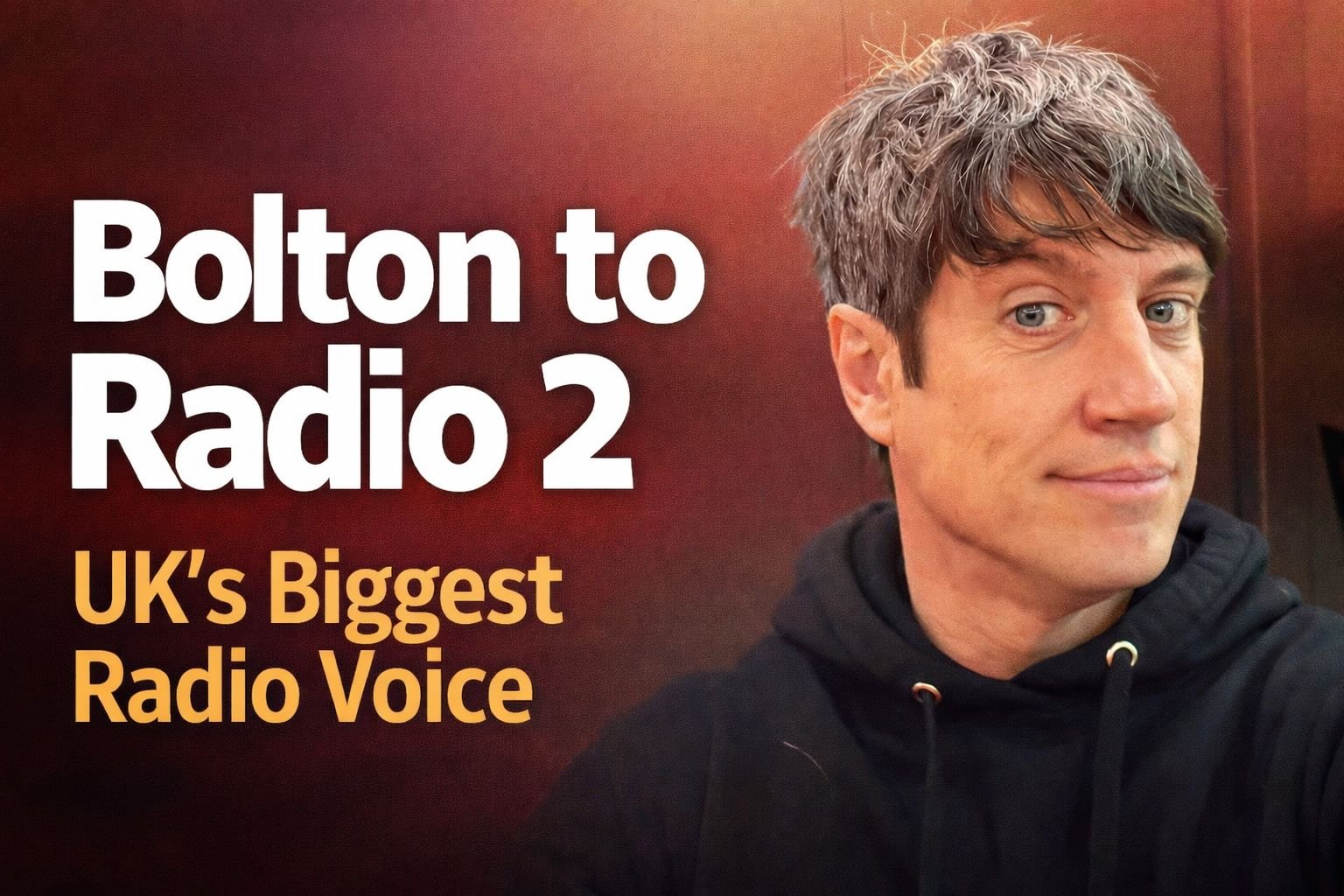
Vernon Kay is one of the few national broadcasters who still sounds like the streets he grew up on, not a focus group’s idea of neutral UK radio.
Born Vernon Charles Kay on 28 April 1974, he grew up in Bolton, the eldest son of Norman and Gladys. He attended St Joseph’s RC Grammar School in Horwich before graduating in environmental science from Manchester Polytechnic, now Manchester Metropolitan University.
For listeners across Greater Manchester and the wider North West, that grounding matters. He talks like us. He backs Bolton Wanderers. He has never softened his accent to fit a London studio.
In 2026, Vernon Kay sits at the centre of the UK’s most listened to radio schedule. That journey from Bolton to BBC Radio 2’s flagship mid morning slot says as much about the shifting balance of British media power as it does about personal ambition.
Early life and Bolton roots
Vernon Kay’s story starts firmly in Bolton, not in a metropolitan media bubble.
He grew up in a working class household. His father worked as a lorry driver, his mother raised Vernon and his younger brother Stephen, who later became a primary school teacher. Those details are not branding. They are biography.
He has kept those roots visible. He speaks openly about supporting Bolton Wanderers and has never distanced himself from his hometown identity.
That connection became highly visible in November 2023. Vernon Kay completed a 116 mile ultramarathon for BBC Children in Need, running from Leicester back to Bolton over four days. The finish at the Toughsheet Community Stadium was not staged for spectacle alone. It was framed as a homecoming.
He initially raised more than £4 million, with the total later exceeding £5 million. Hundreds of supporters gathered at the stadium, alongside his parents, reinforcing that this was not just a broadcast moment but a civic one.
For Bolton and Greater Manchester, it carried emotional weight.
Rise through ITV and national television
Before BBC Radio 2, Vernon Kay had already built a substantial television career.
He broke through on Channel 4’s T4 between 2000 and 2005, presenting to younger audiences during a period when Northern talent was gaining stronger national visibility. That exposure opened the door to ITV, where he hosted All Star Family Fortunes from 2006 to 2015 and fronted shows including Beat the Star, The Whole 19 Yards and Splash!.
These were mainstream, prime-time formats. They positioned Vernon Kay as a dependable Saturday night presence rather than a niche presenter.
He later appeared as a contestant on I’m A Celebrity… Get Me Out of Here!, reaching the final in 2020. The show introduced him to a new generation and reinforced a key part of his public image: competitive, self-aware and unpretentious.
His marriage to Tess Daly, whom he wed in Horwich on 12 September 2003, further connected him to the core of British television. Yet the couple have consistently avoided the detached celebrity narrative that often surrounds high profile broadcasting partnerships.
BBC Radio 2 era and career evolution
Vernon Kay’s radio journey predates his Radio 2 headline role.
He joined BBC Radio 1 in 2004, presenting weekend shows until 2012. That near decade gave him national live radio experience long before his current prominence.
After hosting the weekday mid morning show on Radio X between 2015 and 2017, he returned to the BBC, covering major Radio 2 slots including Zoe Ball’s Breakfast Show, Steve Wright in the Afternoon, Rylan on Saturday and Dermot O’Leary’s programme.
The defining moment came in 2023. The BBC confirmed Vernon Kay would succeed Ken Bruce in the 9:30 am to noon slot on BBC Radio 2, beginning 15 May. Replacing a presenter who had held the programme for 31 years was a significant institutional decision.
According to RAJAR audience figures, his show has since established itself as the most listened to programme in UK radio, drawing roughly six and a half million listeners. BBC Radio 2 remains the single most listened to station in the country.
Those numbers matter. They shift the narrative from personality to performance.
Public perception in the North West
In Greater Manchester, the description of Vernon Kay is consistent. Successful, but still ours.
Part of that perception comes from visibility. He studied at what is now Manchester Metropolitan University. He publicly supports Bolton Wanderers. He returns for North West based initiatives.
The Children in Need ultramarathon finish in Bolton felt less like a corporate BBC event and more like a community moment.
There is also a broader media context. Manchester has grown into one of the UK’s major broadcasting hubs, with BBC operations in Salford and a strong commercial radio presence. Vernon Kay represents a Northern route into that national ecosystem without erasing regional identity.
For many local listeners, that visibility carries quiet significance.
Connection to Manchester audiences
Manchester now hosts major national media brands alongside regional outlets. In that landscape, having a Bolton raised presenter fronting BBC Radio 2’s mid morning schedule reinforces the North West’s cultural weight.
Vernon Kay’s presenting style aligns with local expectations. He favours warmth, clear structure and understated humour over theatrical delivery. His reflections on the Children in Need challenge focused more on the families he met and the communities that donated than on personal endurance.
That approach resonates across areas from Bolton to Bury to Wythenshawe, where audiences often value sincerity over polish.
What sets him apart from other broadcasters
Several factors distinguish Vernon Kay in 2026.
First is cross platform consistency. He has fronted major ITV entertainment shows, held long running national radio slots and now anchors the UK’s largest radio programme without dramatic reinvention.
Second is regional authenticity. He can interview high profile guests and handle national phone ins while still referencing Bolton Wanderers or traffic on the M61 without it sounding contrived.
Third is public trust. The 116 mile charity run was physically demanding and publicly documented. Raising more than £5 million demonstrated audience confidence in his credibility.
In an industry where trust is increasingly fragile, sustained reliability has measurable value.
Why Vernon Kay still matters in 2026
In 2026, Vernon Kay sits at the intersection of three significant shifts: the decentralisation of UK broadcasting away from London, the demand for presenters who reflect their audiences, and the renewed importance of public service media.
His continued success on BBC Radio 2, backed by audience data, confirms that a Bolton educated broadcaster can hold one of the most competitive slots in British radio without diluting identity.
For Manchester and Bolton, that remains a point of pride.
For the wider industry, it offers a reminder that authenticity and longevity still outperform short term hype.
And for millions tuning in each morning, Vernon Kay remains what he has been since the early T4 days: a steady, recognisable voice that sounds less like a constructed brand and more like someone who never forgot where he started.
Read More: Nicola Bulley Husband: Paul Ansell’s Role During the Investigation
