

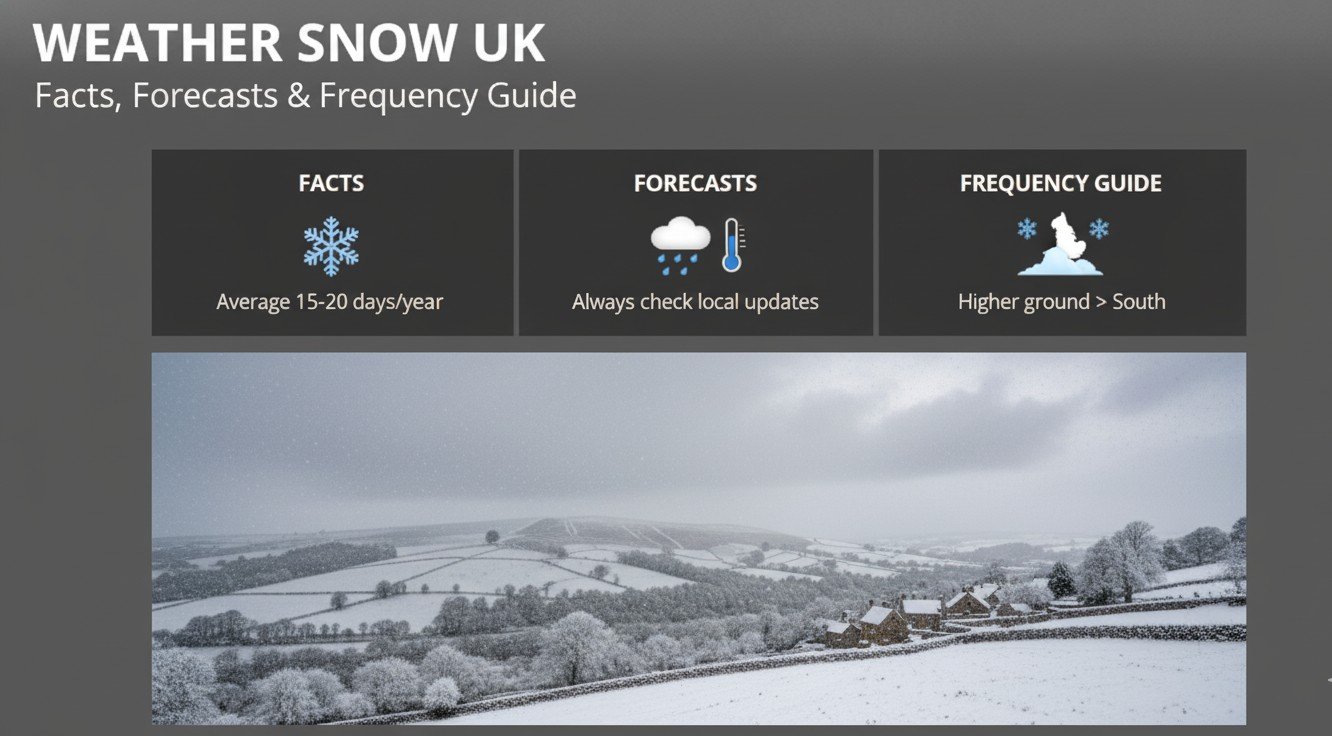
When winter arrives in the United Kingdom, one word captures the collective imagination of residents and visitors alike: snow. Yet the reality of British snow is far more nuanced than the picturesque Christmas card images that dominate festive marketing. Understanding Weather Snow uk requires looking at genuine statistics, regional variations, and the complex atmospheric conditions that determine whether winter precipitation falls as snow, sleet, or rain.
How Much Snow Actually Falls in the UK?
The first surprise for many people is just how infrequent lying snow is across most of the UK. According to the Met Office’s long-term data from 1991 to 2020, the UK experiences an average of just 13 days of lying snow per year. This statistic often shocks those who imagine Britain blanketed in white throughout winter.
More nuanced data reveals that it’s not so much that snow never falls—it’s that it rarely settles. Snow does fall more frequently than lying snow suggests, but most snowfall melts or turns to rain before accumulating on the ground. February represents the snowiest month with an average of 5.6 days of snow or sleet falling nationally, followed by January at 5.3 days. December, despite being associated with the fantasy of a “White Christmas,” sees only 3.9 days of snow or sleet on average.
The critical weather pattern here reveals why UK snow is so unpredictable. For snow to form and persist in the UK, specific atmospheric conditions must align perfectly: cold air temperatures, moisture availability, and crucially, a sustained freezing period. The freezing level—the altitude where precipitation transitions from snow to rain—becomes the critical factor determining what actually reaches the ground. Most UK weather systems bring warm, moisture-laden air from the Atlantic, which means precipitation often starts as snow in the upper atmosphere but melts as it descends through warmer air layers, arriving as rain.
Where Snow Really Falls in the UK
The most striking aspect of Weather Snow uk statistics is the dramatic regional variation. Scotland dominates snowfall frequency, with an average of 23 days of lying snow per year—nearly double the UK average. However, even within Scotland, variations are extreme.
Scottish Snowfall Hotspots
Scotland’s highest and most mountainous regions experience the most snow. The Cairngorm National Park in the Grampian Mountains is home to the UK’s snowiest locations, with snow falling on an average of 76 days per year. This remarkable frequency makes the Cairngorms the UK’s premier skiing destination, though even here, persistent snow cover is increasingly unreliable due to climate warming.
Other Scottish snow champions include:
Leadhills, South Lanarkshire: 52 snow days annually, as the second-highest inhabited village in Scotland at 450 metres elevation
Eskdalemuir, Dumfries and Galloway: 50 snowy days yearly
Kinbrace, Sutherland: 49 snow days on average
Shetland Islands: 60-64 snow days annually, benefiting from northern latitude and maritime exposure
Aberdeen: 34 days of snow with average accumulation of 115.2cm annually
Lerwick, Shetland Islands: 48 snow days with 90.5cm average annual accumulation
The west coast of Scotland, despite its northerly position, receives less snow than the east due to maritime influence, which keeps temperatures slightly higher.
England’s Snow Reality
In England, snow becomes increasingly rare as you move south and east. The North Pennines represent England’s snowiest region, particularly elevated areas.
Copley, County Durham: 53 snow days annually, hosting one of England’s few outdoor ski centres
Widdybank Fell, North Pennines: 50 snow days yearly
Manchester: 20 days of snow with 26.1cm average accumulation
Birmingham: 24 snow days with 86.6cm average accumulation
London: 16 snow days with 46.7cm average snowfall
Southern coastal regions experience dramatically less snow:
Ramsgate, Kent: 15 snow days with 26.6cm accumulation
Plymouth, Devon: Only 6 snow days annually with just 6.7cm average snowfall
Bournemouth, Dorset: 7 snow days with 17.6cm accumulation
This north-south gradient reflects the fundamental challenge of Weather Snow uk: southern regions experience warmer temperatures and more maritime influence, making persistent snow almost a novelty.
Wales and Northern Ireland
Cardiff, Wales experiences 12 snow days annually with 32.4cm average accumulation, placing it between England’s extremes. Mountainous regions of Snowdonia see considerably more snow due to elevation.
Belfast, Northern Ireland records 19 snow days yearly with 32.3cm average snowfall, reflecting its maritime temperate climate.
Why Is UK Snow Forecasting So Difficult?
One of the most frustrating aspects of Weather Snow uk is the notorious difficulty in forecasting it accurately. This challenge stems from the UK’s position between competing air masses and the typically narrow margins between rain and snow.
The Freezing Level Challenge
Meteorologists focus on the freezing level—the altitude where the atmospheric temperature drops to 0°C. Above this level, precipitation forms as snow or supercooled raindrops. Below it, snowflakes melt into rain. The crucial point: this freezing level can change hour by hour, vary across just a few miles, or shift throughout a single day.
UK weather systems typically bring moisture wrapped in warm air. While this moisture is essential for precipitation, the warmth makes it extremely difficult to forecast whether it will fall as snow or rain. A forecast might predict snow, only for temperatures to rise by 1-2°C, transforming the entire event into rain.
Several elements complicate UK snow forecasting:
Air mass origin: If Arctic air has travelled over the Atlantic, it becomes slightly warmer due to oceanic influence, raising the freezing level. Continental air from Europe carries different temperature profiles.
Precipitation intensity: Counter-intuitively, heavy rainfall can actually trigger snow at lower altitudes. Intense precipitation drags the freezing level downward through evaporative cooling. This explains why sometimes the heaviest precipitation falls as snow despite moderate temperatures.
Weather fronts: When cold and warm air masses collide along weather fronts, the boundary between snow and rain becomes razor-thin and unpredictable.
Altitude: Elevations above 200ft (60 metres) have substantially better chances of seeing snow rather than rain, as they sit closer to the freezing level.
Historical Snow Events and Recent Patterns
Britain has experienced devastating historical snow events. The Great Snowstorm of Christmas Eve 1836 produced drifts 10-40 feet deep in places, with catastrophic consequences including the famous Lewes Avalanche in Sussex. More recent significant events include the Winter of 2017-2018, when Storm Emma brought 20-30cm accumulations that disrupted transport nationwide.
However, the broader trend is concerning for snow lovers: UK snow days are declining. Analysis shows snow days in UK winters dropped from an average of 12.3 days (1971-2000) to just 9.5 days (1991-2020). This 23% reduction reflects warming temperatures and the changing atmospheric conditions that increasingly favour rain over snow.
The greatest decreases in lying snow have occurred in southern and central England and Wales. Scotland, with its colder northern position, has experienced smaller percentage declines, though absolute snow days remain significantly higher than in southern regions.
UK Snow’s Impact on Daily Life and Infrastructure
Despite its relative rarity, snow disrupts British infrastructure significantly when it does occur, largely because the country lacks the heavy snow management equipment found in colder climates.
Transportation Disruptions
Snow and ice cause immediate travel chaos. Recent events demonstrate this vulnerability:
Airport closures: Manchester Airport, Liverpool’s John Lennon Airport, Newcastle International, and Bristol Airport have all temporarily closed runways during moderate snowfall, with passengers advised to check before travelling
Rail service impacts: Heavy snow triggers speed restrictions and line closures to ensure train safety. Northern Rail and LNER frequently report delays and cancellations during Weather Snow uk events
Road hazards: The A66, A1, and other major motorways regularly face closures or severe congestion during snow and ice events
The fundamental issue: the UK simply doesn’t experience enough snow to justify the infrastructure investment that Nordic or North American countries maintain. Councils and transport operators must balance preparedness against cost efficiency.
Read More: Car Boot Sales in Manchester: The Best Places to Hunt for Bargains in 2025
Why Does Minor Snow Cause Major Disruption?
Several factors explain this seeming overreaction:
Vehicle preparation: Many UK drivers use summer tyres year-round and lack experience driving in snow. This inexperience, combined with inappropriate tyres, creates dangerous accident conditions.
Salt and grit scarcity: While the UK does salt roads, the quantity stockpiled reflects statistical snow expectations. Major events quickly exhaust supplies, leaving roads untreated.
Drainage systems: UK drainage infrastructure is optimised for rain management. Large volumes of melting snow can overwhelm systems, causing flooding and compounding disruption.
Altitude advantage: Slightly elevated areas, just 200-300 feet above sea level, can experience persistent snow while lowland towns remain clear, creating confusing fragmented conditions that make coordinated response difficult.
The Future of UK Weather Snow: Climate Change Projections
Perhaps the most significant aspect of Weather Snow uk is its uncertain future. Met Office climate projections paint a stark picture: snow, already uncommon, may become rarer still.
By the 2040s, most of southern England could cease experiencing sub-zero days throughout winter. By the 2060s, only high ground and northern Scotland are projected to regularly see freezing temperatures. By century’s end, according to high-emission scenarios, lying snow could disappear entirely from most of the UK except over the highest ground.
These projections underscore a critical point: the UK’s temperate maritime climate is becoming even more temperate. The Gulf Stream’s influence, which already keeps British winters milder than continental equivalents at similar latitudes, will make snow increasingly exotic.
However, researchers stress that these projections contain significant uncertainty. Some climate models suggest that while average snow days decline, extreme precipitation events might occasionally bring heavier snow due to atmosphere’s increased moisture capacity. Additionally, if global emissions are significantly reduced, temperature rises will be smaller and snow decline less dramatic.
When Can You Expect UK Weather Snow?
For those hoping to experience snow in the UK, understanding probability by month, location, and elevation is essential:
Most likely for snow: January through March, particularly in Scotland, northern England, Wales mountains, and areas above 300 metres elevation
White Christmas chances: Only 39 times in the last 53 years—approximately once every 1.4 years—has snow fallen on Christmas Day across the UK. You’re statistically more likely to experience a “White Easter” than a “White Christmas”
Sunniest low-snow regions: Southern coastal areas like Plymouth, Bournemouth, and southern Wales, where snow falls fewer than 10 days per year
Most reliable snow destinations: Scottish mountains, particularly the Cairngorms above 600m elevation, where snow occurs on 50+ days annually
Embracing British Winter Weather
The Weather Snow uk picture across the UK reflects a fascinating meteorological paradox: a nation famous for rainy, grey winters that rarely experiences the snow those miserable reputations might suggest. The UK’s temperate maritime climate, moderated by the Atlantic Ocean and the Gulf Stream, transforms what could be harsh continental winters into characteristically mild, damp seasons.
For those seeking snow in the UK, location and timing are everything. The Scottish Highlands between January and March offer the most reliable snow chances. Southern regions should expect perhaps one significant snow event per winter season. As global temperatures continue rising, even these modest snow opportunities face increasingly uncertain futures.
Understanding Weather Snow uk means appreciating the atmospheric complexity underlying forecasting challenges, respecting the infrastructure limitations that make even modest snowfall disruptive, and recognising that the picturesque snowy landscapes of British folklore represent an increasingly vanishing climate. Yet whenever winter snow does arrive, it remains a remarkable phenomenon in a nation where it’s become a precious rarity
Frequently Asked Questions About UK Weather Snow
What is the average snowfall in the UK?
The UK receives 13 days of lying snow per year on average, with Scotland seeing 23 days. However, snow fall is far more frequent than snow settling—precipitation falls as snow 30-40% of days nationally during winter months.
When is the UK’s most snowy month?
February sees the most snow or sleet, averaging 5.6 days nationally. January follows at 5.3 days. December averages only 3.9 days, making “White Christmas” relatively rare.
Which UK cities get the most snow?
Edinburgh (22 days/22cm annually), Belfast (19 days/32.3cm), Manchester weather today (20 days/26.1cm), and Birmingham (24 days/86.6cm) lead major UK cities in snow frequency. However, Scottish mountain locations like Cairngorms (76 days) and Lerwick (48 days) experience far more snow.
Why does UK snow cause such transport disruption?
The combination of infrequent snow, limited cold-weather infrastructure, driver inexperience, and drainage systems designed for rain rather than snowmelt means the UK lacks resilience to winter weather that Nordic and North American nations handle routinely.
Is UK snow becoming less common?
Yes. Historical analysis shows snow days have declined 23% since the 1970s, from 12.3 to 9.5 days per winter, reflecting climate warming. Future projections suggest further declines through the 21st century.
Can you predict UK snow accurately?
Forecasting is extremely challenging due to the UK’s position between competing air masses and the narrow temperature margins between snow and rain. The freezing level—which determines snow versus rain—can change hour-hourly and vary across just kilometres.